


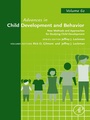
New Methods and Approaches for Studying Child Development: Volume 62
Published on 8. March 2022
Book
Hardback
308 pages
978-0-323-91587-8 (ISBN)
Description
New Methods and Approaches for Studying Child Development, Volume 62 in the Advances in Child Development and Behavior series, highlights new advances in the field, with this new volume presenting interesting chapters written by an international board of authors.
More details
Series
Language
English
Place of publication
Oxford
United Kingdom
Publishing group
Elsevier Science & Technology
Target group
Professional and scholarly
Professionals, graduate students and advanced undergraduates in developmental psychology and related fields (e.g., clinical psychology, education, nursing, social work, early childhood education, child policy)
Product notice
Laminated cover
Dimensions
Height: 229 mm
Width: 152 mm
Thickness: 19 mm
Weight
585 gr
ISBN-13
978-0-323-91587-8 (9780323915878)
Copyright in bibliographic data and cover images is held by Nielsen Book Services Limited or by the publishers or by their respective licensors: all rights reserved.
Schweitzer Classification
Other editions
Additional editions
Jeffrey J. Lockman | Rick Gilmore
New Methods and Approaches for Studying Child Development
E-Book
03/2022
Academic Press
€81.95
Available for download
Persons
Professor Jeffrey J. Lockman got his Ph.D at the University of Minnesota. His research interests center on perception-action and cognitive development. In his recent work, he has been studying the development of tool use in children and how it might be related to the object manipulation skills of infants. Additionally, he has been conducting work on spatial cognition in children, focusing on how children code the location of objects and object features. Prof. Rick Gilmore works at the Pennsylvania State University in PA, USA.
Content
1. Using big data from long-form recordings to study development and optimize societal impact
Margaret Cychosz and Alejandrina Cristia
2. Show your work: Tools for open developmental science
Rick O. Gilmore
3. Beyond screen time: Using head-mounted eye tracking to study natural behavior
John M. Franchak and Chen Yu
4. Online testing in developmental science: A guide to design and implementation
Lorijn Zaadnoordijk and Rhodri Cusack
5. Belief, culture, & development: Insights from studying the development of religious beliefs and behaviors
Rebekah A. Richert, Kara Weisman, Kirsten A. Lesage, Maliki E. Ghossainy, Bolivar Reyes-Jaquez, and Kathleen H. Corriveau
6. Using temporal network methods to reveal the idiographic nature of development
Natasha Chaku and Adriene M. Beltz
7. Computational approaches to understanding interaction and development
D.S. Messinger, L.K. Perry, S.G. Mitsven, Y. Tao, J. Moffitt, R.M. Fasano, S.A. Custode, and C.M. Jerry
8. A model for using developmental science to create effective early intervention programs and technologies to improve children's developmental outcomes
Iryna Babik, Andrea B. Cunha, and Michele A. Lobo
9. Child development in real time: The power of ambulatory assessment for investigating dynamic developmental processes and behavior longitudinally
Diana J. Meter and Samuel E. Ehrenreich
Margaret Cychosz and Alejandrina Cristia
2. Show your work: Tools for open developmental science
Rick O. Gilmore
3. Beyond screen time: Using head-mounted eye tracking to study natural behavior
John M. Franchak and Chen Yu
4. Online testing in developmental science: A guide to design and implementation
Lorijn Zaadnoordijk and Rhodri Cusack
5. Belief, culture, & development: Insights from studying the development of religious beliefs and behaviors
Rebekah A. Richert, Kara Weisman, Kirsten A. Lesage, Maliki E. Ghossainy, Bolivar Reyes-Jaquez, and Kathleen H. Corriveau
6. Using temporal network methods to reveal the idiographic nature of development
Natasha Chaku and Adriene M. Beltz
7. Computational approaches to understanding interaction and development
D.S. Messinger, L.K. Perry, S.G. Mitsven, Y. Tao, J. Moffitt, R.M. Fasano, S.A. Custode, and C.M. Jerry
8. A model for using developmental science to create effective early intervention programs and technologies to improve children's developmental outcomes
Iryna Babik, Andrea B. Cunha, and Michele A. Lobo
9. Child development in real time: The power of ambulatory assessment for investigating dynamic developmental processes and behavior longitudinally
Diana J. Meter and Samuel E. Ehrenreich