

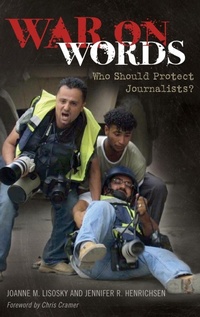
War on Words
Who Should Protect Journalists?
Published on 13. July 2011
Book
Hardback
292 pages
978-0-313-38557-5 (ISBN)
Description
This unprecedented book provides a comprehensive examination of the issue of protecting journalists in conflict situations from both a practical and humanitarian law perspective.
Violent criminals and corrupt governmental officials harass, co-opt, and kill local and foreign journalists in countries from Mexico to Afghanistan, to Russia and the Philippines. Staggeringly, there has been little or no prosecution in 89 percent of journalist murders worldwide. Such widespread impunity is arguably one of the greatest threats to press freedom. A number of international organizations and advocates have developed efforts to mitigate this problem, but belligerents continue to act with few restraints and little, if any, accountability.
War on Words: Who Should Protect Journalists? is an examination of the deteriorating and dangerous environment facing journalists and what stakeholders are doing to address this serious problem threatening democracy worldwide. The authors explore the peril facing journalists, delve into the legal and practical history of press protection, evaluate current safety strategies for journalists, and gather opinions from an array of local and international correspondents and practitioners on how to improve this untenable situation.
Violent criminals and corrupt governmental officials harass, co-opt, and kill local and foreign journalists in countries from Mexico to Afghanistan, to Russia and the Philippines. Staggeringly, there has been little or no prosecution in 89 percent of journalist murders worldwide. Such widespread impunity is arguably one of the greatest threats to press freedom. A number of international organizations and advocates have developed efforts to mitigate this problem, but belligerents continue to act with few restraints and little, if any, accountability.
War on Words: Who Should Protect Journalists? is an examination of the deteriorating and dangerous environment facing journalists and what stakeholders are doing to address this serious problem threatening democracy worldwide. The authors explore the peril facing journalists, delve into the legal and practical history of press protection, evaluate current safety strategies for journalists, and gather opinions from an array of local and international correspondents and practitioners on how to improve this untenable situation.
Reviews / Votes
This is a valuable sourcebook on the safety of journalists in dangerous locations around the globe. . . . The authors correctly observe that cooperation among journalism advocacy groups is critical to such efforts. Summing Up: Recommended. * Choice *More details
Language
English
Place of publication
United States
Publishing group
Bloomsbury Publishing Plc
Target group
Adult education
Dimensions
Height: 240 mm
Width: 161 mm
Thickness: 20 mm
Weight
605 gr
ISBN-13
978-0-313-38557-5 (9780313385575)
Copyright in bibliographic data and cover images is held by Nielsen Book Services Limited or by the publishers or by their respective licensors: all rights reserved.
Schweitzer Classification
Other editions
Additional editions
E-Book
07/2011
1st Edition
Praeger Publishers Inc
€47.99
Available for download
Persons
Joanne M. Lisosky, PhD, is associate professor of communication and journalism at Pacific Lutheran University, Tacoma, WA.
Jennifer R. Henrichsen is project assistant for the Democracy Coalition Project and research assistant for the Open Society Foundations in Washington, DC, where she conducts research and advocacy relating to the advancement of democracy and human rights internationally.
Jennifer R. Henrichsen is project assistant for the Democracy Coalition Project and research assistant for the Open Society Foundations in Washington, DC, where she conducts research and advocacy relating to the advancement of democracy and human rights internationally.
Content
Foreword by Chris Cramer
Acknowledgments
Introduction
1. Risks and Rewards: Reporting from Armed and Non-Armed Conflict Situations
2. Measures of Civility: Legal Protections Developed for Journalists Reporting from Danger Zones
3. From "Name and Shame" to Media Literacy: Nonstate Strategies and Tactics to Protect Journalists
4. Don't Shoot the Messenger: Journalists Who Risk Everything to Tell Stories of Conflict
Addendum
5. Are We Doing Enough? What Stakeholders Suggest Should Be Done to Protect Journalists and Media Workers
Appendices
Notes
Selected Bibliography
Index
Acknowledgments
Introduction
1. Risks and Rewards: Reporting from Armed and Non-Armed Conflict Situations
2. Measures of Civility: Legal Protections Developed for Journalists Reporting from Danger Zones
3. From "Name and Shame" to Media Literacy: Nonstate Strategies and Tactics to Protect Journalists
4. Don't Shoot the Messenger: Journalists Who Risk Everything to Tell Stories of Conflict
Addendum
5. Are We Doing Enough? What Stakeholders Suggest Should Be Done to Protect Journalists and Media Workers
Appendices
Notes
Selected Bibliography
Index