

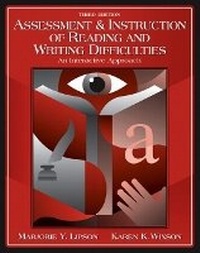
Assessment & Instruction of Reading and Writing Difficulty
An Interactive Approach
3rd Edition
Published on 17. January 2003
Book
Hardback
720 pages
978-0-205-35540-2 (ISBN)
Description
Focusing on ability/disability and reading/writing from an interactive perspective, this text emphasizes the importance of determining and establishing the appropriate learning environment for the individual learner.
Extensive, in-depth treatment of current research and best practices make this text a 'must-have' addition to any current or future teacher's library. Section I (Chs. 1-3) provides the readers with a strong, comprehensive knowledge of reading/writing research and assessment practices from which readers can move forward to the second and third sections of the text (Chs. 4-10), which contain detailed discussions and examples of assessment practices. Traditional assessments of students are fully explored, and two chapters are devoted to assessing context factors like instructional methods and materials and tasks. Both classroom-based and standardized assessments are described. Section IV stands alone as an important chapter linking assessment to instruction by means of diagnostic instruction. Section V (Ch. 12-15) is devoted to instructional practices designed to improve reading and writing instruction for struggling students. Chapters on word recognition, vocabulary, comprehension-composition, and "high-utility strategies" address the major components of literacy development. In the final section (Ch. 16), issues related to professional standards and written reports is addressed.
Extensive, in-depth treatment of current research and best practices make this text a 'must-have' addition to any current or future teacher's library. Section I (Chs. 1-3) provides the readers with a strong, comprehensive knowledge of reading/writing research and assessment practices from which readers can move forward to the second and third sections of the text (Chs. 4-10), which contain detailed discussions and examples of assessment practices. Traditional assessments of students are fully explored, and two chapters are devoted to assessing context factors like instructional methods and materials and tasks. Both classroom-based and standardized assessments are described. Section IV stands alone as an important chapter linking assessment to instruction by means of diagnostic instruction. Section V (Ch. 12-15) is devoted to instructional practices designed to improve reading and writing instruction for struggling students. Chapters on word recognition, vocabulary, comprehension-composition, and "high-utility strategies" address the major components of literacy development. In the final section (Ch. 16), issues related to professional standards and written reports is addressed.
More details
Edition
3rd edition
Language
English
Place of publication
United States
Publishing group
Pearson Education (US)
Target group
Professional and scholarly
Dimensions
Height: 235 mm
Width: 191 mm
Weight
1243 gr
ISBN-13
978-0-205-35540-2 (9780205355402)
Copyright in bibliographic data and cover images is held by Nielsen Book Services Limited or by the publishers or by their respective licensors: all rights reserved.
Schweitzer Classification
Other editions
New editions
Marjorie Y. Lipson | Karen K. Wixson
Assessment & Instruction of Reading and Writing Difficulties
An Interactive Approach
Book
02/2008
4th Edition
Pearson
€141.12
Article exhausted; check for reprint
Previous edition

Lipson | Karen K. Wixson
Assessment and Instruction of Reading and Writing Disability
An Interactive Approach
Book
12/1999
2nd Edition
Pearson
€49.24
Article exhausted; check for reprint
Content
I. THEORY INTO PRACTICE
1. Perspectives on Reading and Writing Ability.
2. An Interactive View of Reading and Writing.
3. Reading and Writing Disability and the Assessment- Instruction Process.
II. EVALUATING THE INSTRUCTIONAL CONTEXT
4. Getting Started with Assessment.
5. The Instructional Environment.
6. Instructional Resources.
III. EVALUATING THE LEARNER
7. The Foundations of Literacy.
8. Informal Classroom-Based Assessment.
9. Structured Inventories and Assessments.
10. Formal Assessment.
IV. INTERACTIONS
11. Interactive Decision-Making.
V. INSTRUCTION.
12. Getting Started in Instruction.
13. Adapting Instruction to Focus on Word Recognition, Fluency, and Spelling.
14. Adapting Instruction to Focus on Vocabulary.
15. Adapting Instruction to Focus on Comprehension, Composing, and Studying.
VI. PROFESSIONAL ROLES AND RESPONSIBILITIES.
16. Professional Roles and Responsibilities.
Appendices:
Sample Case Report: Seth.
Award-Winning Books for Children and Youth.
Resources for Multicultural Literature and Teaching.
1. Perspectives on Reading and Writing Ability.
2. An Interactive View of Reading and Writing.
3. Reading and Writing Disability and the Assessment- Instruction Process.
II. EVALUATING THE INSTRUCTIONAL CONTEXT
4. Getting Started with Assessment.
5. The Instructional Environment.
6. Instructional Resources.
III. EVALUATING THE LEARNER
7. The Foundations of Literacy.
8. Informal Classroom-Based Assessment.
9. Structured Inventories and Assessments.
10. Formal Assessment.
IV. INTERACTIONS
11. Interactive Decision-Making.
V. INSTRUCTION.
12. Getting Started in Instruction.
13. Adapting Instruction to Focus on Word Recognition, Fluency, and Spelling.
14. Adapting Instruction to Focus on Vocabulary.
15. Adapting Instruction to Focus on Comprehension, Composing, and Studying.
VI. PROFESSIONAL ROLES AND RESPONSIBILITIES.
16. Professional Roles and Responsibilities.
Appendices:
Sample Case Report: Seth.
Award-Winning Books for Children and Youth.
Resources for Multicultural Literature and Teaching.