

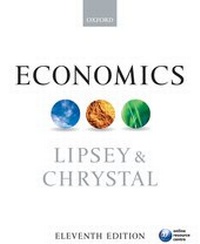
Economics
11th Edition
Published on 29. March 2007
Book
Paperback/Softback
688 pages
978-0-19-928641-6 (ISBN)
Description
The eleventh edition of this successful textbook for Economics majors has been thoroughly updated and revised to give more depth to core principles. Pitched at a level that will stretch readers but still comprehensible for beginners, Economics is explained in a straightforward manner, whilst maintaining the rigour needed to enable students to progress with their studies. The book features a depth and breadth of topics combined with a balance of technical and applied material. In-depth explanations of theoretical concepts are balanced with a range of real world examples help students to understand and apply the concepts they have learnt. A supporting and newly expanded Online Resource Centre features supplements for lecturers including an instructor's manual; PowerPoint slides; answers to questions in the text; class exercises; and artwork from the text. Supplements for students include self-assessment multiple choice questions with feedback; crosswords compiled from key glossary terms; a list of useful websites; maths appendices; past exam papers and additional case studies.
More details
Edition
11th Revised edition
Language
English
Place of publication
Oxford
United Kingdom
Target group
College/higher education
Edition type
Revised edition
Illustrations
300 tables and line drawings
Dimensions
Height: 258 mm
Width: 188 mm
Thickness: 27 mm
Weight
1710 gr
ISBN-13
978-0-19-928641-6 (9780199286416)
Copyright in bibliographic data and cover images is held by Nielsen Book Services Limited or by the publishers or by their respective licensors: all rights reserved.
Schweitzer Classification
Other editions
Content
1. Economic Issues and Concepts; 2. How Economists Work; PART 1: MARKETS AND CONSUMERS; 3. Demand, Supply, and Price; 4. Elasticity of Demand and Supply; 5. Consumer choice: Indifference Theory; PART 2: MARKETS AND FIRMS; 6. The Cost Structure of Firms; 7. Perfect Competition; 8. Monopoly; 9. Imperfect Competition; PART 3: MARKETS FOR INPUTS; 10. Demand and Supply of Inputs; 11. The Labour Market; 12. Capital, Investment, and New Technology; PART 4: GOVERNMENT AND THE MARKET; 13. Market Failure; 14. The Role of Government; PART 5: MACROECONOMICS: ISSUES AND FRAMEWORK; 15. Macroeconomic Issues and Measurement; 16. A Basic Model of the Determination of GDP in the Short Term; 17. GDP in an Open Economy with Government; 18. GDP and the Price Level in the Short Run; 19. GDP and the Price Level in the Long Run; PART 6: MACROECONOMIC POLICY IN A MONETARY ECONOMY; 20. Money and Monetary Institutions; 21. The Role of Money in Macroeconomics; 22. The Balance of Payments and Exchange Rates; 23. Macroeconomic Policy in an Open Economy; PART 7: GLOBAL ECONOMIC ISSUES; 24. Inflation; 25. Unemployment; 26. Economic Growth; 27. International Trade