

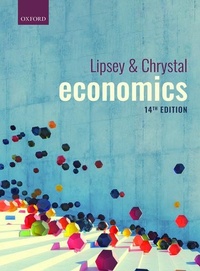
Economics
14th Edition
Published on 19. March 2020
Book
Paperback/Softback
792 pages
978-0-19-879103-4 (ISBN)
Description
An illuminating and robust introduction to economics principles, the fourteenth edition of Lipsey and Chrystal's established textbook continues to provide complete coverage for those new to micro and macroeconomics.
The authors help students to understand the subject matter through a combination of lucid explanation and supportive learning features which encourage independent thought. The principles are examined through a theoretical lens before empirical examples demonstrate how the concepts work in practice.
The applied nature of the models is further emphasised by case studies from around the world, which encourage students to develop and contextualise their understanding of the key themes.
Suitable for beginners, the authors provide in-depth explanations of key theoretical concepts which relate to a wide range of applied material. End-of-chapter questions give students the opportunity to test their knowledge and advance their critical thinking skills.
Economics undergraduates studying a core module on the principles of economics. It may also be suitable for students taking business, management, or finance and accounting degrees who are taking a module which introduces economics.
This book is accompanied by online resources to support both students and lecturers.
For students:
- Self-test questions
- Flashcard glossary
- Additional chapter material
- Web links
For lecturers:
- PowerPoint slides
- Instructor's manual
- Test bank
- Additional chapters covering Economics of Developing Countries and Macroeconomic Policy in an Open Economy
The authors help students to understand the subject matter through a combination of lucid explanation and supportive learning features which encourage independent thought. The principles are examined through a theoretical lens before empirical examples demonstrate how the concepts work in practice.
The applied nature of the models is further emphasised by case studies from around the world, which encourage students to develop and contextualise their understanding of the key themes.
Suitable for beginners, the authors provide in-depth explanations of key theoretical concepts which relate to a wide range of applied material. End-of-chapter questions give students the opportunity to test their knowledge and advance their critical thinking skills.
Economics undergraduates studying a core module on the principles of economics. It may also be suitable for students taking business, management, or finance and accounting degrees who are taking a module which introduces economics.
This book is accompanied by online resources to support both students and lecturers.
For students:
- Self-test questions
- Flashcard glossary
- Additional chapter material
- Web links
For lecturers:
- PowerPoint slides
- Instructor's manual
- Test bank
- Additional chapters covering Economics of Developing Countries and Macroeconomic Policy in an Open Economy
Reviews / Votes
Lipsey & Chrystal have been breaking boundaries for decades. The pairing of theory and examples is excellent. * Professor Parviz Dabir-Alai, Professor of Economics, Richmond University * A title which all economists should have on their shelves: an accessible and reliable companion for a lifetime. * Professor Joao Sousa Andrade, Professor of Economics, University of Coimbra *More details
Edition
14th Revised edition
Language
English
Place of publication
Oxford
United Kingdom
Target group
College/higher education
Edition type
Revised edition
Dimensions
Height: 264 mm
Width: 195 mm
Thickness: 38 mm
Weight
1678 gr
ISBN-13
978-0-19-879103-4 (9780198791034)
Copyright in bibliographic data and cover images is held by Nielsen Book Services Limited or by the publishers or by their respective licensors: all rights reserved.
Schweitzer Classification
Other editions
Previous edition
Richard G. Lipsey | Alec Chrystal
Economics
Book
03/2015
13th Edition
Oxford University Press
€73.03
Article exhausted; check for reprint
Persons
Content
Microeconomics
Part 1: Markets and Consumers
1: Economic issues and concepts
2: Demand and supply
3: Elasticity of demand and supply
4: Consumer choice: indifference theory
Part 2: Markets and Firms
5: The cost structure of firms
6: Perfect competition
7: Monopoly
8: Imperfect competition
Part 3: Markets for Inputs
9: Demand and supply of inputs
10: The labour market
11: Capital, investment, and new technology
12: Risk, uncertainty, and finance
Part 4: Government and the Market
13: Successes and failures of markets
14: The role of government
Macroeconomics
Part 5: Macroeconomics: Issues and Framework
15: Macroeconomic issues and measurement
16: A basic model of the determination of GDP in the short term
17: GDP determination with government and trade
18: Money and monetary institutions
19: Money, interest, and GDP: the LM curve
20: Investment, the interest rate, and GDP: the IS-LM Model
21: GDP and the price level: aggregate demand and aggregate supply
22: The determination of GDP with steady inflation
6: Macroeconomics of the Global Economy
23: Business cycles, unemployment, and inflation
24: Exchange rates and the balance of payments
25: Fiscal and monetary policies
26: Economic growth and sustainability
27: International trade
Part 1: Markets and Consumers
1: Economic issues and concepts
2: Demand and supply
3: Elasticity of demand and supply
4: Consumer choice: indifference theory
Part 2: Markets and Firms
5: The cost structure of firms
6: Perfect competition
7: Monopoly
8: Imperfect competition
Part 3: Markets for Inputs
9: Demand and supply of inputs
10: The labour market
11: Capital, investment, and new technology
12: Risk, uncertainty, and finance
Part 4: Government and the Market
13: Successes and failures of markets
14: The role of government
Macroeconomics
Part 5: Macroeconomics: Issues and Framework
15: Macroeconomic issues and measurement
16: A basic model of the determination of GDP in the short term
17: GDP determination with government and trade
18: Money and monetary institutions
19: Money, interest, and GDP: the LM curve
20: Investment, the interest rate, and GDP: the IS-LM Model
21: GDP and the price level: aggregate demand and aggregate supply
22: The determination of GDP with steady inflation
6: Macroeconomics of the Global Economy
23: Business cycles, unemployment, and inflation
24: Exchange rates and the balance of payments
25: Fiscal and monetary policies
26: Economic growth and sustainability
27: International trade