

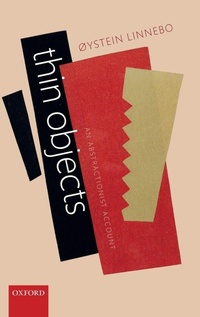
Thin Objects
An Abstractionist Account
Published on 14. June 2018
Book
Hardback
256 pages
978-0-19-964131-4 (ISBN)
Description
Are there objects that are "thin" in the sense that not very much is required for their existence? Frege famously thought so. He claimed that the equinumerosity of the knives and the forks suffices for there to be objects such as the number of knives and the number of forks, and for these objects to be identical. The idea of thin objects holds great philosophical promise but has proved hard to explicate. Oystein Linnebo aims to do so by drawing on some Fregean ideas. First, to be an object is to be a possible referent of a singular term. Second, singular reference can be achieved by providing a criterion of identity for the would-be referent. The second idea enables a form of easy reference and thus, via the first idea, also a form of easy being. Paradox is avoided by imposing a predicativity restriction on the criteria of identity. But the abstraction based on a criterion of identity may result in an expanded domain. By iterating such expansions, a powerful account of dynamic abstraction is developed.
The result is a distinctive approach to ontology. Abstract objects such as numbers and sets are demystified and allowed to exist alongside more familiar physical objects. And Linnebo also offers a novel approach to set theory which takes seriously the idea that sets are "formed" successively.
The result is a distinctive approach to ontology. Abstract objects such as numbers and sets are demystified and allowed to exist alongside more familiar physical objects. And Linnebo also offers a novel approach to set theory which takes seriously the idea that sets are "formed" successively.
Reviews / Votes
Thin Objects is therefore warmly recommended as a novel contribution to the philosophy of mathematics. It gives a thorough understanding of the abstractionist approach, clearly showing its Fregean roots, but at the same time diverging from Frege and the neo-Fregeans in substantial and innovative ways. * Inger Bakken Pedersen, The Mathematical Intelligencer * Recommended. * D. A. Forbes, CHOICE *More details
Language
English
Place of publication
Oxford
United Kingdom
Target group
Professional and scholarly
Dimensions
Height: 240 mm
Width: 161 mm
Thickness: 18 mm
Weight
552 gr
ISBN-13
978-0-19-964131-4 (9780199641314)
Copyright in bibliographic data and cover images is held by Nielsen Book Services Limited or by the publishers or by their respective licensors: all rights reserved.
Schweitzer Classification
Other editions
Additional editions
E-Book
05/2018
1st Edition
OUP eBook
€45.99
Available for download
E-Book
05/2018
1st Edition
OUP eBook
€43.49
Available for download
Person
Oystein Linnebo took up a Professorship at the University of Oslo in 2012, having previously been a Professor at Birkbeck, University of London, and held positions at Bristol and Oxford. He obtained his PhD in Philosophy from Harvard in 2002 and an MA in Mathematics from Oslo in 1995. His main research interests lie in philosophical logic, philosophy of mathematics, metaphysics, early analytic philosophy (especially Frege), as well as parts of philosophy of language and philosophy of science. He has published more than fifty articles and is the author of Philosophy of Mathematics (Princeton University Press 2017).
Content
Part I: Essentials
1: In search of thin objects
2: Thin objects via criteria of identity
3: Dynamic abstraction
Part II: Comparisons
4: Abstraction and the question of symmetry
5: Unbearable lightness of being
6: Predicative vs. impredicative abstraction
7: The context principle
III: Details
8: Reference by abstraction
9: The Julius Caesar problem
10: The natural numbers
11: The question of platonism
12: Dynamic set theory
1: In search of thin objects
2: Thin objects via criteria of identity
3: Dynamic abstraction
Part II: Comparisons
4: Abstraction and the question of symmetry
5: Unbearable lightness of being
6: Predicative vs. impredicative abstraction
7: The context principle
III: Details
8: Reference by abstraction
9: The Julius Caesar problem
10: The natural numbers
11: The question of platonism
12: Dynamic set theory