

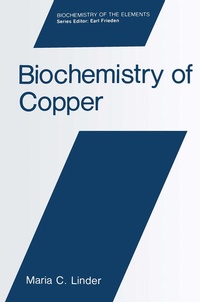
Biochemistry of Copper
Published on 31. October 1991
Book
Hardback
XIV, 526 pages
978-0-306-43658-1 (ISBN)
Description
Copper has long been known as essential to living systems, in part through its fundamental role in electron transport and respiration. Over the years into the present, its involvement in an ever increasing number of processes in all kinds of organisms has become apparent, and new and exciting vistas of its roles in such areas as the central nervous system, and in humoral functions, are appearing on the horizon. Although the biochemistry of this element has not been studied nearly as much as that of many others, a for midable amount of work has been carried out. It has thus been a challenge to produce a summary of what has been found that provides both breadth and depth. My goal has been to try to be as comprehensive as possible, within some limitations. I have tried to provide basic information and basic data that should continue to be useful for a long time. The goal has also been to interpret where we currently stand in our knowledge of the structure, function, regulation, and metabolism of Cu-dependent processes and sub stances, especially proteins. Thus, I have tried to make this a source book for historic as well as current information on all aspects of copper bio chemistry, and a summary of our current knowledge of copper-dependent proteins and processes. Most of the research on copper has been carried out on vertebrates, especially mammals. This has played a role in the organization of the book.
More details
Series
Edition
1991 ed.
Language
English
Place of publication
New York
United States
Publishing group
Springer Science+Business Media
Target group
Professional and scholarly
Research
Illustrations
XIV, 526 p.
Dimensions
Height: 241 mm
Width: 160 mm
Thickness: 34 mm
Weight
975 gr
ISBN-13
978-0-306-43658-1 (9780306436581)
DOI
10.1007/978-1-4757-9432-8
Schweitzer Classification
Other editions
Additional editions
Content
1. Introduction and Overview of Copper as an Element Essential for Life.- 2. Absorption of Copper from the Digestive Tract.- 3. Copper Uptake by Nongastrointestinal Vertebrate Cells.- 4. Extracellular Copper Substituents and Mammalian Copper Transport.- 5. Excretion of Copper in the Mammal.- 6. Copper within Vertebrate Cells.- 7. Copper and Metabolic Regulation.- 8. Copper in Growth and Development.- 9. Copper and Disease.- 10. Copper in Nonvertebrate Organisms.- Appendix A: Copper Contents of Foods.- Appendix B: Copper Content of Human and Animal Tissues.- References.