

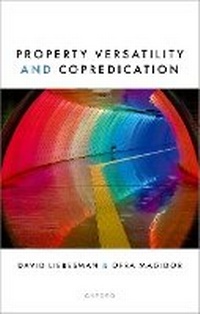
Property Versatility and Copredication
Published on 29. May 2025
Book
Hardback
464 pages
978-0-19-289423-6 (ISBN)
Description
Nearly all properties are, to a certain extent, versatile: there are many different ways to instantiate them. Consider a light-blue scarf and a dark-blue gemstone. They share the property of being blue, despite being different kinds of objects and differing in the way in which they are blue. The key insight explored in this book is that this apparently mundane observation should be extended: many properties are considerably more versatile than theorists typically take them to be. This insight turns out to be incredibly powerful in addressing a wide range of issues in the philosophy of language, metaphysics, and beyond.
One such issue is the problem of copredication. Copredication sentences such as 'Lunch was delicious but took hours' are common yet puzzling. These sentences can be true despite seemingly ascribing incompatible properties: it appears that only the food eaten can be delicious, and only the event attended can take hours. This book offers a comprehensive discussion of the problem of copredication, including a critical evaluation of extant approaches to the problem and culminating with a defence of the Property Versatility approach to copredication. In addition, the book demonstrates how Property Versatility is a powerful tool in addressing a wide range of issues beyond copredication, including the semantics of generics, the metaphysics of establishments and repeatable artworks, fictional discourse, and the nature of ambiguity, as well as a host of others.
One such issue is the problem of copredication. Copredication sentences such as 'Lunch was delicious but took hours' are common yet puzzling. These sentences can be true despite seemingly ascribing incompatible properties: it appears that only the food eaten can be delicious, and only the event attended can take hours. This book offers a comprehensive discussion of the problem of copredication, including a critical evaluation of extant approaches to the problem and culminating with a defence of the Property Versatility approach to copredication. In addition, the book demonstrates how Property Versatility is a powerful tool in addressing a wide range of issues beyond copredication, including the semantics of generics, the metaphysics of establishments and repeatable artworks, fictional discourse, and the nature of ambiguity, as well as a host of others.
More details
Language
English
Place of publication
Oxford
United Kingdom
Target group
Professional and scholarly
College/higher education
Product notice
sewn/stitched
Cloth over boards
Dimensions
Height: 198 mm
Width: 8 mm
Thickness: 25 mm
Weight
680 gr
ISBN-13
978-0-19-289423-6 (9780192894236)
Copyright in bibliographic data and cover images is held by Nielsen Book Services Limited or by the publishers or by their respective licensors: all rights reserved.
Schweitzer Classification
Persons
David Liebesman is Professor of Philosophy and Linguistics at the University of Calgary.
Ofra Magidor is Waynflete Professor of Metaphysical Philosophy at the University of Oxford.
Ofra Magidor is Waynflete Professor of Metaphysical Philosophy at the University of Oxford.
Content
Introduction
I. Dual Nature Approaches to Copredication
1: Introduction to Dual Nature Approaches
2: Asher's Theory of Copredication
3: Gotham's Theory of Copredication
4: Additional Dual Nature Approaches and Concluding Remarks
II. Additional Approaches to Copredication
5: Reinterpretation Approaches
6: Scepticism about Externalist Semantics
7: Polysemy, Copredication, and Polysemy-centric Approaches
III. The Property Versatility Approach to Copredication
8: The Property Versatility Approach
9: The Property Versatility Approach: Detailed Case Studies
IV. The Property Versatility View of Generics
10: The Property Versatility View of Generics Motivated
11: The Property Versatility View of Generics Defended
V. Property Versatility and Social Ontology
12: The Metaphysics of Establishments
13: The Metaphysics of Repeatable Artworks
14: Property Versatility and Fictional Discourse
VI. Further Applications of Property Versatility
15: Further Applications of Property Versatility
I. Dual Nature Approaches to Copredication
1: Introduction to Dual Nature Approaches
2: Asher's Theory of Copredication
3: Gotham's Theory of Copredication
4: Additional Dual Nature Approaches and Concluding Remarks
II. Additional Approaches to Copredication
5: Reinterpretation Approaches
6: Scepticism about Externalist Semantics
7: Polysemy, Copredication, and Polysemy-centric Approaches
III. The Property Versatility Approach to Copredication
8: The Property Versatility Approach
9: The Property Versatility Approach: Detailed Case Studies
IV. The Property Versatility View of Generics
10: The Property Versatility View of Generics Motivated
11: The Property Versatility View of Generics Defended
V. Property Versatility and Social Ontology
12: The Metaphysics of Establishments
13: The Metaphysics of Repeatable Artworks
14: Property Versatility and Fictional Discourse
VI. Further Applications of Property Versatility
15: Further Applications of Property Versatility