

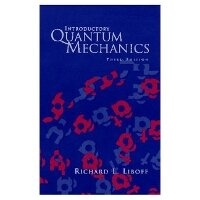
Introductory Quantum Mechanics
3rd Edition
Published on 13. August 1997
Book
Hardback
839 pages
978-0-201-87879-0 (ISBN)
Description
By providing detailed explanations of challenging concepts for students and by offering professors an extensive list of subjects, the third edition of this best-selling quantum mechanics text follows the continuing evolution of physics in both esoteric and pragmatic directions. A new chapter, 15, develops the subject of relativistic waves, beginning with a review of basic relativistic concepts and continues with derivation of the Klein-Gordon equation. The chapter delves into the Dirac theory and the Dirac formulation of the four-dimensional spin operator, and concludes with a brief introduction to the covariant formulation of relativistic quantum mechanics. The revision also includes new descriptions and discussions of quantum-well configurations relevant to the quantum dot and the quantum wire and pertinent to semiconductor technology. Employing an assortment of symmetry principles, the transfer matrix method is developed and employed to regain the Kronig-Penny dispersion relation. The discussion of impurity semiconductors has been revised and is accompanied by a new subsection on the p-n junction. A new description of the Hartree-Fock model is included in the revision, which affords a method for obtaining approximate atomic wavefunctions and eigenenergies. This description complements the Thomas-Fermi model, which was new to the second edition. The third edition of Introductory Quantum Mechanics also includes a number of new intriguing problems many of which carry solutions, and a new, informative periodic chart appearing on the inside flap of the front cover. As with his previous editions, Liboff starts with a review of the most relevant elements of classical mechanics and proceeds through two parts that develop quantum theory.
More details
Edition
3rd edition
Language
English
Place of publication
United States
Publishing group
Pearson Education (US)
Target group
Professional and scholarly
Dimensions
Height: 241 mm
Width: 170 mm
Thickness: 40 mm
Weight
1250 gr
ISBN-13
978-0-201-87879-0 (9780201878790)
Copyright in bibliographic data and cover images is held by Nielsen Book Services Limited or by the publishers or by their respective licensors: all rights reserved.
Schweitzer Classification
Other editions
New editions
Richard Liboff
Introductory Quantum Mechanics
Book
09/2002
4th Edition
Pearson Education (US)
€147.61
Article is exhausted; no reprint
Previous edition

Richard L. Liboff
Introductory Quantum Mechanics
Book
09/1991
2nd Edition
Addison Wesley
€35.90
Article exhausted; check for reprint
Content
I. ELEMENTARY PRINCIPLES AND APPLICATIONS TO PROBLEMS IN ONE DIMENSION.
1. Review of Concepts of Classical Mechanics.
2. Historical Review: Experiments and Theories.
3. The Postulates of Quantum Mechanics: Operators, Eigenfunctions, and Eigenvalues.
4. Preparatory Concepts: Function Spaces and Hermitian Operators.
5. Time Development, Conservation Theorems, and Parity.
6. Time Development, Conservation Theorems, and Parity.
7. Additional One-Dimensional Problems: Bound and Unbound States.
8. Finite Potential Well, Periodic Lattice, and Some Simple Problems with Two Degrees of Freedom.
II. FURTHER DEVELOPMENT OF THE THEORY AND APPLICATIONS TO PROBLEMS IN THREE DIMENSIONS.
9. Angular Momentum.
10. Problems in Three Dimension.
11. Elements of Matrix Mechanics: Spin Wavefunctions.
12. Application to Atomic, Molecular, Solid-State, and Nuclear Physics: Elements of Quantum Statistics.
13. Perturbation Theory.
14. Scattering in Three Dimensions.
15. Relativistic Quantum Mechanics.
List of Symbols.
Appendices.
Index.
List of Tables.
Topical Problems.
1. Review of Concepts of Classical Mechanics.
2. Historical Review: Experiments and Theories.
3. The Postulates of Quantum Mechanics: Operators, Eigenfunctions, and Eigenvalues.
4. Preparatory Concepts: Function Spaces and Hermitian Operators.
5. Time Development, Conservation Theorems, and Parity.
6. Time Development, Conservation Theorems, and Parity.
7. Additional One-Dimensional Problems: Bound and Unbound States.
8. Finite Potential Well, Periodic Lattice, and Some Simple Problems with Two Degrees of Freedom.
II. FURTHER DEVELOPMENT OF THE THEORY AND APPLICATIONS TO PROBLEMS IN THREE DIMENSIONS.
9. Angular Momentum.
10. Problems in Three Dimension.
11. Elements of Matrix Mechanics: Spin Wavefunctions.
12. Application to Atomic, Molecular, Solid-State, and Nuclear Physics: Elements of Quantum Statistics.
13. Perturbation Theory.
14. Scattering in Three Dimensions.
15. Relativistic Quantum Mechanics.
List of Symbols.
Appendices.
Index.
List of Tables.
Topical Problems.