

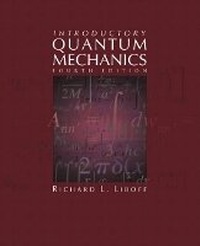
Introductory Quantum Mechanics
4th Edition
Published on 5. September 2002
Book
Hardback
900 pages
978-0-8053-8714-8 (ISBN)
Description
Careful and detailed explanations of challenging concepts in Introductory Quantum Mechanics, Fourth Edition, and comprehensive and up-to-date coverage, continue to set the standard in physics education. In the new edition of this best-selling quantum mechanics book, a new chapter on the revolutionary topic of of quantum computing (not currently covered in any other book at this level) and thorough updates to the rest of the book bring it up to date.
More details
Edition
4th edition
Language
English
Place of publication
Upper Saddle River
United States
Target group
Professional and scholarly
Dimensions
Height: 237 mm
Width: 209 mm
Thickness: 55 mm
Weight
1718 gr
ISBN-13
978-0-8053-8714-8 (9780805387148)
Copyright in bibliographic data and cover images is held by Nielsen Book Services Limited or by the publishers or by their respective licensors: all rights reserved.
Schweitzer Classification
Other editions
Previous edition

Richard L. Liboff
Introductory Quantum Mechanics
Book
11/1999
3rd Edition
Addison Wesley
€58.17
Article exhausted; check for reprint
Person
Dr. Richard Liboff received his Ph.D. in Physics from New York University in 1961 and was appointed to the Physics department at the same university upon graduation. He came to Cornell University in 1964, where he is presently a Full Professor of Applied Physics, Applied Math, and Electrical Engineering. He has served as visiting professor at numerous universities and was awarded a Fulbright Scholarship in 1984 in support of a Visiting Professorship of Physics at Tel Aviv University.
He has written over 100 scientific articles and has authored four textbooks. His research specialties include condensed-matter theory, kinetic theory, applied math, and elements of astrophysics.
He has written over 100 scientific articles and has authored four textbooks. His research specialties include condensed-matter theory, kinetic theory, applied math, and elements of astrophysics.
Content
I. ELEMENTARY PRINCIPLES AND APPLICATIONS TO PROBLEMS IN ONE DIMENSION.
1. Review of Concepts of Classical Mechanics.
2. Historical Review: Experiments and Theories.
3. The Postulates of Quantum Mechanics: Operators, Eigenfunctions, and Eigenvalues.
4. Preparatory Concepts: Function Spaces and Hermitian Operators.
5. Time Development, Conservation Theorems, and Parity.
6. Time Development, Conservation Theorems, and Parity.
7. Additional One-Dimensional Problems: Bound and Unbound States.
8. Finite Potential Well, Periodic Lattice, and Some Simple Problems with Two Degrees of Freedom.
II. FURTHER DEVELOPMENT OF THE THEORY AND APPLICATIONS TO PROBLEMS IN THREE DIMENSIONS.
9. Angular Momentum.
10. Problems in Three Dimensions.
11. Elements of Matrix Mechanics: Spin Wavefunctions.
12. Application to Atomic, Molecular, Solid-State, and Nuclear Physics: Elements of Quantum Statistics.
13. Perturbation Theory.
14. Scattering in Three Dimensions.
15. Relativistic Quantum Mechanics.
16. Quantum Computing.
List of Symbols.
Appendices.
Index.
List of Tables.
Topical Problems.
1. Review of Concepts of Classical Mechanics.
2. Historical Review: Experiments and Theories.
3. The Postulates of Quantum Mechanics: Operators, Eigenfunctions, and Eigenvalues.
4. Preparatory Concepts: Function Spaces and Hermitian Operators.
5. Time Development, Conservation Theorems, and Parity.
6. Time Development, Conservation Theorems, and Parity.
7. Additional One-Dimensional Problems: Bound and Unbound States.
8. Finite Potential Well, Periodic Lattice, and Some Simple Problems with Two Degrees of Freedom.
II. FURTHER DEVELOPMENT OF THE THEORY AND APPLICATIONS TO PROBLEMS IN THREE DIMENSIONS.
9. Angular Momentum.
10. Problems in Three Dimensions.
11. Elements of Matrix Mechanics: Spin Wavefunctions.
12. Application to Atomic, Molecular, Solid-State, and Nuclear Physics: Elements of Quantum Statistics.
13. Perturbation Theory.
14. Scattering in Three Dimensions.
15. Relativistic Quantum Mechanics.
16. Quantum Computing.
List of Symbols.
Appendices.
Index.
List of Tables.
Topical Problems.