

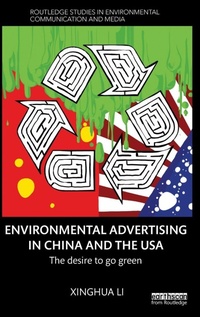
Environmental Advertising in China and the USA
The desire to go green
1st Edition
Published on 16. May 2016
Book
Hardback
158 pages
978-0-415-74413-3 (ISBN)
Description
Since the late 1980s, green consumerism has been hailed in the West as an efficient solution to environmental problems. However, Chinese consumers have been slow to warm up to eco-friendly products. Consumers prefer SUVs to hybrid cars, health supplements and snake oil medicines to organic foods and eco-fashion is still secluded in high-end designer studios. These choices contradict the findings of many sustainable lifestyle surveys that claim to register a rising desire for green products among the Chinese.
This book examines the psycho-cultural differences that disrupt the translation of "eco-friendly" appeals to China by analyzing environmental advertising. It explores the different notions of "green", the structures of desire that underlies the advertisements, and how they are shaped by ideological, cultural, and historical differences. Rather than arguing the superiority of the American or Chinese version of green consumerism, the book interrogates the role of advertising in the global spread of Western ideologies and explores the possibilities for consumers to resist transnational corporate hegemony in the green movement.
This book fills an important gap in the critical scholarship on green marketing and should be of interest to students and scholars of environment studies, green advertising and marketing, environmental communication and media studies, China studies and environmental sociology, ethics and cultural studies.
This book examines the psycho-cultural differences that disrupt the translation of "eco-friendly" appeals to China by analyzing environmental advertising. It explores the different notions of "green", the structures of desire that underlies the advertisements, and how they are shaped by ideological, cultural, and historical differences. Rather than arguing the superiority of the American or Chinese version of green consumerism, the book interrogates the role of advertising in the global spread of Western ideologies and explores the possibilities for consumers to resist transnational corporate hegemony in the green movement.
This book fills an important gap in the critical scholarship on green marketing and should be of interest to students and scholars of environment studies, green advertising and marketing, environmental communication and media studies, China studies and environmental sociology, ethics and cultural studies.
Reviews / Votes
In sum, Environmental Advertising in China and the USA is a useful, nuanced, and sometimes frustrating look at the increasingly consumer-driven world of Bgreen^ advertising...the work is essential reading for those with an interest in the nexus of environmentalism, consumerism and advertising in the U. S and China.- Jonathan Hassid, 2016, Vol.44, No.6 edition of Human Ecology.
More details
Series
Language
English
Place of publication
London
United Kingdom
Publishing group
Taylor & Francis Ltd
Target group
College/higher education
Dimensions
Height: 240 mm
Width: 161 mm
Thickness: 14 mm
Weight
426 gr
ISBN-13
978-0-415-74413-3 (9780415744133)
Copyright in bibliographic data and cover images is held by Nielsen Book Services Limited or by the publishers or by their respective licensors: all rights reserved.
Schweitzer Classification
Other editions
Additional editions
Book
01/2019
1st Edition
Routledge
€70.90
Shipment within 15-20 days
E-Book
05/2016
Routledge
€64.49
Available for download
E-Book
05/2016
Routledge
€64.49
Available for download
Person
Xinghua Li is Assistant Professor of Media Studies?at Babson College, Massachusetts, USA. She?writes about the global spread of consumer capitalism through the perspectives of psychoanalysis, environmental communication, and critical media theory.
Content
Introduction 1. Morphing The Self: Hybrid Car Advertising 2. Detoxing the Private: Green Home Advertising 3. The "Organi-vore's" Dilemma: Organic Food Advertising 4. The "Useless" Sustainability: Eco-Fashion Advertising Conclusion