

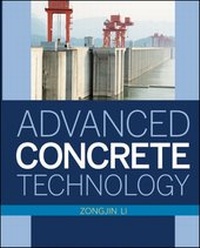
Advanced Concrete Technology
Published on 8. March 2011
Book
Hardback
624 pages
978-0-470-43743-8 (ISBN)
Description
Over the past two decades concrete has enjoyed a renewed level of research and testing, resulting in the development of many new types of concrete. Through the use of various additives, production techniques and chemical processes, there is now a great degree of control over the properties of specific concretes for a wide range of applications. New theories, models and testing techniques have also been developed to push the envelope of concrete as a building material. There is no current textbook which brings all of these advancements together in a single volume. This book aims to bridge the gap between the traditional concrete technologies and the emerging state-of-the-art technologies which are gaining wider use.
More details
Product info
gebunden
Edition
1. Auflage
Language
English
Place of publication
New York
United States
Target group
Professional and scholarly
Illustrations
Photos: 109 B&W, 0 Color; Drawings: 263 B&W, 0 Color
Dimensions
Height: 23.7 cm
Width: 19.6 cm
Thickness: 3.2 cm
Weight
1055 gr
ISBN-13
978-0-470-43743-8 (9780470437438)
Schweitzer Classification
Other editions
New editions
Additional editions
Person
Zongjin Li is a Professor in the Civil and Environmental Engineering Department at the Hong Kong University of Science and Technology. He is the chief scientist in a study of environmentally friendly contemporary concrete, a national key project in China.
Content
Preface.
1 Introduction to Concrete.
1.1 Concrete Definition and Historical Development.
1.2 Concrete as a Structural Material.
1.3 Characteristics of Concrete.
1.4 Types of Concrete.
1.5 Factors Influencing Concrete Properties.
1.6 Approaches to Study Concrete.
Discussion Topics.
References.
2 Materials for Making Concrete.
2.1 Aggregates.
2.2 Cementitious Binders.
2.3 Admixtures.
2.4 Water.
Discussion Topics.
Problems.
References.
3 Fresh Concrete.
3.1 Workability of Fresh Concrete.
3.2 Mix Design.
3.3 Procedures for Concrete Mix Design.
3.4 Manufacture of Concrete.
3.5 Delivery of Concrete.
3.6 Concrete Placing.
3.7 Early-Age Properties of Concrete.
Discussion Topics.
Problems.
References.
4 Structure of Concrete.
4.1 Introduction.
4.2 Structural Levels.
4.3 Structure of Concrete in Nanometer Scale: C-S-H Structure.
4.4 Transition Zone in Concrete.
4.5 Microstructural Engineering.
Discussion Topics.
References.
5 Hardened Concrete.
5.1 Strengths of Hardened Concrete.
5.2 Stress-Strain Relationship and Constitutive Equations.
5.3 Dimensional Stability--Shrinkage and Creep.
5.4 Durability.
Discussion Topics.
Problems.
References.
6 Advanced Cementitious Composites.
6.1 Fiber-Reinforced Cementitious Composites.
6.2 High-Strength Cementitious Composites.
6.3 Polymers in Concrete.
6.4 Shrinkage-Compensating Concrete.
6.5 Self-Compacting Concrete.
6.6 Engineered Cementitious Composite.
6.7 Tube-Reinforced Concrete.
6.8 High-Volume Fly Ash Concrete.
6.9 Structural Lightweight Concrete.
6.10 Heavyweight Concrete.
Discussion Topics.
Problems.
References.
7 Concrete Fracture Mechanics.
7.1 Introduction.
7.2 Linear Elastic Fracture Mechanics.
7.3 The Crack Tip Plastic Zone.
7.4 Crack Tip Opening Displacement.
7.5 Fracture Process in Concrete.
7.6 Nonlinear Fracture Mechanics for Concrete.
7.7 Two-Parameter Fracture Model.
7.8 Size Effect Model.
7.9 The Fictitious Model by Hillerborg.
7.10 R-Curve Method for Quasi-Brittle Materials.
Discussion Topics.
Problems.
References.
8 Nondestructive Testing in Concrete Engineering.
8.1 Introduction.
8.2 Review of Wave Theory for a 1D Case.
8.3 Reflected and Transmitted Waves.
8.4 Attenuation and Scattering.
8.5 Main Commonly Used NDT-CE Techniques.
8.6 Noncontacting Resistivity Measurement Method.
Discussion Topics.
Problems.
References.
9 The Future and Development Trends of Concrete.
9.1 Sustainability of Concrete.
9.2 Deep Understanding of the Nature of Hydration.
9.3 Load-Carrying Capability-Durability Unified Service Life Design Theory.
9.4 High Toughness and Ductile Concrete.
References.
Index.