

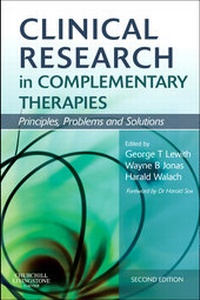
Clinical Research in Complementary Therapies
Principles, Problems and Solutions
2nd Edition
Published on 23. November 2010
Book
Paperback/Softback
426 pages
978-0-443-06956-7 (ISBN)
Description
The use of complementary therapies is exploding, increasing the pressure to establish a rigorous science to support its practice. Clinical Research in Complementary Therapies: Principles, Problems and Solutions provides students with the tools they need to research complementary and integrative medicine (CIM) and so fill this gap. Essential for both undergraduate and postgraduate students, this second edition is significantly updated and enhanced.
Part 1 deals with research strategies and methods, explaining the major types of clinical research in CIM and how these inter-relate. New chapters are included on whole systems research, qualitative research and questionnaire development. Not all therapies can be treated the same way nor channeled through the signal process of randomized controlled trials. Therefore, detailed description of mixed methods approaches including observational, qualitative, cost-benefit and comparative effectiveness research are described. Part 2 deals with specific complementary therapies and how they are invested by experts in each field.
The book analyses the key questions asked and the controversies debated in complementary medicine research and offers clear and innovative guidance for answering these questions.
FEATURES
. Provides an overarching synthesis of methods in CIM and how they are to be used collectively including the role of comparative effectiveness research. Suggests both general and specific factors which need to be considered in assessing or planning complementary therapy research . Pinpoints aspects of research which are different in orthodox research and complementary therapy research . Reviews the types of research carried out in specific complementary therapies and analyses issues which arise . Includes information on measuring the economic cost and benefits of complementary medicine, clinical audit and the role of placebos use . Builds upon recent research results, looks at the lessons these provide for all complementary therapies and suggests key issues to address in future research.
. Provides an overarching synthesis of methods in CIM and how they are to be used collectively including the role of comparative effectiveness research. Suggests both general and specific factors which need to be considered in assessing or planning complementary therapy research . Pinpoints aspects of research which are different in orthodox research and complementary therapy research . Reviews the types of research carried out in specific complementary therapies and analyses issues which arise . Includes information on measuring the economic cost and benefits of complementary medicine, clinical audit and the role of placebos use . Builds upon recent research results, looks at the lessons these provide for all complementary therapies and suggests key issues to address in future research.
Part 1 deals with research strategies and methods, explaining the major types of clinical research in CIM and how these inter-relate. New chapters are included on whole systems research, qualitative research and questionnaire development. Not all therapies can be treated the same way nor channeled through the signal process of randomized controlled trials. Therefore, detailed description of mixed methods approaches including observational, qualitative, cost-benefit and comparative effectiveness research are described. Part 2 deals with specific complementary therapies and how they are invested by experts in each field.
The book analyses the key questions asked and the controversies debated in complementary medicine research and offers clear and innovative guidance for answering these questions.
FEATURES
. Provides an overarching synthesis of methods in CIM and how they are to be used collectively including the role of comparative effectiveness research. Suggests both general and specific factors which need to be considered in assessing or planning complementary therapy research . Pinpoints aspects of research which are different in orthodox research and complementary therapy research . Reviews the types of research carried out in specific complementary therapies and analyses issues which arise . Includes information on measuring the economic cost and benefits of complementary medicine, clinical audit and the role of placebos use . Builds upon recent research results, looks at the lessons these provide for all complementary therapies and suggests key issues to address in future research.
. Provides an overarching synthesis of methods in CIM and how they are to be used collectively including the role of comparative effectiveness research. Suggests both general and specific factors which need to be considered in assessing or planning complementary therapy research . Pinpoints aspects of research which are different in orthodox research and complementary therapy research . Reviews the types of research carried out in specific complementary therapies and analyses issues which arise . Includes information on measuring the economic cost and benefits of complementary medicine, clinical audit and the role of placebos use . Builds upon recent research results, looks at the lessons these provide for all complementary therapies and suggests key issues to address in future research.
More details
Edition
2nd edition
Language
English
Place of publication
London
United Kingdom
Publishing group
Elsevier Health Sciences
Target group
College/higher education
Illustrations
Illustrated
Dimensions
Height: 234 mm
Width: 156 mm
Weight
650 gr
ISBN-13
978-0-443-06956-7 (9780443069567)
Copyright in bibliographic data and cover images is held by Nielsen Book Services Limited or by the publishers or by their respective licensors: all rights reserved.
Schweitzer Classification
Other editions
Additional editions
George Thomas Lewith | Wayne B. Jonas | Harald Walach
Clinical Research in Complementary Therapies
Principles, Problems and Solutions
E-Book
11/2010
2nd Edition
Elsevier
from
€67.82
Available for download
Previous edition
George Thomas Lewith | Wayne B. Jonas | Harald Walach
Clinical Research in Complementary Therapies
Principles, Problems and Solutions
Book
09/2001
Churchill Livingstone
€49.51
Article exhausted; check for reprint
Persons
Editor
Professor of Health Research, Complementary and Integrated Medicine Research Unit, Aldermoor Health Centre, Southampton, UK
Department of Family Medicine, Uniformed Services of Health Sciences, Uniformed Services University, Bethesda, Maryland, USA
Professor of Research in Psychology, University of Northampton, School of Social Sciences, Northampton, UK; European University Viadrina, Institute for Transcultural Health Studies & Samueli Institute, European Office, Frankfurt, Germany