

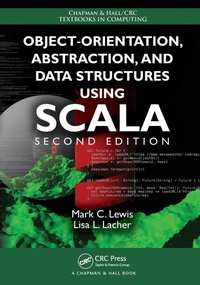
Object-Orientation, Abstraction, and Data Structures Using Scala
2nd Edition
Published on 19. December 2016
Book
Paperback/Softback
662 pages
978-1-4987-3216-1 (ISBN)
Description
Praise for the first edition:
"The well-written, comprehensive book...[is] aiming to become a de facto reference for the language and its features and capabilities. The pace is appropriate for beginners; programming concepts are introduced progressively through a range of examples and then used as tools for building applications in various domains, including sophisticated data structures and algorithms...Highly recommended. Students of all levels, faculty, and professionals/practitioners.
-D. Papamichail, University of Miami in CHOICE Magazine
Mark Lewis' Introduction to the Art of Programming Using Scala was the first textbook to use Scala for introductory CS courses. Fully revised and expanded, the new edition of this popular text has been divided into two books. Object-Orientation, Abstraction, and Data Structures Using Scala, Second Edition is intended to be used as a textbook for a second or third semester course in Computer Science.
The Scala programming language provides powerful constructs for expressing both object orientation and abstraction. This book provides students with these tools of object orientation to help them structure solutions to larger, more complex problems, and to expand on their knowledge of abstraction so that they can make their code more powerful and flexible. The book also illustrates key concepts through the creation of data structures, showing how data structures can be written, and the strengths and weaknesses of each one. Libraries that provide the functionality needed to do real programming are also explored in the text, including GUIs, multithreading, and networking.
The book is filled with end-of-chapter projects and exercises, and the authors have also posted a number of different supplements on the book website. Video lectures for each chapter in the book are also available on YouTube. The videos show construction of code from the ground up and this type of "live coding" is invaluable for learning to program, as it allows students into the mind of a more experienced programmer, where they can see the thought processes associated with the development of the code.
About the Authors
Mark Lewis is an Associate Professor at Trinity University. He teaches a number of different courses, spanning from first semester introductory courses to advanced seminars. His research interests included simulations and modeling, programming languages, and numerical modeling of rings around planets with nearby moons.
Lisa Lacher is an Assistant Professor at the University of Houston, Clear Lake with over 25 years of professional software development experience. She teaches a number of different courses spanning from first semester introductory courses to graduate level courses. Her research interests include Computer Science Education, Agile Software Development, Human Computer Interaction and Usability Engineering, as well as Measurement and Empirical Software Engineering.
"The well-written, comprehensive book...[is] aiming to become a de facto reference for the language and its features and capabilities. The pace is appropriate for beginners; programming concepts are introduced progressively through a range of examples and then used as tools for building applications in various domains, including sophisticated data structures and algorithms...Highly recommended. Students of all levels, faculty, and professionals/practitioners.
-D. Papamichail, University of Miami in CHOICE Magazine
Mark Lewis' Introduction to the Art of Programming Using Scala was the first textbook to use Scala for introductory CS courses. Fully revised and expanded, the new edition of this popular text has been divided into two books. Object-Orientation, Abstraction, and Data Structures Using Scala, Second Edition is intended to be used as a textbook for a second or third semester course in Computer Science.
The Scala programming language provides powerful constructs for expressing both object orientation and abstraction. This book provides students with these tools of object orientation to help them structure solutions to larger, more complex problems, and to expand on their knowledge of abstraction so that they can make their code more powerful and flexible. The book also illustrates key concepts through the creation of data structures, showing how data structures can be written, and the strengths and weaknesses of each one. Libraries that provide the functionality needed to do real programming are also explored in the text, including GUIs, multithreading, and networking.
The book is filled with end-of-chapter projects and exercises, and the authors have also posted a number of different supplements on the book website. Video lectures for each chapter in the book are also available on YouTube. The videos show construction of code from the ground up and this type of "live coding" is invaluable for learning to program, as it allows students into the mind of a more experienced programmer, where they can see the thought processes associated with the development of the code.
About the Authors
Mark Lewis is an Associate Professor at Trinity University. He teaches a number of different courses, spanning from first semester introductory courses to advanced seminars. His research interests included simulations and modeling, programming languages, and numerical modeling of rings around planets with nearby moons.
Lisa Lacher is an Assistant Professor at the University of Houston, Clear Lake with over 25 years of professional software development experience. She teaches a number of different courses spanning from first semester introductory courses to graduate level courses. Her research interests include Computer Science Education, Agile Software Development, Human Computer Interaction and Usability Engineering, as well as Measurement and Empirical Software Engineering.
More details
Series
Edition
2nd edition
Language
English
Place of publication
Oxford
United States
Publishing group
Taylor & Francis Inc
Target group
College/higher education
Illustrations
50 s/w Abbildungen
50 Illustrations, black and white
Dimensions
Height: 254 mm
Width: 178 mm
Thickness: 35 mm
Weight
1228 gr
ISBN-13
978-1-4987-3216-1 (9781498732161)
Copyright in bibliographic data and cover images is held by Nielsen Book Services Limited or by the publishers or by their respective licensors: all rights reserved.
Schweitzer Classification
Other editions
Additional editions
Mark C. Lewis | Lisa Lacher
Object-Orientation, Abstraction, and Data Structures Using Scala
Book
07/2017
2nd Edition
CRC Press
€282.26
Shipment within 10-20 days
Mark C. Lewis | Lisa Lacher
Object-Orientation, Abstraction, and Data Structures Using Scala
E-Book
01/2017
2nd Edition
Chapman & Hall/CRC
€138.99
Available for download
Mark C. Lewis | Lisa Lacher
Object-Orientation, Abstraction, and Data Structures Using Scala
E-Book
01/2017
2nd Edition
Chapman & Hall/CRC
€138.99
Available for download
Persons
Mark C. Lewis, Lisa Lacher
Content
Object-Orientation. Bigger Programs/New Tools. A Project (Drawing Program). Abstraction and Polymorphism. Other Collection Types. Multithreading and Concurrency. Stream I/O. Networking. Stacks and Queues. Linked Lists. Priority Queues. Refactoring. Recursion. Trees. Regular Expressions and Context-Free Parsers. Spatial Trees. Binary Heaps . Direct Access Binary Files. Actors. Augmenting Trees. Wrapping Up