

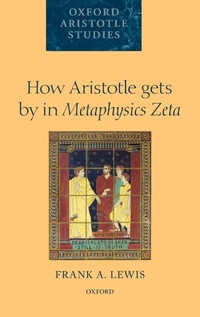
How Aristotle gets by in Metaphysics Zeta
Published on 27. June 2013
Book
Hardback
342 pages
978-0-19-966401-6 (ISBN)
Description
Frank A. Lewis presents a closely argued exposition of Metaphysics Zeta--one of Aristotle's most dense and controversial texts. It is commonly understood to contain Aristotle's deepest thoughts on the definition of substance and surrounding metaphysical issues. But people have increasingly come to recognize how little Aristotle says in Zeta about his own theory of (Aristotelian) form and matter. Instead, he spends the bulk of the book examining 'received opinions', often as filtered through his own Organon, but including above all the views of Plato, who is at times friend, and at times foe. For much of the time, we are left to reconstruct Aristotle's finished views, subject to the constraint that they survive the critique he directs in Zeta at the philosophical tradition.
In this book, Lewis argues that in giving his actual conclusion to Zeta in its final chapter, 17, Aristotle drops his earlier, largely critical engagement with received views, and turns approvingly to his own Posterior Analytics. The result is a causal view of (primary) substance, representing the property of being a (primary) substance (or the substance of a thing) as, in modern dress, the second-order functional property of (Aristotelian) forms, that they be the cause of being for different compound material substances. The property of being the cause of being for a thing is a role property, and it is realized in different forms and the sets of causal powers associated with them, matching the variety of things that have a form as their substance.
Meanwhile, the failure of previous attempts at definition in earlier chapters leaves Aristotle's own definition standing as the 'best explanation' for the views proprietary to the theory of form and matter. The point that (Aristotelian) forms are the primary substances is not the main conclusion to Zeta, but rather a result his definition must give, if the definition is to be acceptable.
In this book, Lewis argues that in giving his actual conclusion to Zeta in its final chapter, 17, Aristotle drops his earlier, largely critical engagement with received views, and turns approvingly to his own Posterior Analytics. The result is a causal view of (primary) substance, representing the property of being a (primary) substance (or the substance of a thing) as, in modern dress, the second-order functional property of (Aristotelian) forms, that they be the cause of being for different compound material substances. The property of being the cause of being for a thing is a role property, and it is realized in different forms and the sets of causal powers associated with them, matching the variety of things that have a form as their substance.
Meanwhile, the failure of previous attempts at definition in earlier chapters leaves Aristotle's own definition standing as the 'best explanation' for the views proprietary to the theory of form and matter. The point that (Aristotelian) forms are the primary substances is not the main conclusion to Zeta, but rather a result his definition must give, if the definition is to be acceptable.
More details
Series
Language
English
Place of publication
Oxford
United Kingdom
Target group
College/higher education
Dimensions
Height: 240 mm
Width: 161 mm
Thickness: 23 mm
Weight
678 gr
ISBN-13
978-0-19-966401-6 (9780199664016)
Copyright in bibliographic data and cover images is held by Nielsen Book Services Limited or by the publishers or by their respective licensors: all rights reserved.
Schweitzer Classification
Other editions
Additional editions
Frank A. Lewis
How Aristotle gets by in Metaphysics Zeta
E-Book
06/2013
1st Edition
OUP eBook
€63.49
Available for download
Person
Frank A. Lewis was educated at Cambridge University and Princeton University, and is Professor of Philosophy at the University of Southern California. He taught previously at the University of Arizona and at UCLA; he has held visiting positions at Stanford and at UCLA, and has twice held fellowships from the American Council of Learned Societies. He is the author of Substance and Predication in Aristotle (Cambridge 1991), and co-editor with R. Bolton of Form, Matter, and Mixture in Aristotle (Blackwell, 1996). Recent publications deal mostly with topics in Aristotle's metaphysics and natural philosophy.
Content
PART ONE. THE SHAPE OF ZETA; PART TWO: SUBSTANCE AS SUBJECT; PART THREE. SUBSTANCE AS ESSENCE; PART FOUR. SUBSTANCE AS UNIVERSAL; APPENDIX TO CHAPTER EIGHT. MUTUAL EXCLUSIVITY AND SOME VERSIONS OF COMPATIBILITY; PART FIVE. BACK TO THE DEFINITION OF SUBSTANCE: THE END-GAME