

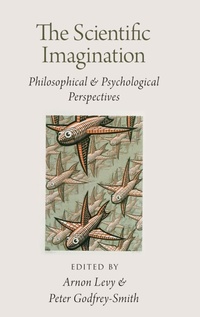
The Scientific Imagination
Published on 10. January 2020
Book
Hardback
360 pages
978-0-19-021230-8 (ISBN)
Description
The imagination, our capacity to entertain thoughts and ideas "in the mind's eye," is indispensable in science as elsewhere in human life. Indeed, common scientific practices such as modeling and idealization rely on the imagination to construct simplified, stylized scenarios essential for scientific understanding. Yet the philosophy of science has traditionally shied away from according an important role to the imagination, wary of psychologizing fundamental scientific concepts like explanation and justification. In recent years, however, advances in thinking about creativity and fiction, and their relation to theorizing and understanding, have prompted a move away from older philosophical perspectives and toward a greater acknowledgement of the place of the imagination in scientific practice. Meanwhile, psychologists have engaged in significant experimental work on the role of the imagination in causal thinking and probabilistic reasoning.
The Scientific Imagination delves into this burgeoning area of debate at the intersection of the philosophy and practice of science, bringing together the work of leading researchers in philosophy and psychology. Philosophers discuss such topics as modeling, idealization, metaphor and explanation, examining their role within science as well as how they affect questions in metaphysics, epistemology and philosophy of language. Psychologists discuss how our imaginative capacities develop and how they work, their relationships with processes of reasoning, and how they compare to related capacities, such as categorization and counterfactual thinking. Together, these contributions combine to provide a comprehensive and exciting picture of the scientific imagination.
The Scientific Imagination delves into this burgeoning area of debate at the intersection of the philosophy and practice of science, bringing together the work of leading researchers in philosophy and psychology. Philosophers discuss such topics as modeling, idealization, metaphor and explanation, examining their role within science as well as how they affect questions in metaphysics, epistemology and philosophy of language. Psychologists discuss how our imaginative capacities develop and how they work, their relationships with processes of reasoning, and how they compare to related capacities, such as categorization and counterfactual thinking. Together, these contributions combine to provide a comprehensive and exciting picture of the scientific imagination.
Reviews / Votes
The book contains thirteen chapters, written by philosophers and psychologists, each exploring the role of imagination in scientific inquiry. Many (though not all) of the chapters focus on scientific modelling and, in particular, on the idea that models can be com- pared to works of fiction, a view defended by Levy and Godfrey-Smith themselves, along with me, Roman Frigg and others...I should stress, however, that the book contains a great deal else that is of interest too. * Adam Toon, History and Philosophy of the Life Sciences * All of the chapters present thought-provoking new ideas * Michael T Stuart, Journal for General Philosophy of Science * This collection of thirteen new essays reflects growing agreement that imagination plays a key role in science, not just in thinking up hypotheses, but in testing them.... The sixteen authors include many of those who have already made significant contributions to meeting the challenge. The volume furthers the debate and will encourage others to get involved. It is greatly to be welcomed... anyone interested in the scientific imagination will have a lot to learn from this volume. * Timothy Williamson, Notre Dame Philosophical Reviews *More details
Language
English
Place of publication
New York
United States
Target group
Professional and scholarly
Dimensions
Height: 240 mm
Width: 161 mm
Thickness: 24 mm
Weight
705 gr
ISBN-13
978-0-19-021230-8 (9780190212308)
Copyright in bibliographic data and cover images is held by Nielsen Book Services Limited or by the publishers or by their respective licensors: all rights reserved.
Schweitzer Classification
Other editions
Additional editions
Arnon Levy | Peter Godfrey-Smith
The Scientific Imagination
E-Book
11/2019
OUP eBook
€60.99
Available for download
Arnon Levy | Peter Godfrey-Smith
The Scientific Imagination
E-Book
11/2019
OUP eBook
€46.99
Available for download
Persons
Arnon Levy is a philosopher of science and biology at the Hebrew University of Jerusalem. His research focuses on explanation and modeling in the life sciences.
Peter Godfrey-Smith is a philosopher at the University of Sydney. His work focuses on philosophy of biology and philosophy of mind.
Peter Godfrey-Smith is a philosopher at the University of Sydney. His work focuses on philosophy of biology and philosophy of mind.
Content
About the Contributors
Arnon Levy and Peter Godfrey-Smith: Introduction
1: Fiora Salis and Roman Frigg: Capturing the Scientific Imagination
2: Amie L. Thomasson: If Models Were Fictions, Then What Would They Be?
3: Martin Thomson-Jones: Realism About Missing Systems
4: Stacie Friend: The Fictional Character of Scientific Models
5: Stephen Yablo: Models and Reality
6: Peter Godfrey-Smith: Models, Fictions, and Conditionals
7: Benjamin Sheredos and William Bechtel: Imagining Mechanisms with Diagrams
8: Michael Weisberg: Abstraction and Representational Capacity in Computational Structures
9: Tania Lombrozo: aLearning by Thinkinga in Science and in Everyday Life
10: Deena Skolnick Weisberg: Is Imagination Constrained Enough for Science?
11: Igor Bascandziev and Paul M. Harris: Can Children Benefit from Thought Experiments?
12: Arnon Levy: Metaphor and Scientific Explanation
13: Elizabeth Camp: Imaginative Frames for Scientific Inquiry: Metaphors, Telling Facts, and Just-So Stories
Arnon Levy and Peter Godfrey-Smith: Introduction
1: Fiora Salis and Roman Frigg: Capturing the Scientific Imagination
2: Amie L. Thomasson: If Models Were Fictions, Then What Would They Be?
3: Martin Thomson-Jones: Realism About Missing Systems
4: Stacie Friend: The Fictional Character of Scientific Models
5: Stephen Yablo: Models and Reality
6: Peter Godfrey-Smith: Models, Fictions, and Conditionals
7: Benjamin Sheredos and William Bechtel: Imagining Mechanisms with Diagrams
8: Michael Weisberg: Abstraction and Representational Capacity in Computational Structures
9: Tania Lombrozo: aLearning by Thinkinga in Science and in Everyday Life
10: Deena Skolnick Weisberg: Is Imagination Constrained Enough for Science?
11: Igor Bascandziev and Paul M. Harris: Can Children Benefit from Thought Experiments?
12: Arnon Levy: Metaphor and Scientific Explanation
13: Elizabeth Camp: Imaginative Frames for Scientific Inquiry: Metaphors, Telling Facts, and Just-So Stories