

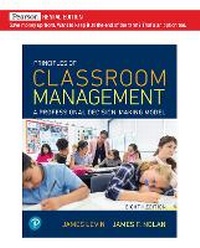
Principles of Classroom Management
A Professional Decision-Making Model
8th Edition
Published on 4. August 2019
Book
Paperback/Softback
416 pages
978-0-13-524053-3 (ISBN)
Description
This print textbook is available for you to rent for your classes. The Pearson print rental program provides you with affordable access to learning materials, so you go to class ready to succeed.
Principles of Classroom Management focuses on the teacher's role as a professional decision-maker in creating positive learning environments that help influence students to behave productively and strive for academic success, rather than focusing on rewards and punishments. Grounded in both theory and practice, it provides a very practical system to guide your decision-making process and foster supportive classroom environments. Principles, theoretical perspectives, and empirical findings provide a foundation for you to confidently make professional decisions with respect to classroom behavior issues. An array of decision-making options guide you in thinking about how to approach specific classroom management situations and choose from a range of strategies designed to prevent disruptive behavior and influence appropriate behavior.
The 8th Edition incorporates updated research, examples, and real-world classroom cases throughout the text. Increased emphasis is placed on relationship building, culturally relevant pedagogy, teacher self-care strategies, and universal design for learning. Both foundational and belief-based strategies are presented as classroom intervention strategies for working with students who exhibit chronic behavior problems.
Principles of Classroom Management focuses on the teacher's role as a professional decision-maker in creating positive learning environments that help influence students to behave productively and strive for academic success, rather than focusing on rewards and punishments. Grounded in both theory and practice, it provides a very practical system to guide your decision-making process and foster supportive classroom environments. Principles, theoretical perspectives, and empirical findings provide a foundation for you to confidently make professional decisions with respect to classroom behavior issues. An array of decision-making options guide you in thinking about how to approach specific classroom management situations and choose from a range of strategies designed to prevent disruptive behavior and influence appropriate behavior.
The 8th Edition incorporates updated research, examples, and real-world classroom cases throughout the text. Increased emphasis is placed on relationship building, culturally relevant pedagogy, teacher self-care strategies, and universal design for learning. Both foundational and belief-based strategies are presented as classroom intervention strategies for working with students who exhibit chronic behavior problems.
More details
Edition
8th edition
Language
English
Place of publication
United States
Publishing group
Pearson Education (US)
Target group
College/higher education
ISBN-13
978-0-13-524053-3 (9780135240533)
Copyright in bibliographic data and cover images is held by Nielsen Book Services Limited or by the publishers or by their respective licensors: all rights reserved.
Schweitzer Classification
Other editions
Previous edition
Book
04/2013
7th Edition
Pearson
€133.69
Shipment within 15-20 days
Persons
About our authors Dr. James Nolan served as an elementary teacher, a secondary German teacher, and a secondary guidance counselor in Pennsylvania schools. At Penn State University he was the Hermanowicz Professor of Teacher Education and Professor in Charge of Elementary and Secondary Field Experiences. For 20 years he worked with an elementary-level professional development school partnership between Penn State University and the State College Area School district. His scholarship focuses on classroom management, teacher supervision and evaluation and teacher education and professional development.
Dr. James Levin is recently retired Director of Academic Advising, Eberly College of Science and Associate Professor of Education in the Graduate School at Penn State University. Dr. Levin has consulted with hundreds of school districts, alternative schools and treatment centers on the topic of working successfully with students who display disruptive behavior. He has taught both graduate and undergraduate courses and secondary math and science in inner city and suburban schools and residential cites for adjudicated youth. He has co-authored 3 other texts on modifying behavior, self-esteem and motivation. Dr. Levin's research interests include classroom management, science education and academic advising.
Dr. James Levin is recently retired Director of Academic Advising, Eberly College of Science and Associate Professor of Education in the Graduate School at Penn State University. Dr. Levin has consulted with hundreds of school districts, alternative schools and treatment centers on the topic of working successfully with students who display disruptive behavior. He has taught both graduate and undergraduate courses and secondary math and science in inner city and suburban schools and residential cites for adjudicated youth. He has co-authored 3 other texts on modifying behavior, self-esteem and motivation. Dr. Levin's research interests include classroom management, science education and academic advising.