

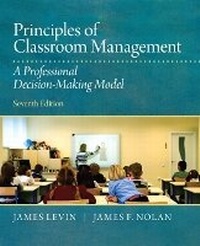
Principles of Classroom Management
A Professional Decision-Making Model
7th Edition
Published on 22. April 2013
Book
Paperback/Softback
360 pages
978-0-13-286862-4 (ISBN)
Description
The only text that takes a decision-making model approach to classroom management. It provides teachers with a very practical system to influence students to choose to behave productively and to strive for academic success. This widely used text presents an array of decision-making options that guide teachers in developing positive, pro-social classroom learning environments through relationship building, effective teaching strategies, and deliberate structuring of the classroom environment. The text also provides sets of principles to intervene when students are not focused in they way should be and to help them choose more productive behaviors. The text also addresses working within the classroom and with families and other school resources to help students who exhibit chronic behavior problems.
Thoroughly revised and updated, Principles of Classroom Management: A Professional Decision-Making Model, 7th Edition, includes
a much stronger focus on relationship building as a core activity in all phases of teaching(See new Chapter 7 as well as Chapters 3, 4, 5, 10, and 11)
increased attention to the principles of motivation and their application in helping students to set high expectations for themselves and to believe they can achieve them(See new Chapter 7 as well as Chapters 3, 4, 5, 10, and 11)
greater coverage of the knowledge teachers need to develop about cultural differences (Throughout the text)
much more coverage of the challenges posed by new technologies, including cyber-bullying, cyber-cheating, and sexting (See Chapters 2 and 3)
a variety of new cases as well as pre and post-chapter reflective activities (New iterative cases are included at the end of Chapters 1, 4, 7, and 11 and new cases are also embedded in Chapters 3, 4, 5, 6, 7, and 10.)
From reviews of the book:
"The text provides a very comprehensive view of classroom management that builds hierarchically, logically, and strategically. . . . The text provides not only the skills for effective classroom management . . ., but [it] includes a conceptual and theoretical perspective that is comprehensive and coupled with numerous examples and case studies that clarify and strengthen."
-Marilyn Howe, Clarion University of Pennsylvania
"I really like the way in which the authors engage readers from the beginning in a realistic conversation about the influence and importance of handling behaviour problems at all levels."
-Eleanor Wilson, University of Virginia
Thoroughly revised and updated, Principles of Classroom Management: A Professional Decision-Making Model, 7th Edition, includes
a much stronger focus on relationship building as a core activity in all phases of teaching(See new Chapter 7 as well as Chapters 3, 4, 5, 10, and 11)
increased attention to the principles of motivation and their application in helping students to set high expectations for themselves and to believe they can achieve them(See new Chapter 7 as well as Chapters 3, 4, 5, 10, and 11)
greater coverage of the knowledge teachers need to develop about cultural differences (Throughout the text)
much more coverage of the challenges posed by new technologies, including cyber-bullying, cyber-cheating, and sexting (See Chapters 2 and 3)
a variety of new cases as well as pre and post-chapter reflective activities (New iterative cases are included at the end of Chapters 1, 4, 7, and 11 and new cases are also embedded in Chapters 3, 4, 5, 6, 7, and 10.)
From reviews of the book:
"The text provides a very comprehensive view of classroom management that builds hierarchically, logically, and strategically. . . . The text provides not only the skills for effective classroom management . . ., but [it] includes a conceptual and theoretical perspective that is comprehensive and coupled with numerous examples and case studies that clarify and strengthen."
-Marilyn Howe, Clarion University of Pennsylvania
"I really like the way in which the authors engage readers from the beginning in a realistic conversation about the influence and importance of handling behaviour problems at all levels."
-Eleanor Wilson, University of Virginia
Reviews / Votes
From reviews of the book: "The text provides a very comprehensive view of classroom management that builds hierarchically, logically, and strategically... The text provides not only the skills for effective classroom management ..., but [it] includes a conceptual and theoretical perspective that is comprehensive and coupled with numerous examples and case studies that clarify and strengthen." -Marilyn Howe, Clarion University of Pennsylvania ' "The cases in each chapter provide interesting points for discussion and ... [t]he end-of -chapter exercises ... would be very helpful... I really like the inclusion of the 'DPAI' inventory in the Appendix that is designed to help the reader reflect on each chapter. [And] I really like the way in which the authors engage readers from the beginning in a realistic conversation about the influence and importance of handling behaviour problems at all levels." -Eleanor Wilson, University of Virginia ' ' From reviews of MyEducationLab for Classroom Management "I find the case studies and videos contained in MyEducationLab effective for further explanation of coursework. The strengths are that they provide hands-on, realistic ideas that can be applied in classroom settings. The questions posed are helpful in understanding what students have learned from watching the videos or doing case studies. Students' skills can be assessed through the assessment modules... The activities assist students in gaining a better understanding of problems encountered in classrooms and approaches for dealing with these. The key strength is allowing for further practice in practical settings." -Beverly Doyle, Creighton UniversityMore details
Edition
7th edition
Language
English
Place of publication
United States
Publishing group
Pearson Education (US)
Target group
College/higher education
Professional and scholarly
Dimensions
Height: 230 mm
Width: 194 mm
Thickness: 16 mm
Weight
660 gr
ISBN-13
978-0-13-286862-4 (9780132868624)
Schweitzer Classification
Other editions
New editions
Book
08/2019
8th Edition
Pearson
€76.74
Article not available
Persons
Dr. James Nolan served as an elementary teacher, a secondary German teacher, and secondary teacher and a secondary guidance counselor in Pennsylvania schools. Currently he is the Hermanowicz Professor of Teacher Education and Professor in Charge of Elementary and Secondary Field Experiences. For the last 15 years he has been working with an elementary level professional development school partnership between Penn State University and the State College Area School district. His scholarship focuses on classroom management, teacher supervision and evaluation, and teacher education and professional development. Dr. James Levin is recently retired Director of Academic Advising, Eberly College of Science and Associate Professor of Education in the Graduate School at Penn State University. Dr. Levin has consulted with hundreds of school districts, alternative schools and treatment centers on the topic of working successfully with students who display disruptive behavior. He has taught both graduate and undergraduate courses and secondary math and science in inner city and suburban schools and residential cites for adjudicated youth. He has co-authored three other texts on modifying behavior, self-esteem and motivation. Dr. Levin's research interests include classroom management, science education, and academic advising.
Content
Chapter 1: The Basics Chapter 2: Nature of the Discipline Problem Chapter 3: Understanding Why Children Misbehave Chapter 4: Philosophical Approaches to Influencing Students Chapter 5: The Professional Teacher Chapter 6: Structuring the Environment Chapter 7: Building Relationships Chapter 8: Using Nonverbal Interventions to Influence Students To Behave Appropriately Chapter 9: Using Verbal Interventions and Logical Consequences to Influence Students To Behave Appropriately Chapter 10: Classroom Interventions for Working with Students Who Exhibit Chronic Behavior Problems Chatper 11: Seeking Outside Assistance Appendix A: The Discipline Problem Analysis Inventory (DPAI) Appendix B: General Guidelines for Working with Special Needs Students Appendix C: Decisions and Tasks for Beginning the School Year