

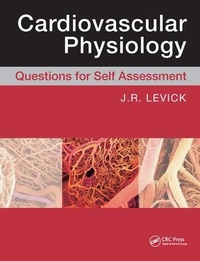
Cardiovascular Physiology: Questions for Self Assessment
1st Edition
Published on 27. July 2017
Book
Hardback
272 pages
978-1-138-45145-2 (ISBN)
Description
This book allows students to test themselves on all aspects of the cardiovascular physiology with over 230 questions and answers, at a pace to suit their learning. The questions are designed to test basic understanding, fundamental principles and medical relevance.
More details
Language
English
Place of publication
London
United Kingdom
Publishing group
Taylor & Francis Ltd
Target group
Professional and scholarly
Professional Practice & Development
Dimensions
Height: 246 mm
Width: 189 mm
Weight
660 gr
ISBN-13
978-1-138-45145-2 (9781138451452)
Copyright in bibliographic data and cover images is held by Nielsen Book Services Limited or by the publishers or by their respective licensors: all rights reserved.
Schweitzer Classification
Other editions
Additional editions
Rodney J. Levick
Cardiovascular Physiology: Questions for Self Assessment
Book
12/2009
1st Edition
Hodder Arnold
€65.87
Shipment within 10-20 days
Rodney J. Levick
Cardiovascular Physiology: Questions for Self Assessment
E-Book
12/2009
1st Edition
CRC Press
€51.49
Available for download
Rodney J. Levick
Cardiovascular Physiology: Questions for Self Assessment
E-Book
12/2009
1st Edition
Hodder Arnold
€51.49
Available for download
Person
J Rodney Levick is Professor of Physiology, St George's Hospital Medical School, University of London, UK.
Content
Introduction 1. Overview of the cardiovascular system 2. The cardiac cycle 3. Cardiac myocyte excitation and contraction 4. Initiation and nervous control of heart beat 5. Electrocardiography and arrhythmias 6. Control of stroke volume and cardiac output 7. Assessment of cardiac output and peripheral pulse 8. Haemodynamics: Flow, pressure and resistance 9. The endothelial cell 10. The microcirculation and solute exchange 11. Circulation of fluid between plasma, interstitium and lymph 12. Vascular smooth muscle: excitation, contraction and relaxation 13. Control of blood vessels: I. Intrinsic control 14. Control of blood vessels: II. Extrinsic control by nerves and hormones 15. Specialization in individual circulations 16. Cardiovascular receptors, reflexes and central control 17. Co-ordinated cardiovascular responses 18. Cardiovascular responses in pathological situations