

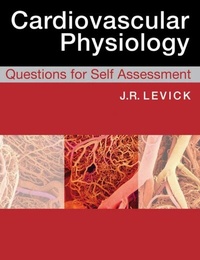
Cardiovascular Physiology: Questions for Self Assessment
1st Edition
Published on 25. December 2009
Book
Paperback/Softback
272 pages
978-0-340-98511-3 (ISBN)
Description
An Introduction to Cardiovascular Physiology provides the student with the key concepts of cardiovascular physiology, from the fundamentals of how the cardiovascular system works in both health and disease, through to a consideration of more complex physiological mechanisms. This brand new companion work Cardiovascular Physiology: Questions for Self-Assessment allows students to test themselves on all aspects of the topic with over 200 questions and answers, at a pace to suit their learning.
Questions follow An Introduction to Cardiovascular Physiology's table of contents, and the author has set at least one question on each chapter's learning objective to help the student to assess their progress against the set objectives. The questions are designed to test basic understanding, fundamental principles and medical relevance, and they avoid excessive detail. Most are in a multiple choice, True/False format, with a sprinkling of other question styles including extended matching questions, where the reader chooses the best answer from a list, and testing little numerical problems. Also included with the answers are 'More information' boxes that include a brief explanation, and links to relevant information and figures from a range of chapters, thus encouraging integration of learning across the subject.
Questions follow An Introduction to Cardiovascular Physiology's table of contents, and the author has set at least one question on each chapter's learning objective to help the student to assess their progress against the set objectives. The questions are designed to test basic understanding, fundamental principles and medical relevance, and they avoid excessive detail. Most are in a multiple choice, True/False format, with a sprinkling of other question styles including extended matching questions, where the reader chooses the best answer from a list, and testing little numerical problems. Also included with the answers are 'More information' boxes that include a brief explanation, and links to relevant information and figures from a range of chapters, thus encouraging integration of learning across the subject.
More details
Language
English
Place of publication
London
United Kingdom
Publishing group
Taylor & Francis Ltd
Target group
College/higher education
Professional and scholarly
Professional Practice & Development
Illustrations
20 s/w Abbildungen, 300 farbige Abbildungen, 20 s/w Photographien bzw. Rasterbilder, 300 farbige Zeichnungen
300 Line drawings, color; 20 Halftones, black and white; 300 Illustrations, color; 20 Illustrations, black and white
Dimensions
Height: 246 mm
Width: 189 mm
Weight
680 gr
ISBN-13
978-0-340-98511-3 (9780340985113)
Copyright in bibliographic data and cover images is held by Nielsen Book Services Limited or by the publishers or by their respective licensors: all rights reserved.
Schweitzer Classification
Other editions
Additional editions
Rodney J. Levick
Cardiovascular Physiology: Questions for Self Assessment
Book
07/2017
1st Edition
CRC Press
€223.21
Shipment within 10-20 days
Rodney J. Levick
Cardiovascular Physiology: Questions for Self Assessment
E-Book
12/2009
1st Edition
CRC Press
€51.49
Available for download
Rodney J. Levick
Cardiovascular Physiology: Questions for Self Assessment
E-Book
12/2009
1st Edition
Hodder Arnold
€51.49
Available for download
Person
J Rodney Levick is Professor of Physiology, St George's Hospital Medical School, University of London, UK
Content
Overview of the cardiovascular system. The cardiac cycle. The cardiac myocyte: excitation and contraction. Initiation and nervous control of heartbeat. Electrocardiography and arrhythmias. Control of stroke volume and cardiac output. Assessment of cardiac output and peripheral pulse. Haemodynamics: flow, pressure and resistance. The endothelial cell. The microcirculation and solute exchange. Circulation of fluid between plasma, interstitium and lymph. Vascular smooth muscle: excitation, contraction and relaxation. Control of blood vessels I. Intrinsic control. Control of blood vessels II. Extrinsic control by nerves and hormones. Specialization in individual circulations. Cardiovascular receptors, reflexes and central control. Co-ordinated cardiovascular responses. Cardiovascular responses in pathological situations.