

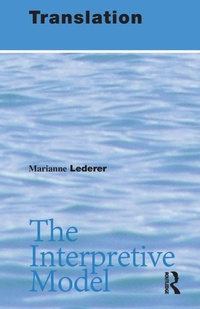
Translation
The Interpretive Model
1st Edition
Published on 31. July 2003
Book
Paperback/Softback
252 pages
978-1-900650-61-8 (ISBN)
Description
This book, the English version of La traduction aujourd'hui (Hachette 1994), describes the interpretive theory of translation developed at the Paris Ecole Superieure d'Interpretes et de Traducteurs (ESIT) over the last 35 years.
The theory identifies the mental and cognitive processes involved in both oral and written translation: understanding the text, deverbalizing its language, re-expressing sense. For the purposes of translation, languages are a means of transmitting sense, they are not to be translated as such. Although translation involves the use of correspondences, translators generally set up equivalence between text segments. The synecdochic nature of both languages and texts, a phenomenon discussed in the book, explains why translation is possible across language differences.
The many practical problems faced by translators, the difference between translation exercises used as a language teaching tool and professional translation, translating into a foreign language, and machine translation as compared to human translation are also discussed.
The theory identifies the mental and cognitive processes involved in both oral and written translation: understanding the text, deverbalizing its language, re-expressing sense. For the purposes of translation, languages are a means of transmitting sense, they are not to be translated as such. Although translation involves the use of correspondences, translators generally set up equivalence between text segments. The synecdochic nature of both languages and texts, a phenomenon discussed in the book, explains why translation is possible across language differences.
The many practical problems faced by translators, the difference between translation exercises used as a language teaching tool and professional translation, translating into a foreign language, and machine translation as compared to human translation are also discussed.
More details
Language
English
Place of publication
Manchester
United Kingdom
Product notice
Paperback (trade)
Dimensions
Height: 216 mm
Width: 140 mm
Thickness: 13 mm
Weight
297 gr
ISBN-13
978-1-900650-61-8 (9781900650618)
Copyright in bibliographic data and cover images is held by Nielsen Book Services Limited or by the publishers or by their respective licensors: all rights reserved.
Schweitzer Classification
Other editions
Additional editions
Book
08/2016
1st Edition
Routledge
€215.41
Shipment within 10-20 days
E-Book
04/2014
1st Edition
Routledge
€53.99
Available for download
E-Book
04/2014
1st Edition
Routledge
€53.99
Available for download
Persons
Marianne Lederer is Professeur Emerite at the Universite de la Sorbonne Nouvelle (Paris III). She was Head of ESIT for 10 years. Her theoretical research in the fields of oral and written translation draws on first-hand practical experience. She is also the author of La traduction simultanee - experience et theorie (Minard Lettres Modernes 1981) and co-author (with Danica Seleskovitch) of Interpreter pour traduire (Didier Erudition 1984, 4th edition 2001) and Pedagogie raisonnee de ''interpretation (Didier Erudition 1989, 2nd edition 2002; English translation by J. Harmer, A Systematic Approach to Teaching Interpretation, RID, Washington, 1995).
Content
Introduction to English Translation; Part 1 The Theoretical Aspects of Translation; Chapter 1 Translation through Interpretation; Chapter 2 Equivalence and Correspondence; Chapter 3 Language and Translation; Part 2 The Practice of Translation; Chapter 4 The Practical Problems of Translation; Chapter 5 Translation and the Teaching of Languages; Chapter 6 Translation into the Foreign Language; Chapter 7 Machine Translation versus Human Translation; S146 Afterword Cannery Row The Woman behind the Woman;