

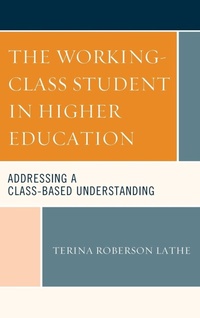
The Working-Class Student in Higher Education
Addressing a Class-Based Understanding
Published on 8. November 2017
Book
Hardback
132 pages
978-1-4985-3729-2 (ISBN)
Description
The Working-Class Student in Higher Education: Addressing a Class-Based Understanding challenges understandings of social class and education by asking how community college faculty perceive working-class students and how that perception reflects class-based assumptions in higher education. Faculty may recognize social class, but how it is experienced within higher education is often "lost in translation," particularly when faculty members are interacting with a differently classed student population. Recommended for scholars of education, pedagogy, and sociology.
Reviews / Votes
For the past 25 years, scholars have focused discussions of social class in higher education on the experiences of working-class academics and the needs of working-class students. The Working-Class Student in Higher Education offers an important shift in focus, examining how cultural assumptions about class shape the way faculty-especially the community college faculty who teach the majority of undergraduates from the working class-view and treat their students. -- Sherry Linkon, Georgetown University This is a well-referenced examination of an important topic that concludes with a list of workable recommendations for increasing completion rates among working class students attending community colleges. Four-year colleges should adopt these proposed reforms as well. If successfully implemented, the suggested changes would raise social class awareness among students, faculty, and administrators throughout higher education, a long overdue and laudable objective.? -- Kenneth W. Oldfield, University of Illinois, Springfield Terina Lathe's new book will be an important addition to the growing library of working class studies. In particular, she addresses the insights and struggles of students and faculty from community colleges, the social location that so many working-class people pass through on their trek into the unknown and unexpected cultural terrain of the professional middle class. She deftly describes the challenges both students and faculty face, in all of higher education, that are often invisible on both sides. Further, she gives us a thorough and thoughtful treatment of differing approaches to defining class in America. She is both personal and professional, she is steeped in the literature-providing an excellent review of it, and she also has her own perspective to add to the field. I strongly recommend this book. -- Barbara Jensen, University of MinnesotaMore details
Series
Language
English
Place of publication
United States
Publishing group
Bloomsbury Publishing Plc
Target group
Professional and scholarly
Dimensions
Height: 235 mm
Width: 157 mm
Thickness: 12 mm
Weight
353 gr
ISBN-13
978-1-4985-3729-2 (9781498537292)
Copyright in bibliographic data and cover images is held by Nielsen Book Services Limited or by the publishers or by their respective licensors: all rights reserved.
Schweitzer Classification
Other editions
Additional editions
Terina Roberson Lathe
The Working-Class Student in Higher Education
Addressing a Class-Based Understanding
E-Book
11/2017
1st Edition
Lexington Books
€90.99
Available for download
Terina Roberson Lathe
The Working-Class Student in Higher Education
Addressing a Class-Based Understanding
E-Book
11/2017
1st Edition
Lexington Books
€90.99
Available for download
Person
Terina Roberson Lathe is professor of sociology at Central Piedmont Community College.
Content
Contents
Introduction
Chapter 1: Framing a "Working-Class" Definition
Chapter 2: Framing a Working-Class Experience in Education
Chapter 3: Working-Class Students as Understood by Faculty
Chapter 4: Working-Class Students as (mis)Understood by Faculty
Chapter 5: Lost in Translation
Chapter 6: Going Forth
References
About the Author
Introduction
Chapter 1: Framing a "Working-Class" Definition
Chapter 2: Framing a Working-Class Experience in Education
Chapter 3: Working-Class Students as Understood by Faculty
Chapter 4: Working-Class Students as (mis)Understood by Faculty
Chapter 5: Lost in Translation
Chapter 6: Going Forth
References
About the Author