

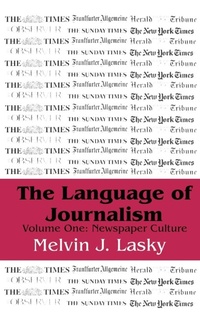
The Language of Journalism
Volume 1, Newspaper Culture
1st Edition
Published on 30. September 2000
Book
Hardback
498 pages
978-0-7658-0001-5 (ISBN)
Description
The newspaper is to the twentieth century what the novel was for the nineteenth century: the expression of popular sentiment. In the first of a three-volume study of journalism and what it has meant as a source of knowledge and as a mechanism for orchestrating mass ideology, Melvin J. Lasky provides a major overview. His research runs the gamut of material found in newspapers, from the trivial to the profound, from pseudo-science to habits of solid investigation.
The volume is divided into four parts. The first attacks deficiencies in grammar and syntax with examples from newspapers and magazines drawn from the German as well as English-language press. The second examines the key issues of journalism: accuracy and authenticity. Lasky provides an especially acute account of differences between active literacy and passive viewing, or the relationship of word and picture in defining authenticity.
The third part emphasizes the problem of bias in everything from racial reporting to cultural correctness. This is the first systematic attempt to study racial nomenclature, identity-labeling, and literary discrimination. Lasky follows closely the model set by George Orwell a half century earlier. The final section of the work covers the competition between popular media and the redefinition of pornography and its language. The volume closes with an examination of how the popular culture both influenced and was influential upon literary titans like Hemingway, Lawrence, and Tynan.
The volume is divided into four parts. The first attacks deficiencies in grammar and syntax with examples from newspapers and magazines drawn from the German as well as English-language press. The second examines the key issues of journalism: accuracy and authenticity. Lasky provides an especially acute account of differences between active literacy and passive viewing, or the relationship of word and picture in defining authenticity.
The third part emphasizes the problem of bias in everything from racial reporting to cultural correctness. This is the first systematic attempt to study racial nomenclature, identity-labeling, and literary discrimination. Lasky follows closely the model set by George Orwell a half century earlier. The final section of the work covers the competition between popular media and the redefinition of pornography and its language. The volume closes with an examination of how the popular culture both influenced and was influential upon literary titans like Hemingway, Lawrence, and Tynan.
More details
Language
English
Place of publication
Somerset
United Kingdom
Publishing group
Taylor & Francis Inc
Target group
College/higher education
Professional and scholarly
Product notice
sewn/stitched
Cloth over boards
Dimensions
Height: 236 mm
Width: 161 mm
Thickness: 31 mm
Weight
857 gr
ISBN-13
978-0-7658-0001-5 (9780765800015)
Copyright in bibliographic data and cover images is held by Nielsen Book Services Limited or by the publishers or by their respective licensors: all rights reserved.
Schweitzer Classification
Other editions
Additional editions
E-Book
04/2018
1st Edition
Routledge
€60.49
Available for download
E-Book
04/2018
Routledge
€60.49
Available for download
Book
04/2018
1st Edition
Routledge
€69.50
Shipment within 10-20 days
Person
Melvin J. Lasky
Content
1: A Question of Style; 1: Words Win, Language Loses; 2: The Equality of Sentences; 3: The Slang of an In-Lingo; 4: Sort of Suspicious, Kind of Guilty; 5: Of Plastic Prose, in Bits and Pieces; 6: Life-Style Crosses the Ocean and Returns; 7: Teutonics, or Refighting World War II; 2: The Art of Quotation; 8: The Little Goose Feet; 9: Television and Press "War"; 10: Mailer's Tales of Oswald; 11: Citations Sown; 12: Words, Words, Words...; 13: The Strategy of Misquotation; 14: The Interviewer and the Interviewee; 3: The Quest for Meaning; 15: Race and the Color of Things; 16: The N-Word and the J-Word; 17: The Art of Punditry; 18: In the Pseuds' Corner; 19: Pop Kulcher; 20: The Art of Explanation; 21: Keeping Up with the Avant-Garde; 22: Hard Words and Generation Gaps; 4: The F-word and Other Obscenities; 23: Skirmishes in the Sex War; 24: World War II, Fifty Years After; 25: A Trio of As*ter*isk*s; 26: Gender in the Combat Zone; 27: Remembering the Founding Fathers