

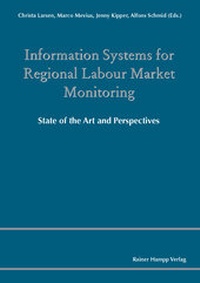
Information Systems for Regional Labour Market Monitoring
State of the Art and Perspectives
1st Edition
Published on 1. September 2009
Book
Paperback/Softback
224 pages
978-3-86618-409-1 (ISBN)
Description
Regional labour market monitoring based on web-based labour market information systems is becoming increasingly more common. This anthology shows the variety of such systems as implemented in various European countries. Two general types can be distinguished. The first are regionally-based information tools and secondly, national systems with regional sub-divisions. In addition, these show what information and communication technologies make possible, but they also give the first indications of where these technologies have their limits. This volume should trigger a wider discussion in this field.
This book was developed by several members of the European Network of Regional Labour Market Monitoring.
This book was developed by several members of the European Network of Regional Labour Market Monitoring.
More details
Other editions
Additional editions
Christa Larsen | Marco Mevius | Jenny Kipper
Information Systems for Regional Labour Market Monitoring
State of the Art and Perspectives
E-Book
11/2009
1st Edition
Edition Rainer Hampp
€24.99
Available for download
Persons
Dr. Christa Larsen is a social scientist and Managing Director at the Institute for Economics, Labour and Culture in Frankfurt am Main. Her current work concentrates on regional labour market monitoring, regionalised analyses of labour markets for health workers, systems for information and diagnoses of labour markets and regional prognoses.
Dr. Marco Mevius is an expert for the management and implementation of large IT projects, designing new business processes and corresponding information in multidisciplinary environments. Currently he is Head of the division for Software Engineering (SE) and member of the Management Board at the Research Center for Information Technology (FZI) in Karlsruhe.
Jenny Kipper is a pedagogue and Scientist at the Institute for Economics, Labour and Culture (IWAK) in
Frankfurt am Main. Her current activities are focussed on process of organisational learning, organisational development, and development of quality.
Dr. Alfons Schmid is Professor for Economics at the faculty of Social Sciences and Scientific Director of the Institute for Economics, Labour, and Culture (IWAK) at the Goethe-University in Frankfurt am Main (Germany). His main areas of research are regional developments of employment and labour market, new information technology and impacts on employment situation, regional competitiveness, attitudes towards welfare states, regional forecasting and regional studies in poverty and wealth.
Dr. Marco Mevius is an expert for the management and implementation of large IT projects, designing new business processes and corresponding information in multidisciplinary environments. Currently he is Head of the division for Software Engineering (SE) and member of the Management Board at the Research Center for Information Technology (FZI) in Karlsruhe.
Jenny Kipper is a pedagogue and Scientist at the Institute for Economics, Labour and Culture (IWAK) in
Frankfurt am Main. Her current activities are focussed on process of organisational learning, organisational development, and development of quality.
Dr. Alfons Schmid is Professor for Economics at the faculty of Social Sciences and Scientific Director of the Institute for Economics, Labour, and Culture (IWAK) at the Goethe-University in Frankfurt am Main (Germany). His main areas of research are regional developments of employment and labour market, new information technology and impacts on employment situation, regional competitiveness, attitudes towards welfare states, regional forecasting and regional studies in poverty and wealth.