

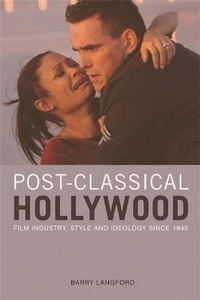
Post-Classical Hollywood
Film Industry, Style and Ideology since 1945
Published on 4. August 2010
Book
Hardback
320 pages
978-0-7486-3857-4 (ISBN)
Description
At the end of World War II, Hollywood basked in unprecedented prosperity. Since then, numerous challenges and crises have changed the American film industry in ways beyond imagination in 1945. Nonetheless, at the start of a new century Hollywood's worldwide dominance is intact - indeed, in today's global economy the products of the American entertainment industry (of which movies are now only one part) are more ubiquitous than ever.How does today's 'Hollywood' - absorbed into transnational media conglomerates like NewsCorp., Sony, and Viacom - differ from the legendary studios of Hollywood's Golden Age? What are the dominant frameworks and conventions, the historical contexts and the governing attitudes through which films are made, marketed and consumed today? How have these changed across the last seven decades? And how have these evolving contexts helped shape the form, the style and the content of Hollywood movies, from Singin' in the Rain to Pirates of the Caribbean?Barry Langford explains and interrogates the concept of 'post-classical' Hollywood cinema - its coherence, its historical justification and how it can help or hinder our understanding of Hollywood from the forties to the present. Integrating film history, discussion of movies' social and political dimensions, and analysis of Hollywood's distinctive methods of storytelling, Post-Classical Hollywood charts key critical debates alongside the histories they interpret, while offering its own account of the 'post-classical'. Wide-ranging yet concise, challenging and insightful, Post-Classical Hollywood offers a new perspective on the most enduringly fascinating artform of our age.
Reviews / Votes
The book's strengths are real strengths: a good deal of original research, smart writing, and interpretative originality that increases as the book progresses. Highly recommended -- S. C. Dillon, Bates College * Choice * The book's strengths are real strengths: a good deal of original research, smart writing, and interpretative originality that increases as the book progresses. Highly recommended. -- S. C. Dillon, Bates College * Choice * Langford's study is both comprehensive and detailed, always keeping the different levels of analysis distinct, while allowing them to inform each other and broaden our understanding of the permutations of Hollywood after 1945. -- Steen Christiansen, Aalborg University, Denmark * SCOPE: An Online Journal of Film Studies *More details
Language
English
Place of publication
Edinburgh
United Kingdom
Target group
College/higher education
Product notice
sewn/stitched
Cloth over boards
Dimensions
Height: 234 mm
Width: 156 mm
Thickness: 25 mm
Weight
599 gr
ISBN-13
978-0-7486-3857-4 (9780748638574)
Copyright in bibliographic data and cover images is held by Nielsen Book Services Limited or by the publishers or by their respective licensors: all rights reserved.
Schweitzer Classification
Other editions
Additional editions
E-Book
08/2010
Edinburgh University Press
€0.00
Available for download
Person
Barry Langford is Senior Lecturer in Film and Television Studies at Royal Holloway, University of London. He is the author of Film Genre: Hollywood and Beyond (Edinburgh University Press, 2005) and Teaching Holocaust Literature and Film (with Robert Eaglestone, Palgrave Macmillan 2007), and has published on a wide variety of subjects in film and media studies and critical theory, including Holocaust film, Chris Marker's politics, revisionist Westerns, exilic identity in European city films, narrative temporalities in The Lord of the Rings, and British television situation comedy. His original short screenplay Torte Bluma was filmed in 2005 and premiered at the Edinburgh Film Festival, going on to win awards at international festivals.
Content
Introduction; Part I: Hollywood in Transition 1946-1965; Introduction; 1, The Autumn of the Patriarchs; 2, The Communication of Ideas; 3, Modernising Hollywood; Part II: Crisis and Renaissance 1966-1981; Introduction; 4, Changing of the Guard; 5, New Wave Hollywood; 6, Who Lost the Picture Show?; Part III: New Hollywood 1982-2006; Introduction; 7, Corporate Hollywood; 8, Culture Wars; 9, Post-Classical Style?; Conclusion: "Hollywood" Now; Further Reading The Biggest, The Best - case studies; 1946: The Best Years of Our Lives; 1955: Marty, Cinerama Holiday; 1965: The Sound of Music; 1975: One Flew Over the Cuckoo's Nest, Jaws; 1985: Out of Africa, Back to the Future; 1995: Braveheart, Toy Story; 2005: Crash, Star Wars Episode III: Revenge of the Sith