

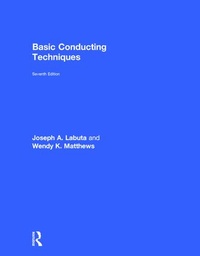
Basic Conducting Techniques
7th Edition
Published on 8. August 2017
Book
Hardback
290 pages
978-1-138-65699-4 (ISBN)
Description
Basic Conducting Techniques, Seventh Edition, provides a clear and intelligible introduction to the art of conducting an ensemble. Over the course of fourteen chapters, the authors explicate the elements of conducting, supplementing their teachings with an extensive selection of musical examples from the classical repertoire. Practical and innovative, clear and approachable, this text illuminates the essential skills a beginning conductor should develop to lead and rehearse a performing group.
This new edition features:
chapters rewritten to highlight important information and show connections between different sections
a new chapter on expressive conducting, consisting of expanded and updated content
select full scores in the "Musical Excerpts" section
excerpts with transpositions for each chapter, allowing easy access for class performance
a new companion website, which includes the scores and transpositions for all musical excerpts, audio recordings of the excerpts, and demonstration videos modeling specific techniques for each chapter.
With the beginning conductor in mind, this hands-on, competency-centered approach is appropriate for mixed classes of choral and instrumental music majors, providing indispensable versatility for students and practicing conductors alike. Rooted in decades of teaching and conducting experience, Basic Conducting Techniques is the essential guide to the principles of conducting.
This new edition features:
chapters rewritten to highlight important information and show connections between different sections
a new chapter on expressive conducting, consisting of expanded and updated content
select full scores in the "Musical Excerpts" section
excerpts with transpositions for each chapter, allowing easy access for class performance
a new companion website, which includes the scores and transpositions for all musical excerpts, audio recordings of the excerpts, and demonstration videos modeling specific techniques for each chapter.
With the beginning conductor in mind, this hands-on, competency-centered approach is appropriate for mixed classes of choral and instrumental music majors, providing indispensable versatility for students and practicing conductors alike. Rooted in decades of teaching and conducting experience, Basic Conducting Techniques is the essential guide to the principles of conducting.
More details
Edition
7th edition
Language
English
Place of publication
London
United Kingdom
Publishing group
Taylor & Francis Ltd
Target group
College/higher education
Illustrations
27 s/w Tabellen
27 Tables, black and white
Dimensions
Height: 280 mm
Width: 210 mm
Weight
952 gr
ISBN-13
978-1-138-65699-4 (9781138656994)
Copyright in bibliographic data and cover images is held by Nielsen Book Services Limited or by the publishers or by their respective licensors: all rights reserved.
Schweitzer Classification
Other editions
New editions
Joseph A. Labuta | Wendy Matthews
Basic Conducting Techniques
Book
01/2023
8th Edition
Routledge
€260.41
Shipment within 10-20 days
Additional editions
Joseph A. Labuta | Wendy Matthews
Basic Conducting Techniques
Book
08/2017
7th Edition
Routledge
€178.56
Article exhausted; check for reprint
Persons
Joseph A. Labuta is Professor Emeritus of Music and former Director of Music Education at Wayne State University.
Wendy K. Matthews is Assistant Professor of Music and Instrumental Music Education at Wayne State University.
Wendy K. Matthews is Assistant Professor of Music and Instrumental Music Education at Wayne State University.
Content
PART I: CONDUCTING TECHNIQUE
Chapter 1: The Baton, Preparation, Downbeat, and Release
Chapter 2: Beat Patterns and Preparations in Tempo, Dynamic, and Basic Style
Chapter 3: Preparations and Releases for All Counts
Chapter 4: Fractional Beat Preparations
Chapter 5: Divided Meters
Chapter 6: Asymmetrical and Changing Meters
Chapter 7: The Fermata
Chapter 8: The Cue
Chapter 9: Conducting Musical Styles
Chapter 10: Expressive Conducting and the Left Hand
Chapter 11: Tempo Changes and Accompanying
PART II: SCORE PREPARATION AND REHEARSAL TECHNIQUE
Chapter 12: Analysis and Score Preparation
Chapter 13: The Instrumental Rehearsal
Chapter 14: The Choral Rehearsal
PART III: MUSICAL EXCERPTS
Chapter 1: The Baton, Preparation, Downbeat, and Release
Chapter 2: Beat Patterns and Preparations in Tempo, Dynamic, and Basic Style
Chapter 3: Preparations and Releases for All Counts
Chapter 4: Fractional Beat Preparations
Chapter 5: Divided Meters
Chapter 6: Asymmetrical and Changing Meters
Chapter 7: The Fermata
Chapter 8: The Cue
Chapter 9: Conducting Musical Styles
Chapter 10: Expressive Conducting and the Left Hand
Chapter 11: Tempo Changes and Accompanying
Chapter 12: Analysis and Score Preparation
Technical Mastery
Appendix A: Competencies for the Beginning Conducting Class
Appendix B: Student Evaluation
Appendix C: Chart of Transpositions and Clefs
Appendix D: Full Score Instrumentation and Foreign Equivalents
Appendix E: Counting Drills for Uneven Meters
Appendix F: Musical Style Chart
Appendix G: Glossary
Appendix H: Model Video Excerpt Chart
Chapter 1: The Baton, Preparation, Downbeat, and Release
Chapter 2: Beat Patterns and Preparations in Tempo, Dynamic, and Basic Style
Chapter 3: Preparations and Releases for All Counts
Chapter 4: Fractional Beat Preparations
Chapter 5: Divided Meters
Chapter 6: Asymmetrical and Changing Meters
Chapter 7: The Fermata
Chapter 8: The Cue
Chapter 9: Conducting Musical Styles
Chapter 10: Expressive Conducting and the Left Hand
Chapter 11: Tempo Changes and Accompanying
PART II: SCORE PREPARATION AND REHEARSAL TECHNIQUE
Chapter 12: Analysis and Score Preparation
Chapter 13: The Instrumental Rehearsal
Chapter 14: The Choral Rehearsal
PART III: MUSICAL EXCERPTS
Chapter 1: The Baton, Preparation, Downbeat, and Release
Chapter 2: Beat Patterns and Preparations in Tempo, Dynamic, and Basic Style
Chapter 3: Preparations and Releases for All Counts
Chapter 4: Fractional Beat Preparations
Chapter 5: Divided Meters
Chapter 6: Asymmetrical and Changing Meters
Chapter 7: The Fermata
Chapter 8: The Cue
Chapter 9: Conducting Musical Styles
Chapter 10: Expressive Conducting and the Left Hand
Chapter 11: Tempo Changes and Accompanying
Chapter 12: Analysis and Score Preparation
Technical Mastery
Appendix A: Competencies for the Beginning Conducting Class
Appendix B: Student Evaluation
Appendix C: Chart of Transpositions and Clefs
Appendix D: Full Score Instrumentation and Foreign Equivalents
Appendix E: Counting Drills for Uneven Meters
Appendix F: Musical Style Chart
Appendix G: Glossary
Appendix H: Model Video Excerpt Chart