

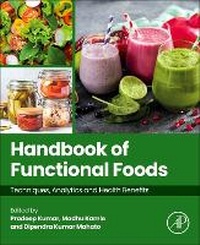
Handbook of Functional Foods
Techniques, Analytics and Health Benefits
Will be published approx. on 2. February 2026
Book
Paperback/Softback
498 pages
978-0-443-33853-3 (ISBN)
Description
Handbook of Functional Foods: Techniques, Analytics and Health Benefits provides a comprehensive overview of the extraction and analytical identification techniques of foods' bioactive components for health and well-being while looking at metabolism, sensory, and safety components. This book reviews, in detail, how functional foods have the potential to drive innovation in the food industry, creating a broad range of healthier and more personalized food options. From emerging extraction and extrusion techniques for the creation of fiber-rich snacks to the synergistic effects of pro- and prebiotics on gut health, readers will come away with an advanced and fresh understanding of necessary insights.
More details
Language
English
Place of publication
San Diego
United States
Publishing group
Elsevier Science Publishing Co Inc
Target group
Professional and scholarly
Dimensions
Height: 276 mm
Width: 216 mm
Weight
1230 gr
ISBN-13
978-0-443-33853-3 (9780443338533)
Copyright in bibliographic data and cover images is held by Nielsen Book Services Limited or by the publishers or by their respective licensors: all rights reserved.
Schweitzer Classification
Other editions
Additional editions

Pradeep Kumar | Madhu Kamle | Dipendra Kumar Mahato
Handbook of Functional Foods
Techniques, Analytics and Health Benefits
E-Book
02/2026
Elsevier
€139.99
Available for download
Persons
Pradeep Kumar, PhD, works as an Associate Professor at the Department of Botany, University of Lucknow, Lucknow, India. Prior to that, he served as an Assistant Professor at NERIST, India, and Assistant Professor at the Department of Biotechnology, Yeungnam University, South Korea. He was awarded a PBC Outstanding Postdoctoral Fellowship to work for more than three years as a postdoctoral researcher at the Department of Biotechnology Engineering, Ben Gurion University of the Negev, Israel. Dr. Kumar's research interests are in applied microbiology, biocontrol, nanotechnology, phytochemistry and Food sciences. He has published more than 90 research and review articles in peer-reviewed journals, 30 international book chapters, and nine edited books with more than 7000 citations. He was awarded an Early Career Research Award (2017) from the SERB, Government of India, and he is currently handling five projects as principal or co-principal investigator, funded by government agencies.
Dr. Madhu Kamle, PhD is currently working as an assistant professor at the Department of Forestry, North Eastern Regional Institute of Science & Technology, Nirjuli, Arunachal Pradesh, India. Her research interests are in plant biotechnology, plant-microbe interactions, microbial genomics, and plant disease diagnosis. She earned her PhD in plant biotechnology from ICARCISH, India, and Bundelkhand University, Jhansi, India. She has been awarded the prestigious PBC Outstanding Postdoctoral Fellowship and a postdoctoral fellowship from the Jacob Blaustein Institute of Desert Research, Ben Gurion University, Israel. She also worked as an international research professor at the School of Biotechnology, Yeungnam University, Gyeongsan, Republic of Korea. Dr. Kamle has ten years of research experience and has published more than 52 research and review articles in peer-reviewed journals, 20 international book chapters, and 4 edited books with more than 3368 citations.
Dr. Dipendra Kumar Mahato completed PhD in Food Science and Technology from Deakin University, Australia. He has a Master degree in Food Science and Technology and a Bachelor degree in Biotechnology. He has been awarded Gold Medal for academic excellence. Before his PhD, Dipendra had worked as Editorial Assistant at Aptara. corp, publication house. He also had an industrial experience with Panacea Biotec. Later, he worked in different research projects at renowned IARI, New-Delhi and IIT, Kharagpur. He was awarded a prestigious Deakin University Postgraduate Research Scholarship (DUPRS), Australia to pursue his PhD in Food and Nutrition. His research area includes food science, new product development, Sensory science, microbiology, biotechnology and innovation in product development in relation to consumer perception, health and wellbeing. He has published more than 50 research and review articles in peer-reviewed journals and 26 book chapters and one edited book with a total of 3005 citations.
Dr. Madhu Kamle, PhD is currently working as an assistant professor at the Department of Forestry, North Eastern Regional Institute of Science & Technology, Nirjuli, Arunachal Pradesh, India. Her research interests are in plant biotechnology, plant-microbe interactions, microbial genomics, and plant disease diagnosis. She earned her PhD in plant biotechnology from ICARCISH, India, and Bundelkhand University, Jhansi, India. She has been awarded the prestigious PBC Outstanding Postdoctoral Fellowship and a postdoctoral fellowship from the Jacob Blaustein Institute of Desert Research, Ben Gurion University, Israel. She also worked as an international research professor at the School of Biotechnology, Yeungnam University, Gyeongsan, Republic of Korea. Dr. Kamle has ten years of research experience and has published more than 52 research and review articles in peer-reviewed journals, 20 international book chapters, and 4 edited books with more than 3368 citations.
Dr. Dipendra Kumar Mahato completed PhD in Food Science and Technology from Deakin University, Australia. He has a Master degree in Food Science and Technology and a Bachelor degree in Biotechnology. He has been awarded Gold Medal for academic excellence. Before his PhD, Dipendra had worked as Editorial Assistant at Aptara. corp, publication house. He also had an industrial experience with Panacea Biotec. Later, he worked in different research projects at renowned IARI, New-Delhi and IIT, Kharagpur. He was awarded a prestigious Deakin University Postgraduate Research Scholarship (DUPRS), Australia to pursue his PhD in Food and Nutrition. His research area includes food science, new product development, Sensory science, microbiology, biotechnology and innovation in product development in relation to consumer perception, health and wellbeing. He has published more than 50 research and review articles in peer-reviewed journals and 26 book chapters and one edited book with a total of 3005 citations.
Content
Part 1: Techniques and Developments
1. Introduction: Definition and Basics of Functional Foods
2. Extraction Techniques for Developing Functional Foods
3. Analytical Techniques for Identifying Functional or Bioactive Compounds for Functional Foods
4. Emulsion Technology for Functional Food Development
5. Microencapsulation and Nanoencapsulation for Functional Foods Development
6. Extrusion Techniques for Functional Foods Development
7. Nanotechnology for Functional Foods Development
Part 2: Functional Foods: Sources and Ingredients
8. Fermented Functional Foods of India: Ancient Flavors and Modern Benefits
9. Probiotic, Prebiotic, and Synbiotic as Functional Foods
10. Antioxidant and Omega-3 Fatty Acid -Rich Functional Foods
11. Insects and other animal sources as functional food
12. Plant-Based Dairy Alternatives as Functional Foods
13. Plant-Based Meat Alternatives as Functional Foods
14. Millet-Based Functional Foods
15. Macroalgae (Seaweed) Based Bioactive Compounds with Health Benefits for Functional Foods Development
Part 3: Nutrition and Health
16. Nutraceuticals as Functional Foods
17. Bioaccessibility, bioavailability and metabolism of functional foods
Part 4: Impact and Future
18. Health Benefit of Functional Foods
19. Functional Foods as Sustainable Foods: Challenges and Opportunities
1. Introduction: Definition and Basics of Functional Foods
2. Extraction Techniques for Developing Functional Foods
3. Analytical Techniques for Identifying Functional or Bioactive Compounds for Functional Foods
4. Emulsion Technology for Functional Food Development
5. Microencapsulation and Nanoencapsulation for Functional Foods Development
6. Extrusion Techniques for Functional Foods Development
7. Nanotechnology for Functional Foods Development
Part 2: Functional Foods: Sources and Ingredients
8. Fermented Functional Foods of India: Ancient Flavors and Modern Benefits
9. Probiotic, Prebiotic, and Synbiotic as Functional Foods
10. Antioxidant and Omega-3 Fatty Acid -Rich Functional Foods
11. Insects and other animal sources as functional food
12. Plant-Based Dairy Alternatives as Functional Foods
13. Plant-Based Meat Alternatives as Functional Foods
14. Millet-Based Functional Foods
15. Macroalgae (Seaweed) Based Bioactive Compounds with Health Benefits for Functional Foods Development
Part 3: Nutrition and Health
16. Nutraceuticals as Functional Foods
17. Bioaccessibility, bioavailability and metabolism of functional foods
Part 4: Impact and Future
18. Health Benefit of Functional Foods
19. Functional Foods as Sustainable Foods: Challenges and Opportunities