

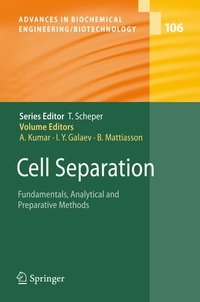
Cell Separation
Fundamentals, Analytical and Preparative Methods
Published on 19. November 2010
Book
Paperback/Softback
XIII, 203 pages
978-3-642-09454-5 (ISBN)
Description
Cell separation, which was once limited to merely being a basic technique for fractionating different cell populations, has come a long way in the last two decades. New, advanced and more speci?c and selective techniques have emerged as the demand for isolating a speci?c cell type for various biological applications has increased. Ef?cient and cost-effective techniques for fr- tionation and isolation of target cell types are necessary to provide pure cell populations for diagnostics, biotechnological and biomedical applications. One can see a considerable need, both in biomedical research and in di- nostic medicine, for the speci?c separation of a discrete population of cells from a mixture. For example, in the ?eld of tissue engineering, isolation of stemcellsfromtissuesororgansisofparticularlygreatimportance.Moreover, understanding cell developmental pathways becomes increasingly signi?cant as diagnosis and treatment of diseases turns more to the molecular level. The diagnosis of cell-related diseases requires methods of detection, isolation and theanalysisofindividualcells,regardlessoftheirrelativecontentinthetissue.
Since cell-based therapies now turn towards more realistic medical options, developing an effective separation system for large-scale cell separation has becomechallengingresearchgoalforcellbiologistsandbiotechnologists.The ideal technique should provide in a short time a good yield of cells with high puritywhile maintaining cellfunction.Despite the growingneed formethods to separate cells into cell subpopulations, the existing cell-separation te- niques stillhave somelimitations when the desired degree ofperformance on apreparativescaleisrequired.Wewillseemoreresearchfocusinthisdirection in the future. The traditional techniques of micro?ltration, ultra?ltration and ultrac- trifugation, which exploit differences in cell size, shape and density, have remainedtheworkhorsesdespitelowspeci?cityandproblemswithscalingup.
Since cell-based therapies now turn towards more realistic medical options, developing an effective separation system for large-scale cell separation has becomechallengingresearchgoalforcellbiologistsandbiotechnologists.The ideal technique should provide in a short time a good yield of cells with high puritywhile maintaining cellfunction.Despite the growingneed formethods to separate cells into cell subpopulations, the existing cell-separation te- niques stillhave somelimitations when the desired degree ofperformance on apreparativescaleisrequired.Wewillseemoreresearchfocusinthisdirection in the future. The traditional techniques of micro?ltration, ultra?ltration and ultrac- trifugation, which exploit differences in cell size, shape and density, have remainedtheworkhorsesdespitelowspeci?cityandproblemswithscalingup.
More details
Series
Edition
Softcover reprint of hardcover 1st ed. 2007
Language
English
Place of publication
Berlin
Germany
Publishing group
Springer Berlin
Target group
Professional and scholarly
Research
Illustrations
XIII, 203 p.
Dimensions
Height: 235 mm
Width: 155 mm
Thickness: 13 mm
Weight
341 gr
ISBN-13
978-3-642-09454-5 (9783642094545)
DOI
10.1007/978-3-540-75263-9
Schweitzer Classification
Other editions
Additional editions
Ashok Kumar | Igor Yu Galaev | Bo Mattiasson
Cell Separation
Fundamentals, Analytical and Preparative Methods
Book
11/2007
Springer
€213.99
Shipment within 10-15 days
Content
Methods in Cell Separations.- Flow Cytometry and Cell Sorting.- Cell Isolation and Expansion Using Dynabeads ®.- Affinity Adsorption of Cells to Surfaces and Strategies for Cell Detachment.- Chromatography of Living Cells Using Supermacroporous Hydrogels, Cryogels.- Hollow-Fibre Affinity Cell Separation.- Cell Partitioning in Aqueous Two-Phase Polymer Systems.- Development of Separation Technique for Stem Cells.