

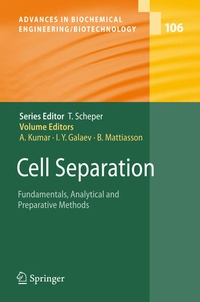
Cell Separation
Fundamentals, Analytical and Preparative Methods
Published on 8. November 2007
Book
Hardback
XIII, 203 pages
978-3-540-75262-2 (ISBN)
Description
Cell separation, which was once limited to merely being a basic technique for fractionating different cell populations, has come a long way in the last two decades. New, advanced and more speci?c and selective techniques have emerged as the demand for isolating a speci?c cell type for various biological applications has increased. Ef?cient and cost-effective techniques for fr- tionation and isolation of target cell types are necessary to provide pure cell populations for diagnostics, biotechnological and biomedical applications. One can see a considerable need, both in biomedical research and in di- nostic medicine, for the speci?c separation of a discrete population of cells from a mixture. For example, in the ?eld of tissue engineering, isolation of stemcellsfromtissuesororgansisofparticularlygreatimportance.Moreover, understanding cell developmental pathways becomes increasingly signi?cant as diagnosis and treatment of diseases turns more to the molecular level. The diagnosis of cell-related diseases requires methods of detection, isolation and theanalysisofindividualcells,regardlessoftheirrelativecontentinthetissue.
Since cell-based therapies now turn towards more realistic medical options, developing an effective separation system for large-scale cell separation has becomechallengingresearchgoalforcellbiologistsandbiotechnologists.The ideal technique should provide in a short time a good yield of cells with high puritywhile maintaining cellfunction.Despite the growingneed formethods to separate cells into cell subpopulations, the existing cell-separation te- niques stillhave somelimitations when the desired degree ofperformance on apreparativescaleisrequired.Wewillseemoreresearchfocusinthisdirection in the future. The traditional techniques of micro?ltration, ultra?ltration and ultrac- trifugation, which exploit differences in cell size, shape and density, have remainedtheworkhorsesdespitelowspeci?cityandproblemswithscalingup.
Since cell-based therapies now turn towards more realistic medical options, developing an effective separation system for large-scale cell separation has becomechallengingresearchgoalforcellbiologistsandbiotechnologists.The ideal technique should provide in a short time a good yield of cells with high puritywhile maintaining cellfunction.Despite the growingneed formethods to separate cells into cell subpopulations, the existing cell-separation te- niques stillhave somelimitations when the desired degree ofperformance on apreparativescaleisrequired.Wewillseemoreresearchfocusinthisdirection in the future. The traditional techniques of micro?ltration, ultra?ltration and ultrac- trifugation, which exploit differences in cell size, shape and density, have remainedtheworkhorsesdespitelowspeci?cityandproblemswithscalingup.
More details
Series
Edition
2007 ed.
Language
English
Place of publication
Berlin
Germany
Publishing group
Springer Berlin
Target group
Professional and scholarly
Research
Illustrations
XIII, 203 p.
Dimensions
Height: 241 mm
Width: 160 mm
Thickness: 18 mm
Weight
500 gr
ISBN-13
978-3-540-75262-2 (9783540752622)
DOI
10.1007/978-3-540-75263-9
Schweitzer Classification
Other editions
Additional editions
Ashok Kumar | Igor Yu Galaev | Bo Mattiasson
Cell Separation
Fundamentals, Analytical and Preparative Methods
Book
11/2010
Springer
€213.99
Shipment within 7-9 days
Ashok Kumar | Igor Yu Galaev | Bo Mattiasson
Cell Separation
Fundamentals, Analytical and Preparative Methods
E-Book
10/2007
Springer
€213.99
Available for download
Content
Methods in Cell Separations.- Flow Cytometry and Cell Sorting.- Cell Isolation and Expansion Using Dynabeads ®.- Affinity Adsorption of Cells to Surfaces and Strategies for Cell Detachment.- Chromatography of Living Cells Using Supermacroporous Hydrogels, Cryogels.- Hollow-Fibre Affinity Cell Separation.- Cell Partitioning in Aqueous Two-Phase Polymer Systems.- Development of Separation Technique for Stem Cells.