


German #MeToo
Rape Cultures and Resistance, 1770-2020
Published on 19. July 2022
Book
Hardback
422 pages
978-1-64014-135-3 (ISBN)
Description
This volume of new essays represents a collective, academic, and activist effort to interpret German literature and culture in the context of the international #MeToo movement, illustrating and interrogating the ways that "rape cultures" persist.
Responding to the worldwide impact of the #MeToo movement, this volume investigates not only the ubiquity of sexual abuse and sexual violence but also the transhistorical and transnational failure to hold perpetrators accountable. From a range of disciplines, the collected essays engage current cultural and political discourses about systemic sexism, feminist theory and practice, and gender-based discrimination from an academic and activist perspective. The focus on national cultures of German-speaking Europe from the mid-eighteenth century to the present captures the persistence of normalized and institutionalized sexism, reframed through the lens of a contemporary political and social movement.
German #MeToo argues that sexual violence is not a universal human constant. Rather, it is nurtured and sustained by the social, political, cultural, legal, and economic fabric of specific societies. The authors sustain and vary their exploration of #MeToo-related issues through considerations of rape, prostitution, sexual murder, the politics of consent, and victim-blaming as enacted in literary works by canonical and marginalized authors, the visual arts, the graphic novel, film, television, and theater. The analysis of rape myths - of discourses and practices in German history and culture that subtend and indemnify sexual violence - is a central subject of this edited volume. Throughout, German #MeToo challenges narratives of sex-based discrimination while emphasizing the strategies of resistance and the importance of telling one's own story.
Responding to the worldwide impact of the #MeToo movement, this volume investigates not only the ubiquity of sexual abuse and sexual violence but also the transhistorical and transnational failure to hold perpetrators accountable. From a range of disciplines, the collected essays engage current cultural and political discourses about systemic sexism, feminist theory and practice, and gender-based discrimination from an academic and activist perspective. The focus on national cultures of German-speaking Europe from the mid-eighteenth century to the present captures the persistence of normalized and institutionalized sexism, reframed through the lens of a contemporary political and social movement.
German #MeToo argues that sexual violence is not a universal human constant. Rather, it is nurtured and sustained by the social, political, cultural, legal, and economic fabric of specific societies. The authors sustain and vary their exploration of #MeToo-related issues through considerations of rape, prostitution, sexual murder, the politics of consent, and victim-blaming as enacted in literary works by canonical and marginalized authors, the visual arts, the graphic novel, film, television, and theater. The analysis of rape myths - of discourses and practices in German history and culture that subtend and indemnify sexual violence - is a central subject of this edited volume. Throughout, German #MeToo challenges narratives of sex-based discrimination while emphasizing the strategies of resistance and the importance of telling one's own story.
Reviews / Votes
German #MeToo provides an impressive range of scholarship that echoes a formidable social movement's impact. We all see things differently in its wake, and the volume's essays arm themselves with knowledge that can no longer be unseen or unheard. * GERMAN QUARTERLY * Die in diesem Band versammelten Analysen machen deutlich, welche aufklaerende Funktion historisch argumentierende Kultur- und Literaturwissenschaften haben koennen. Zumal in Zeiten eines Krieges in Europa, inden der Angreifer einerseits mit Atomwaffen droht, zugleich Potenzmittel fuer die Soldaten zurVerfuegung gestellt werden, um die Feinde durch Anwendung von sexueller Gewalt zu erniedrigen. Dem Band ist eine breite Rezeption zu wuenschen. "
(The analyses collected in this volume make it clear what an enlightening function historically oriented cultural and literary studies can have-especially in times of war in Europe, when the aggressor simultaneously threatens with nuclear weapons and provides soldiers with potency-enhancing drugs to humiliate enemies through acts of sexual violence. One can only wish for this volume to receive widespread reception.) * COLLOQUIA GERMANICA *
More details
Series
Language
English
Place of publication
Columbia, MD
United States
Publishing group
Boydell & Brewer Ltd
Target group
Professional and scholarly
Product notice
Cloth over boards
Illustrations
22 b/w illus.
Dimensions
Height: 235 mm
Width: 157 mm
Thickness: 27 mm
Weight
759 gr
ISBN-13
978-1-64014-135-3 (9781640141353)
Copyright in bibliographic data and cover images is held by Nielsen Book Services Limited or by the publishers or by their respective licensors: all rights reserved.
Schweitzer Classification
Other editions
Additional editions
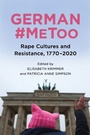
Unknown | Elisabeth Krimmer | Patricia Anne Simpson
German #MeToo
Rape Cultures and Resistance, 1770-2020
E-Book
07/2022
1st Edition
Boydell & Brewer
€72.99
Available for download
E-Book
07/2022
1st Edition
De Gruyter
€72.99
Available for download
Persons
ELISABETH KRIMMER is Professor of German at the University of California, Davis. PATRICIA ANNE SIMPSON is Professor of German at the University of Nebraska-Lincoln. Lisa Wille, is research associate at the Department of Modern German Literature at the Technical University of Darmstadt. Melissa Sheedy is a Lecturer in the Department of German, Nordic, and Slavic at the University of Wisconsin-Madison. Deborah Janson is an associate professor of German at West Virginia University Sonja Boos, was Associate Professor of German at the University of Oregon, where she was also affiliated with European Studies. Jessica Davis is a PhD candidate majoring in modern/contemporary art with minors in African art and eighteenth/nineteenth century European art MAUREEN BURDOCK is a graphic storyteller, writer, and illustrator with dual master's degrees from the California School of the Arts and a PhD in Cultural Studies from the University of California, Davis. KATHERINE BRUCE is an Associate Professor in German Studies at the University of Warwick. Niklas Straetker is a doctoral candidate in the Department of Germanic Languages at Columbia University Anna Sator is a Doctoral Candidate at the University of Freiburg Lisa Haegele is assistant professor of German at Texas State University Aylin Bademsoy is a PhD candidate in the German Department at UC Davis. Daniele Vecchiato is Assistant Professor of German and Translation Studies at the University of Padua, Italy. Sascha Andreas Gerhards is a Visiting Assistant Professor of German at Wittenberg University in Springfield, OH Florian Gassner received his PhD in Germanic Studies from the University of British Columbia; followed by lectureship at Mount Allison University, postdoctoral fellowship at the New Europe College in Bucharest, and DAAD-Lektorat at the Donetsk National University. He is Associate Professor of Teaching at the University of British Columbia. Kathrin Breuer is an Associate Professor of Practice of German at Brandeis University where she also serves as the Director of the German Language Program.
Content
Introduction - Elisabeth Krimmer and Patricia Anne Simpson
Part I. Histories
1: Eighteenth-Century #MeToo: Rape Culture and Victim Blaming in Heinrich Leopold Wagner's Die Kindermoerderin (1776) - Lisa Wille
2: #MeToo: Prostitution and the Syntax of Sexuality around 1800 - Patricia Anne Simpson
Part II. Dialogues across Time
3: "Immaculate Conception," the "Romance of Rape," and #MeToo: Kleistian Echoes in Kerstin Hensel and Julia Franck - Melissa Ann Sheedy
4: Female Sacrifice, Sexual Assault, and Dehumanization: Bourgeois Tragedy, Horror, and the Making of Jud Suess - Deborah Janson
5: "Na, wenn du mich erst fragst?": Reconsidering Affirmative Consent with Schnitzler, Schnitt, Habermas, and Ranciere - Sonja Boos
Part III. Sexual Violence, Warfare, and Genocide
6: War of the Vulva: The Women of Otto Dix's Lustmord Series - Jessica Davis
7: Death to the Patriarchal Theater! Charlotte Salomon's Graphic Testimony - Maureen Burdock
8: #MeToo and Wartime Rape: Looking Back and Moving Forward - Katherine Stone
Part IV. The Institutions of #MeToo
9: Boarding-School Novels around 1900: The Relation of Male Fear of Women to Male-Male Seduction and Sexual Abuse in Hesse, Musil, and Walser - Niklas Straetker
10: Breaking the Silence about Sexualized Violence in Lilly Axtser's and Beate Teresa Hanika's Young Adult Fiction (YAF) - Anna Sator
11: "Eine gigantische Vergewaltigung": Rape as Subject in Roger Fritz's Maedchen mit Gewalt (1970) - Lisa Haegele
12: Elfriede Jelinek and Ingeborg Bachmann: Transformations of the Capitalist Patriarchy and Narrating Sexual Violence in the Twentieth Century - Aylin Bademsoy
13: Staging Consent and Threatened Masculinity: The Debate on #MeToo in Contemporary German Theater - Daniele Vecchiato
Part V. #MeToo Across Cultural and National Borders
14: Patriarchy, Male Violence, and Disadvantaged Women: Representations of Muslims in the Crime Television Series Tatort - Sascha Gerhards
15: Fatih Akin's Head On: Challenging Mythologies of German Social Work in Gegen die Wand (2004) - Florian Gassner
16: Is a Prostitute Rapeable? Teresa Ruiz Rosas's Novel Nada que declarar in Dialogue with #MeToo - Kathrin Breuer
Notes on the Contributors
Index
Part I. Histories
1: Eighteenth-Century #MeToo: Rape Culture and Victim Blaming in Heinrich Leopold Wagner's Die Kindermoerderin (1776) - Lisa Wille
2: #MeToo: Prostitution and the Syntax of Sexuality around 1800 - Patricia Anne Simpson
Part II. Dialogues across Time
3: "Immaculate Conception," the "Romance of Rape," and #MeToo: Kleistian Echoes in Kerstin Hensel and Julia Franck - Melissa Ann Sheedy
4: Female Sacrifice, Sexual Assault, and Dehumanization: Bourgeois Tragedy, Horror, and the Making of Jud Suess - Deborah Janson
5: "Na, wenn du mich erst fragst?": Reconsidering Affirmative Consent with Schnitzler, Schnitt, Habermas, and Ranciere - Sonja Boos
Part III. Sexual Violence, Warfare, and Genocide
6: War of the Vulva: The Women of Otto Dix's Lustmord Series - Jessica Davis
7: Death to the Patriarchal Theater! Charlotte Salomon's Graphic Testimony - Maureen Burdock
8: #MeToo and Wartime Rape: Looking Back and Moving Forward - Katherine Stone
Part IV. The Institutions of #MeToo
9: Boarding-School Novels around 1900: The Relation of Male Fear of Women to Male-Male Seduction and Sexual Abuse in Hesse, Musil, and Walser - Niklas Straetker
10: Breaking the Silence about Sexualized Violence in Lilly Axtser's and Beate Teresa Hanika's Young Adult Fiction (YAF) - Anna Sator
11: "Eine gigantische Vergewaltigung": Rape as Subject in Roger Fritz's Maedchen mit Gewalt (1970) - Lisa Haegele
12: Elfriede Jelinek and Ingeborg Bachmann: Transformations of the Capitalist Patriarchy and Narrating Sexual Violence in the Twentieth Century - Aylin Bademsoy
13: Staging Consent and Threatened Masculinity: The Debate on #MeToo in Contemporary German Theater - Daniele Vecchiato
Part V. #MeToo Across Cultural and National Borders
14: Patriarchy, Male Violence, and Disadvantaged Women: Representations of Muslims in the Crime Television Series Tatort - Sascha Gerhards
15: Fatih Akin's Head On: Challenging Mythologies of German Social Work in Gegen die Wand (2004) - Florian Gassner
16: Is a Prostitute Rapeable? Teresa Ruiz Rosas's Novel Nada que declarar in Dialogue with #MeToo - Kathrin Breuer
Notes on the Contributors
Index