


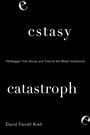
Ecstasy, Catastrophe
Heidegger from Being and Time to the Black Notebooks
Published on 1. August 2015
Book
Hardback
220 pages
978-1-4384-5825-0 (ISBN)
Description
Lectures on ecstatic temporality and on Heidegger's political legacy.
In Ecstasy, Catastrophe, David Farrell Krell provides insight into two areas of Heidegger's thought: his analysis of ecstatic temporality in Being and Time (1927) and his "political" remarks in the recently published Black Notebooks (1931-1941). The first part of Krell's book focuses on Heidegger's interpretation of time, which Krell takes to be one of Heidegger's greatest philosophical achievements. In addition to providing detailed commentary on ecstatic temporality, Krell considers Derrida's analysis of ekstasis in his first seminar on Heidegger, taught in Paris in 1964-1965. Krell also relates ecstatic temporality to the work of other philosophers, including Aristotle, Augustine, Kant, Schelling, Hoelderlin, and Merleau-Ponty; he then analyzes Dasein as infant and child, relating ecstatic temporality to the "mirror stage" theory of Jacques Lacan.
The second part of the book turns to Heidegger's Black Notebooks, which have received a great deal of critical attention in the press and in philosophical circles. Notorious for their pejorative references to Jews and Jewish culture, the Notebooks exhibit a level of polemic throughout that Krell takes to be catastrophic in and for Heidegger's thought. Heidegger's legacy therefore seems to be split between the best and the worst of thinking-somewhere between ecstasy and catastrophe.
Based on the 2014 Brauer Lectures in German Studies at Brown University, the book communicates the fruits of Krell's many years of work on Heidegger in an engaging and accessible style.
In Ecstasy, Catastrophe, David Farrell Krell provides insight into two areas of Heidegger's thought: his analysis of ecstatic temporality in Being and Time (1927) and his "political" remarks in the recently published Black Notebooks (1931-1941). The first part of Krell's book focuses on Heidegger's interpretation of time, which Krell takes to be one of Heidegger's greatest philosophical achievements. In addition to providing detailed commentary on ecstatic temporality, Krell considers Derrida's analysis of ekstasis in his first seminar on Heidegger, taught in Paris in 1964-1965. Krell also relates ecstatic temporality to the work of other philosophers, including Aristotle, Augustine, Kant, Schelling, Hoelderlin, and Merleau-Ponty; he then analyzes Dasein as infant and child, relating ecstatic temporality to the "mirror stage" theory of Jacques Lacan.
The second part of the book turns to Heidegger's Black Notebooks, which have received a great deal of critical attention in the press and in philosophical circles. Notorious for their pejorative references to Jews and Jewish culture, the Notebooks exhibit a level of polemic throughout that Krell takes to be catastrophic in and for Heidegger's thought. Heidegger's legacy therefore seems to be split between the best and the worst of thinking-somewhere between ecstasy and catastrophe.
Based on the 2014 Brauer Lectures in German Studies at Brown University, the book communicates the fruits of Krell's many years of work on Heidegger in an engaging and accessible style.
Reviews / Votes
"...[the book] reveals Krell as a generous and gracious thinker and teacher." - Notre Dame Philosophical ReviewsMore details
Series
Language
English
Place of publication
Albany, NY
United States
Target group
US School Grade: College Graduate Student and over
Product notice
sewn/stitched
Cloth over boards
Dimensions
Height: 236 mm
Width: 163 mm
Thickness: 23 mm
Weight
522 gr
ISBN-13
978-1-4384-5825-0 (9781438458250)
Copyright in bibliographic data and cover images is held by Nielsen Book Services Limited or by the publishers or by their respective licensors: all rights reserved.
Schweitzer Classification
Other editions
Additional editions
E-Book
08/2015
1st Edition
De Gruyter
from
€84.99
Available for download
Person
David Farrell Krell is Emeritus Professor of Philosophy at DePaul University, Brauer Distinguished Visiting Professor of German Studies at Brown University, and Adjunct Professor of Philosophy at the Albert-Ludwig University of Freiburg. He is the author of many books, including Struck by Apollo: Hoelderlin's Journeys to Bordeaux and Back and Beyond and A Black Forest Walden: Conversations with Henry David Thoreau and Marlonbrando, both by SUNY Press.
Content
Preface
Key to Works Cited
Introduction
Part One. Ecstatic Temporality in Heidegger's Being and Time (1927)
1. The Ecstases of Time
2. Raptures and Ruptures of Time
3. Ecstasy at the "Other End" of Dasein
4. Dasein Through the Looking-Glass
Interlude: Some Indefensible Ideas About Polemic and Criticism
Part Two. On the Black Notebooks (1931-1941)
5. Does Rescue Also Grow?
6. The Tragedy of the Black Notebooks
Conclusion
Index
Key to Works Cited
Introduction
Part One. Ecstatic Temporality in Heidegger's Being and Time (1927)
1. The Ecstases of Time
2. Raptures and Ruptures of Time
3. Ecstasy at the "Other End" of Dasein
4. Dasein Through the Looking-Glass
Interlude: Some Indefensible Ideas About Polemic and Criticism
Part Two. On the Black Notebooks (1931-1941)
5. Does Rescue Also Grow?
6. The Tragedy of the Black Notebooks
Conclusion
Index