

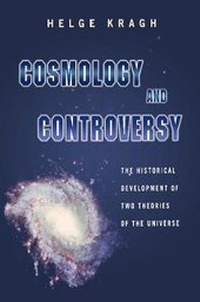
Cosmology and Controversy
The Historical Development of Two Theories of the Universe
Published on 20. October 1996
Book
Hardback
488 pages
978-0-691-02623-7 (ISBN)
Description
For over three millennia, most people could understand the universe only in terms of myth, religion, and philosophy. Between 1920 and 1970, cosmology transformed into a branch of physics. With this remarkably rapid change came a theory that would finally lend empirical support to many long-held beliefs about the origins and development of the entire universe: the theory of the big bang. In this book, Helge Kragh presents the development of scientific cosmology for the first time as a historical event, one that embroiled many famous scientists in a controversy over the very notion of an evolving universe with a beginning in time. In rich detail he examines how the big-bang theory drew inspiration from and eventually triumphed over rival views, mainly the steady-state theory and its concept of a stationary universe of infinite age. In the 1920s, Alexander Friedmann and Georges Lemaitre showed that Einstein's general relativity equations possessed solutions for a universe expanding in time.
Kragh follows the story from here, showing how the big-bang theory evolved, from Edwin Hubble's observation that most galaxies are receding from us, to the discovery of the cosmic microwave background radiation. Sir Fred Hoyle proposed instead the steady-state theory, a model of dynamic equilibrium involving the continuous creation of matter throughout the universe. Although today it is generally accepted that the universe started some ten billion years ago in a big bang, any readers may not fully realize that this standard view owed much of its formation to the steady-state theory. By exploring the similarities and tensions between the theories , Kragh provides the reader with indispensable background for understanding much of today's commentary about our universe.
Kragh follows the story from here, showing how the big-bang theory evolved, from Edwin Hubble's observation that most galaxies are receding from us, to the discovery of the cosmic microwave background radiation. Sir Fred Hoyle proposed instead the steady-state theory, a model of dynamic equilibrium involving the continuous creation of matter throughout the universe. Although today it is generally accepted that the universe started some ten billion years ago in a big bang, any readers may not fully realize that this standard view owed much of its formation to the steady-state theory. By exploring the similarities and tensions between the theories , Kragh provides the reader with indispensable background for understanding much of today's commentary about our universe.
Reviews / Votes
"Honorable Mention for the 1997 Award for Best Professional/Scholarly Book in Physics and Astronomy, Association of American Publishers" "One of Choice's Outstanding Academic Titles for 1997" "An exhilarating read--and not just for cosmologists. For although Kragh has produced a thoroughly scholarly work, he is nevertheless an excellent writer and his book could easily be enjoyed by anyone who is fascinated by the evolution of big scientific ideas. And they don't come much bigger than the origin, evolution, and fate of the Universe."---Marcus Chown, New Scientist "[An] insightful, thoroughly researched treatment of the intellectual development of modern cosmology."---Woodruff T. Sullivan III, Science "[An] excellent book . . . [a] thorough and detailed understanding. . . has enabled Kragh to write. . . enjoyable descriptions of complex issues. . . . It is difficult to imagine a more complete and scholarly account of this epoch of cosmological history."---Bernard Lovell, The Times Literary Supplement "As one who has been intimately involved with the subject, I thoroughly appreciated reading this work.... There are still a few left who believe that science advances relentlessly in a straight line. The actual zigzag path is beautifully illuminated in this book."---Hermann Bondi, Nature "[A] masterful interpretation of modern cosmology's emergence."---Karl Hufbauer, Physics Today "[An] excellent book.... It is difficult to imagine a more complete and scholarly account of this epoch of cosmological history."---Bernard Lovell, The Times Literary Supplement "This is very good scientific history and in some measure philosophy written by someone who has an understanding of the process of scientific work. The writing is clear and largely non-technical. . . . The general ideas that underpin the book hold for science broadly. Although the focus is cosmology, the book will appeal to anyone to anyone with an interest in how science actually works, whether it is through the history or the philosophy."---D.R. Matravers, Contemporary PhysicsMore details
Language
English
Place of publication
New Jersey
United States
Target group
College/higher education
Professional and scholarly
Product notice
Trade binding
Illustrations
4 tables 23 line illus.
Dimensions
Height: 254 mm
Width: 197 mm
Weight
907 gr
ISBN-13
978-0-691-02623-7 (9780691026237)
Copyright in bibliographic data and cover images is held by Nielsen Book Services Limited or by the publishers or by their respective licensors: all rights reserved.
Schweitzer Classification
Other editions
Additional editions
E-Book
10/2022
1st Edition
Princeton University Press
€66.99
Available for download
Person
Helge Kragh is Professor of the History of Science at the University of Oslo. His works include a biography of P.A.M. Dirac.