

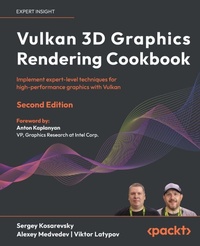
Vulkan 3D Graphics Rendering Cookbook
Implement expert-level techniques for high-performance graphics with Vulkan
2nd Edition
Published on 14. February 2025
Book
Paperback/Softback
722 pages
978-1-80324-811-0 (ISBN)
Description
Master Vulkan 1.3 with practical recipes for building, rendering, and optimizing stunning 3D graphics, guided by AR and rendering experts Sergey Kosarevsky and Alexey Medvedev
Get With Your Book: PDF Copy, AI Assistant, and Next-Gen Reader Free
Key Features
Learn to harness Vulkan 1.3 for building high-performance applications
Integrate cutting-edge rendering techniques into a real-time 3D engine
Use bindless Vulkan to render complex 3D scenes efficiently
Book DescriptionWritten by experts with decades of rendering experience, this cookbook equips you with practical, hands-on recipes to master modern 3D graphics development by using bindless Vulkan.
Focusing on Vulkan 1.3, this second edition starts by setting up your development environment, and quickly transitions to building a robust 3D rendering framework using self-contained recipes. Each recipe helps you incrementally enhance your codebase, integrating a variety of 3D rendering techniques and algorithms into a cohesive project. You'll get to grips with core techniques, such as glTF 2.0 physically based rendering, image-based lighting, and GPU-driven rendering. The chapters help you grasp advanced topics, including glTF animations, screen-space rendering techniques, and optimization strategies. You'll also learn how to use glTF 2.0 advanced PBR extensions and handle complex geometry data, ensuring your rendering engine is both powerful and performant. These new additions will enable you to create dynamic and realistic 3D graphics environments, fully utilizing Vulkan's capabilities.
By the end of this 3D rendering book, you'll have gained an improved understanding of best practices used in modern graphic APIs and be able to create fast and versatile 3D rendering frameworks.What you will learn
Master the core features of Vulkan 1.3, with a focus on bindless rendering
Learn effective techniques for debugging and profiling Vulkan applications
Build a glTF 2.0 physically based rendering pipeline from scratch
Enhance visual quality with advanced glTF 2.0 PBR extensions
Integrate multiple rendering techniques and optimizations into a single application
Manage large-scale content efficiently in real-time 3D rendering engines
Leverage Vulkan compute pipelines for advanced image and geometry processing
Who this book is forThis book is for 3D graphics developers who want to build high-performance rendering engines with the latest Vulkan features and modern rendering methods. Whether you're an experienced developer with a solid grasp of 3D rendering math or someone proficient in C++ and basic linear algebra, this book offers valuable insights to deepen your expertise. If you've dabbled in creating custom 3D applications without relying on premade rendering engines, you'll find this guide particularly useful.
Get With Your Book: PDF Copy, AI Assistant, and Next-Gen Reader Free
Key Features
Learn to harness Vulkan 1.3 for building high-performance applications
Integrate cutting-edge rendering techniques into a real-time 3D engine
Use bindless Vulkan to render complex 3D scenes efficiently
Book DescriptionWritten by experts with decades of rendering experience, this cookbook equips you with practical, hands-on recipes to master modern 3D graphics development by using bindless Vulkan.
Focusing on Vulkan 1.3, this second edition starts by setting up your development environment, and quickly transitions to building a robust 3D rendering framework using self-contained recipes. Each recipe helps you incrementally enhance your codebase, integrating a variety of 3D rendering techniques and algorithms into a cohesive project. You'll get to grips with core techniques, such as glTF 2.0 physically based rendering, image-based lighting, and GPU-driven rendering. The chapters help you grasp advanced topics, including glTF animations, screen-space rendering techniques, and optimization strategies. You'll also learn how to use glTF 2.0 advanced PBR extensions and handle complex geometry data, ensuring your rendering engine is both powerful and performant. These new additions will enable you to create dynamic and realistic 3D graphics environments, fully utilizing Vulkan's capabilities.
By the end of this 3D rendering book, you'll have gained an improved understanding of best practices used in modern graphic APIs and be able to create fast and versatile 3D rendering frameworks.What you will learn
Master the core features of Vulkan 1.3, with a focus on bindless rendering
Learn effective techniques for debugging and profiling Vulkan applications
Build a glTF 2.0 physically based rendering pipeline from scratch
Enhance visual quality with advanced glTF 2.0 PBR extensions
Integrate multiple rendering techniques and optimizations into a single application
Manage large-scale content efficiently in real-time 3D rendering engines
Leverage Vulkan compute pipelines for advanced image and geometry processing
Who this book is forThis book is for 3D graphics developers who want to build high-performance rendering engines with the latest Vulkan features and modern rendering methods. Whether you're an experienced developer with a solid grasp of 3D rendering math or someone proficient in C++ and basic linear algebra, this book offers valuable insights to deepen your expertise. If you've dabbled in creating custom 3D applications without relying on premade rendering engines, you'll find this guide particularly useful.
More details
Edition
2nd Revised edition
Language
English
Place of publication
Birmingham
United Kingdom
Target group
Professional and scholarly
Edition type
Revised edition
Dimensions
Height: 235 mm
Width: 191 mm
Thickness: 39 mm
Weight
1323 gr
ISBN-13
978-1-80324-811-0 (9781803248110)
Copyright in bibliographic data and cover images is held by Nielsen Book Services Limited or by the publishers or by their respective licensors: all rights reserved.
Schweitzer Classification
Other editions
Additional editions
Sergey Kosarevsky | Alexey Medvedev | Viktor Latypov
Vulkan 3D Graphics Rendering Cookbook
Implement expert-level techniques for high-performance graphics with Vulkan
E-Book
04/2025
2nd Edition
Packt Publishing Limited
from
€35.99
Available for download
Persons
Sergey Kosarevsky is a former rendering lead at Ubisoft RedLynx. He currently leads Vulkan development at Meta. He worked in the mobile industry at SPB Software, Yandex, Layar and Blippar, TWNKLS, and DAQRI, where he designed and implemented real-time rendering technology. He has more than 20 years of software development experience and more than 12 years of mobile and embedded 3D graphics experience. In his Ph.D. thesis, Sergey employed computer vision to solve mechanical engineering problems. He is also a co-author of several books on 3D graphics and mobile software development in C++, including "3D Graphics Rendering Cookbook". Alexey Medvedev is the AR Tech Lead at Meta, with over 20 years of experience in software development, primarily in game development. He has worked as an engine, graphics, and rendering engineer at renowned companies like Crytek, Blizzard, and Hangar 13, contributing to the release of several AAA games. At the time of writing this book, Alexey also serves as the Khronos Chair of the 3D Formats Working Group, which develops the glTF standards.. Viktor Latypov is a software engineer specializing in embedded C/C++, 3D graphics, and computer vision. With more than 15 years of software development experience and a Ph.D. in applied mathematics, he has implemented a number of real-time renderers for medical and automotive applications over the last 10 years. Together with Sergey, he has co-authored two books on mobile software development in C++.
Content
Table of Contents
Establishing a Build Environment
Getting Started with Vulkan
Working with Vulkan Objects
Adding User Interaction and Productivity Tools
Working with Geometry Data
Physically Based Rendering Using the glTF 2.0 Shading Model
Advanced PBR Extensions
Graphics Rendering Pipeline
glTF Animations
Image-Based Techniques
Advanced Rendering Techniques and Optimizations
Establishing a Build Environment
Getting Started with Vulkan
Working with Vulkan Objects
Adding User Interaction and Productivity Tools
Working with Geometry Data
Physically Based Rendering Using the glTF 2.0 Shading Model
Advanced PBR Extensions
Graphics Rendering Pipeline
glTF Animations
Image-Based Techniques
Advanced Rendering Techniques and Optimizations