

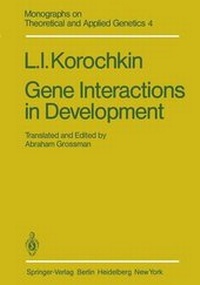
Gene Interactions in Development
Published on 1. February 1981
Book
Hardback
XIV, 320 pages
978-3-540-10112-3 (ISBN)
Description
Since the Russian edition of this book was published in 1975 many new research works have appeared which have made necessary some additions for the English edition, to reflect progress in molecular developmental genetics. Recent important findings in this field have brought about essential corrections to the concept of genetic regulation of the process of cell differentiation. The discovery of the mosaic structure of a gene prompted the re evaluation of our considerations about the regulation of gene activity in eukaryotes, and the data about transcriptional events during ontogenesis are of great importance as well. Formerly it was generally accepted that a derepression of genes was responsible for cell differentiation in the process of develop ment. Recently three important conclusions have been derived (Davidson and Britten, 1979) which help to pose the problem in a new way: 1) Only a small part of single copy sequences of DNA is represented in nuclear RNA of a given type of cell or tissue: 10% to 20% in sea urchin embryos, 11 % in rat liver, 4% to 6% in Drosophila cell culture, etc. Since only about 10% of single copy sequences represent the structural genes (Davidson and Britten, 1973), transcription of almost the whole set of structural genes occurs.
More details
Other editions
Additional editions
L. I. Korochkin | A. Grossman
Gene Interactions in Development
E-Book
12/2012
Springer
€96.29
Available for download
L. I. Korochkin | A. Grossman
Gene Interactions in Development
Book
01/2012
Springer
€106.99
Shipment within 7-9 days
Persons
Content
1 Gene Interaction at the Cellular Level.- 1.1 Differential Activity of Genes as a Basis for Cell Dif-ferentiation.- 1.1.1 The Leading Role of the Nucleus in Ontogenic Regulation.- 1.1.2 The Expression of Differential Gene Activity in Tran-scriptional Level.- 1.1.3 Temporal Variability of Morphogenetic Nuclear Activity.- 1.1.4 Puffing as a Cytological Indicator of Differential Gene Activity.- 1.1.5 Gene Amplification.- 1.1.6 The Interactional Effect of Certain Genes on the Tran-scription of Ribosomal Genes.- 1.1.7 Dose Compensation of Genes and Transcription.- 1.2 The Realization of Differential Gene Activity on the Post-Transcriptional, Translational, and Post-Translational Levels.- 1.2.1 The Stages of Gene Activity Realization in the Phenotype.- 1.2.2 Spatial Heterogeneity of Certain Isoenzymes and Proteins.- 1.2.3 Temporary Specificity in the Establishment of the Isozyme Spectrum.- 1.2.3.1 Nonallelic Genes Controlling the Synthesis of Isozymes Which Form Hybrid Patterns.- 1.2.3.2 Control of the Synthesis of Isozymes and Nonrelated Enzymes by Nonallelic Genes.- 1.2.3.3 Allelic Genes.- 1.2.4 Isozymes and the Maternal Effect.- 1.2.5 The Influence of Gene Modifiers on the Phenotypic Expression of Enzymes.- 1.3 The Phenomenon of Allelic Exclusion.- 1.3.1 The Concept of Allelic Exclusion, Its Phenomenology.- 1.3.2 Suppressive Action of Allotypic Antibodies on the Synthesis of Immunoglobulins of Corresponding Specificity.- 1.3.3 Examples of True Allelic Exclusion.- 1.3.3.1 The Differential Activity of Parental Genomes.- 1.3.3.2 The Differential Activity of X Chromosomes in Mammals.- 1.3.3.3 Cases of Functional Inactivation of Homologous Autosomal Loci.- 1.3.3.4 Heteromorphic Puffs.- 1.3.3.5 Heteromorphism of the Lateral Loops in "Lamp-brush" Chromosomes.- 1.3.3.6 The Differential Activity of the Nucleolar Organizer.- 1.4 Nuclear-Cytoplasmic Interactions. The Basis for the Regulation of Gene Activity.- 1.4.1 Segregation of Ooplasm.- 1.4.2 Control of Nuclear Function by Cytoplasmic Factors.- 1.4.3 The Nature of Cytoplasmic Factors Controlling Nuclear Function.- 1.4.4 Molecular Mechanisms for the Interaction of Regulatory Proteins with Chromosomal DNA.- 2 Gene Interaction at the Tissue Level.- 2.1 Functional-Genetic Mosaicism in Cell Regulation.- 2.1.1 Determination and Differentiation - the Properties of the Cell Populations.- 2.1.2 The Phenomenon of Transdetermination in Cell Po-pulations.- 2.1.3 The Heterogeneity of Cell Populations.- 2.1.3.1 Structural-Genetical Mosaicism.- 2.1.3.2 Functional-Genetical Mosaicism.- 2.2 Genetic Heterogeneity and the Establishment of Tissue Systems During Development.- 2.2.1 Interactions Between Cell Populations During Morphogenesis.- 2.2.2 The Genetic Basis of Inductive Interactions of Embryonic Layers During Early Embryogenesis.- 2.2.3 Significant Time-Factors in the Genetic Regulation of Ontogenesis.- 2.2.4 Interaction at the Cell and Tissue Levels in the Genetic Regulation of Ontogenesis.- 2.2.5 The Function of Genes in Terminal Cell Differentiation.- 2.3 Genetic Regulation of Ontogenesis on the Organismal Level.- 2.3.1 Hormones and Development.- 2.3.2 Genetic Regulation and the Hormonal System.- 2.3.3 Other Factors in the Regulation of Gene Activity on the Organismal Level.- 2.3.4 The Genome and the Function of Tissue Systems.- 2.4 The Organization of Systems Which Control Differential Gene Expression.- 2.4.1 The Organization of Gene Regulatory Systems in Bacteria and Phage and the Function of These Systems in Ontogenesis.- 2.4.2 Hypotheses on the Organization of the Gene Regulatory Systems in Eukaryotes.- 2.4.2.1 Bithorax Model.- 2.4.2.2 Transposable Genetic Elements and the As-Ds System in Corn.- 2.4.2.3 The Scute Locus in Drosophila.- 2.4.3 Molecular Organization of the Genome of Higher Eukaryotic Organisms.- 2.4.4 The Multilevel Character of Gene Regulation of Onto-genesis in Eukaryotic Organisms.- 2.4.5 A Hypothesis for the Temporal Organization of the Gene Systems Controlling Development.- 2.4.6 Phases of Gene Activity in Ontogenesis.- Conclusion.- References.