

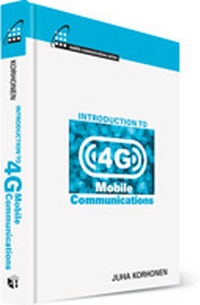
Introduction to 4G Mobile Communications
Published in March 2014
Book
Hardback
290 pages
978-1-60807-699-4 (ISBN)
Description
Long Term Evolution (LTE) was originally an internal 3GPP name for a program to enhance the capabilities of 3G radio access networks. The nickname has now evolved to become synonymous with 4G. This book concentrates on 4G systems, also known as LTE-Advanced. Telecommunications engineers and students are provided with a history of these systems, along with an overview of a mobile telecommunications system. The overview addresses the components in the system as well as their function. This resource guides telecommunications engineers though many important aspects of 4G including the air interface physical layer, Radio Access Networks, and 3GPP standardization, to name a few.
Long Term Evolution (LTE) was originally an internal 3GPP name for a program to enhance the capabilities of 3G radio access networks. The nickname has now evolved to become synonymous with 4G. This book concentrates on 4G systems, also known as LTE-Advanced. Telecommunications engineers and students are provided with a history of these systems, along with an overview of a mobile telecommunications system. The overview addresses the components in the system as well as their function. This resource guides telecommunications engineers though many important aspects of 4G including the air interface physical layer, Radio Access Networks, and 3GPP standardization, to name a few.
Long Term Evolution (LTE) was originally an internal 3GPP name for a program to enhance the capabilities of 3G radio access networks. The nickname has now evolved to become synonymous with 4G. This book concentrates on 4G systems, also known as LTE-Advanced. Telecommunications engineers and students are provided with a history of these systems, along with an overview of a mobile telecommunications system. The overview addresses the components in the system as well as their function. This resource guides telecommunications engineers though many important aspects of 4G including the air interface physical layer, Radio Access Networks, and 3GPP standardization, to name a few.
More details
Edition
Unabridged edition
Language
English
Place of publication
Norwood
United States
Target group
Professional and scholarly
Edition type
Unabridged edition
ISBN-13
978-1-60807-699-4 (9781608076994)
Copyright in bibliographic data and cover images is held by Nielsen Book Services Limited or by the publishers or by their respective licensors: all rights reserved.
Schweitzer Classification
Other editions
Additional editions
Juha Korhonen
Introduction to 4G Mobile Communications
E-Book
01/2014
1st Edition
Artech House
€129.99
Available for download
Person
Juha Korhonen is a project manager within the Mobile Competence Center at ETSI, Sophia Antipolis, France. He earned his Ph.D. in telecommunications engineering from University of Cambridge in Cambridge, UK.
Juha Korhonen is a project manager within the Mobile Competence Center at ETSI, Sophia Antipolis, France. He earned his Ph.D. in telecommunications engineering from University of Cambridge in Cambridge, UK.
Juha Korhonen is a project manager within the Mobile Competence Center at ETSI, Sophia Antipolis, France. He earned his Ph.D. in telecommunications engineering from University of Cambridge in Cambridge, UK.
Content
Introduction; History of Mobile Telecommunications - First Generation. Second Generation. Third Generation. Conclusions.; Overview of a Modern 4G Telecommunications System -Introduction. LTE-A System Architecture. LTE RAN. OFDM Air Interface. Evolved Packet Core. LTE Requirements. LTE-Advanced. LTE-A in Release.; OFDMA -Introduction. OFDM Principles. LTE UplinkSC-FDMA. Summary of OFDMA.; Air Interface: Physical Layer -Introduction. Physical LayerGeneral. Physical-Layer Processing. Physical Channels in LTE-A. Physical Layer Signals. Summary. ; Air Interface: Protocol Stack -Introduction. Medium Access Control (MAC). Radio Link Control (RLC). Packet Data Convergence Protocol (PDCP). Radio Resource Control (RRC). ; Radio Access Network -Introduction. E-UTRAN Architecture. eNodeB. Home eNodeB. Relay Node.; Core Network: Evolved Packet Core -Introduction. Architecture. EPC Interfaces and Protocols.; Procedures -Introduction. Cell Search. Random Access. Tracking Area Update. Initial Context Setup. Handover (X2 interface). CSG Inbound HO. S1 Release Procedure. Dedicated Bearer Activation. ; Specifications -Introduction. Internal Structure. Standardization Process. Specification Numbering. Backwards Compatibility. E-UTRAN Specifications.; LTE-A Features - Energy Saving. MIMO . Relays. Carrier Aggregation. Enhanced Intercell Interference Coordination. Evolved Multimedia Broadcast Multicast Service. Self-Organizing Networks. Coordinated Multipoint Transmission/Reception. LTE and Voice.; Future Developments -Introduction. Evolving LTE-A. The Fifth Generation. METIS Project.; Appendix: LTE and LTE-A Specifications. About the Author. Index. ;