

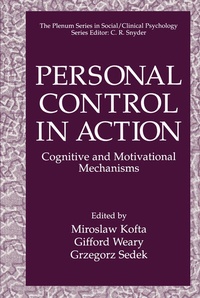
Personal Control in Action
Cognitive and Motivational Mechanisms
Published on 3. December 2010
Book
Paperback/Softback
XXVI, 460 pages
978-1-4419-3285-3 (ISBN)
Description
Human beings are agents: They may exert influence over their own fate. They initiate their actions, experience a considerable degree of freedom and control in their mundane activities, and respond adversely to external constraints to their agency; they are able to monitor and modify their moti- vation, affective states, and behavior. Since the sixties, the notion of person-as-agent has become increas- ingly accepted in scientific psychology. Nowadays, personal control is a standard topic in research on personality, motivation, and social behavior. The most popular approach identifies personal control with a feeling or judgment: To have control means to perceive the self as a source of causa- tion. Within this perspective, such consciously accessible contents like perceived freedom and self-determination, feelings and expectations of control, or perceived self-efficacy and competence emerge as natural tar- gets of research (see e.g., Alloy, Clements, & Koenig, 1993; Bandura, 1977; OeCharms, 1968; Oeci & Ryan, 1985; Harvey, 1976; Rotter, 1966; Thomp- son, 1993; Wortman, 1975).
More details
Series
Edition
1st ed. Softcover of orig. ed. 1998
Language
English
Place of publication
New York
United States
Target group
Professional and scholarly
Research
Illustrations
XXVI, 460 p.
Dimensions
Height: 235 mm
Width: 155 mm
Thickness: 27 mm
Weight
733 gr
ISBN-13
978-1-4419-3285-3 (9781441932853)
DOI
10.1007/978-1-4757-2901-6
Schweitzer Classification
Other editions
Additional editions
Miroslaw Kofta | Gifford Weary | Grzegorz Sedek
Personal Control in Action
Cognitive and Motivational Mechanisms
E-Book
03/2013
Springer
€149.79
Available for download
Miroslaw Kofta | Gifford Weary | Grzegorz Sedek
Personal Control in Action
Cognitive and Motivational Mechanisms
Book
06/1998
Kluwer Academic/Plenum Publishers
€160.49
Shipment within 10-15 days
Content
I: The Person as an Agent of Control.- 1 Personal Control from the Perspective of Cognitive-Experiential Self-Theory.- 2 Dynamics in the Coordination of Mind and Action.- 3 Opening versus Closing Strategies in Controlling One's Responses to Experience.- 4 A Terror Management Perspective on the Psychology of Control: Controlling the Uncontrollable.- 5 Personal Goals and Personal Agency: Linking Everyday Goals to Future Images of the Self.- II: Affective and Cognitive Mechanisms of Executive Agency.- 6 The Emotional Control of Behavior.- 7 Mood Management: The Role of Processing Strategies in Affect Control and Affect Infusion.- 8 Ability Perception and Cardiovascular Response to Behavioral Challenge.- 9 Confirmation Bias: Cognitive Error or Adaptive Strategy of Action Control?.- 10 Intrusive Thoughts, Rumination, and Incomplete Intentions.- 11 Decision Making and Action: The Search for a Dominance Structure.- 12 Improving Efficiency of Action Control through Technical and Social Resources.- III: Threatened Personal Control: Mobilization Versus Demobilization.- 13 To Control or Not to Control.- 14 Interpersonal Power Repair in Response to Threats to Control from Dependent Others.- 15 Control Motivation, Depression, and Counterfactual Thought.- 16 Uncontrollability as a Source of Cognitive Exhaustion: Implications for Helplessness and Depression.- 17 Intellectual Helplessness: Domain Specificity, Teaching Styles, and School Achievement.