

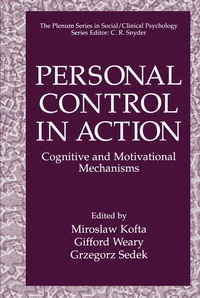
Personal Control in Action
Cognitive and Motivational Mechanisms
Published on 30. June 1998
Book
Hardback
XXVI, 460 pages
978-0-306-45720-3 (ISBN)
Description
Human beings are agents: They may exert influence over their own fate. They initiate their actions, experience a considerable degree of freedom and control in their mundane activities, and respond adversely to external constraints to their agency; they are able to monitor and modify their moti- vation, affective states, and behavior. Since the sixties, the notion of person-as-agent has become increas- ingly accepted in scientific psychology. Nowadays, personal control is a standard topic in research on personality, motivation, and social behavior. The most popular approach identifies personal control with a feeling or judgment: To have control means to perceive the self as a source of causa- tion. Within this perspective, such consciously accessible contents like perceived freedom and self-determination, feelings and expectations of control, or perceived self-efficacy and competence emerge as natural tar- gets of research (see e.g., Alloy, Clements, & Koenig, 1993; Bandura, 1977; OeCharms, 1968; Oeci & Ryan, 1985; Harvey, 1976; Rotter, 1966; Thomp- son, 1993; Wortman, 1975).
More details
Series
Edition
1998 ed.
Language
English
Place of publication
New York
United States
Publishing group
Springer Science+Business Media
Target group
Professional and scholarly
Research
Illustrations
XXVI, 460 p.
Dimensions
Height: 241 mm
Width: 160 mm
Thickness: 32 mm
Weight
891 gr
ISBN-13
978-0-306-45720-3 (9780306457203)
DOI
10.1007/978-1-4757-2901-6
Schweitzer Classification
Other editions
Additional editions
Miroslaw Kofta | Gifford Weary | Grzegorz Sedek
Personal Control in Action
Cognitive and Motivational Mechanisms
E-Book
03/2013
Springer
€149.79
Available for download
Miroslaw Kofta | Gifford Weary | Grzegorz Sedek
Personal Control in Action
Cognitive and Motivational Mechanisms
Book
12/2010
Springer
€160.49
Shipment within 15-20 days
Content
I: The Person as an Agent of Control.- 1 Personal Control from the Perspective of Cognitive-Experiential Self-Theory.- 2 Dynamics in the Coordination of Mind and Action.- 3 Opening versus Closing Strategies in Controlling One's Responses to Experience.- 4 A Terror Management Perspective on the Psychology of Control: Controlling the Uncontrollable.- 5 Personal Goals and Personal Agency: Linking Everyday Goals to Future Images of the Self.- II: Affective and Cognitive Mechanisms of Executive Agency.- 6 The Emotional Control of Behavior.- 7 Mood Management: The Role of Processing Strategies in Affect Control and Affect Infusion.- 8 Ability Perception and Cardiovascular Response to Behavioral Challenge.- 9 Confirmation Bias: Cognitive Error or Adaptive Strategy of Action Control?.- 10 Intrusive Thoughts, Rumination, and Incomplete Intentions.- 11 Decision Making and Action: The Search for a Dominance Structure.- 12 Improving Efficiency of Action Control through Technical and Social Resources.- III: Threatened Personal Control: Mobilization Versus Demobilization.- 13 To Control or Not to Control.- 14 Interpersonal Power Repair in Response to Threats to Control from Dependent Others.- 15 Control Motivation, Depression, and Counterfactual Thought.- 16 Uncontrollability as a Source of Cognitive Exhaustion: Implications for Helplessness and Depression.- 17 Intellectual Helplessness: Domain Specificity, Teaching Styles, and School Achievement.