

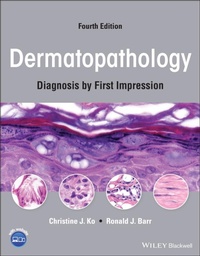
Dermatopathology
Diagnosis by First Impression
Published on 2. June 2022
Book
Paperback/Softback
384 pages
978-1-119-82605-7 (ISBN)
Description
Dermatopathology The most up-to-date edition of a pattern-based dermatopathology atlas
In Dermatopathology: Diagnosis by First Impression, an expert team of dermatopathologists deliver an authoritative guide to the microscopic differentiation of visually similar dermatological diseases that is useful for both trainees and practicing physicians. This latest fourth edition includes new sections on alopecia and immunohistochemistry as well as over 100 new photomicrographs for a total of almost 1000 high-resolution and annotated figures.
The "Key Differences" pages walk the reader through the identification of distinctive diagnostic features, and disease-based and alphabetical indexes make it simple to quickly locate necessary information. Unique amongst dermatopathology atlases, this book remains organized by microscopic pattern???as opposed to disease category???which makes it the perfect companion for slide analysis. It also offers self-assessment questions and algorithms for pattern analysis, as well as:
An introduction to gestalt diagnosis
Focus on architectural patterns as well as cell type/morphology
Practical discussion of immunohistochemistry
Expanded sections on melanocytic, soft tissue, and lymphoid lesions as well as alopecia
A visual feast for practicing dermatologists and pathologists, Dermatopathology: Diagnosis by First Impression will also earn a place in the libraries of trainees.
In Dermatopathology: Diagnosis by First Impression, an expert team of dermatopathologists deliver an authoritative guide to the microscopic differentiation of visually similar dermatological diseases that is useful for both trainees and practicing physicians. This latest fourth edition includes new sections on alopecia and immunohistochemistry as well as over 100 new photomicrographs for a total of almost 1000 high-resolution and annotated figures.
The "Key Differences" pages walk the reader through the identification of distinctive diagnostic features, and disease-based and alphabetical indexes make it simple to quickly locate necessary information. Unique amongst dermatopathology atlases, this book remains organized by microscopic pattern???as opposed to disease category???which makes it the perfect companion for slide analysis. It also offers self-assessment questions and algorithms for pattern analysis, as well as:
An introduction to gestalt diagnosis
Focus on architectural patterns as well as cell type/morphology
Practical discussion of immunohistochemistry
Expanded sections on melanocytic, soft tissue, and lymphoid lesions as well as alopecia
A visual feast for practicing dermatologists and pathologists, Dermatopathology: Diagnosis by First Impression will also earn a place in the libraries of trainees.
More details
Edition
4th Edition
Language
English
Place of publication
Hoboken
United States
Publishing group
John Wiley and Sons Ltd
Target group
Professional and scholarly
Dimensions
Height: 274 mm
Width: 214 mm
Thickness: 19 mm
Weight
1060 gr
ISBN-13
978-1-119-82605-7 (9781119826057)
Copyright in bibliographic data and cover images is held by Nielsen Book Services Limited or by the publishers or by their respective licensors: all rights reserved.
Schweitzer Classification
Other editions
Additional editions
E-Book
02/2022
4th Edition
Wiley
€108.99
Available for download
E-Book
02/2022
4th Edition
Wiley
€108.99
Available for download
Previous edition
Book
10/2016
3rd Edition
Wiley
€114.03
Article exhausted; check for reprint
Persons
Christine J. Ko, MD, is Professor of Dermatology and Pathology at Yale University. She is board certified in both dermatology and dermatopathology. She is the author of several academic texts in dermatology and dermatopathology, including Dermatology Essentials and Dermatology: Visual Recognition and Case??Reviews.
Ronald J. Barr, MD, is Professor Emeritus of Dermatology and Pathology at University of California, Irvine. He??is board certified in anatomical pathology, dermatology, and dermatopathology. He is recognized for his many contributions in dermatopathology, involving both neoplastic and non-neoplastic disorders.
Ronald J. Barr, MD, is Professor Emeritus of Dermatology and Pathology at University of California, Irvine. He??is board certified in anatomical pathology, dermatology, and dermatopathology. He is recognized for his many contributions in dermatopathology, involving both neoplastic and non-neoplastic disorders.
Content
Preface, 00
Acknowledgments, 00
About the Companion Website, 00
Chapter 1 Shape on Low Power
Epidermis
Regular acanthosis, 00
Lobular proliferation, 00
Reticulated proliferation, 00
Central pore, 00
Epidermal perforation, 00
Dermis
Circular islands, 00
Cords/tubules and comma shapes, 00
Space with a lining, 00
Papillations, 00
Polypoid (dome-shaped), 00
Square/rectangular, 00
Palisading reactions, 00
Pseudoepitheliomatous hyperplasia above abscesses, 00
Pink ball (see Chapter 6)
Chapter 2 Gestalt: Rash/inflammatory
Epidermal changes
Parakeratosis, 00
Spongiosis, 00
Papulosquamous (psoriasiform), 00
Interface (vacuolar), 00
Interface (lichenoid), 00
Inflammation: specific patterns and cell type
Epidermal eosinophils, 00
Perivascular, 00
Band-like dermal/papillary dermal infiltrate, 00
Diffuse/nodular, 00
Subcutaneous, 00
Chapter 3 Cell Type
Melanocytic, 00
Spindle cells, 00
Endothelial, 00
Giant, 00
Clear, 00
Chapter 4 Top-Down
Arthropods, 000
Hyperkeratosis/parakeratosis, 000
Upper epidermal change, 000
Acantholysis, 000
Subepidermal space/cleft, 000
Granular "material" in cells, 000
"Busy" dermis, 000
Dermal material, 000
Fat necrosis, 000
Chapter 5 Color - Blue
Blue tumor, 000
Mucin and glands or ducts, 000
Mucin, 000
Chapter 6 Color - Pink
Pink ball of spindle cells, 000
Pink material, 000
Pink dermis, 000
Epidermal necrosis, 000
Chapter 7 Miscellaneous
Alopecia, 000
Immunhistochemistry, 000
Mimics, 000
Index (Pattern), 000
Index (Histologic Category), 000
Index (Alphabetical), 000
Acknowledgments, 00
About the Companion Website, 00
Chapter 1 Shape on Low Power
Epidermis
Regular acanthosis, 00
Lobular proliferation, 00
Reticulated proliferation, 00
Central pore, 00
Epidermal perforation, 00
Dermis
Circular islands, 00
Cords/tubules and comma shapes, 00
Space with a lining, 00
Papillations, 00
Polypoid (dome-shaped), 00
Square/rectangular, 00
Palisading reactions, 00
Pseudoepitheliomatous hyperplasia above abscesses, 00
Pink ball (see Chapter 6)
Chapter 2 Gestalt: Rash/inflammatory
Epidermal changes
Parakeratosis, 00
Spongiosis, 00
Papulosquamous (psoriasiform), 00
Interface (vacuolar), 00
Interface (lichenoid), 00
Inflammation: specific patterns and cell type
Epidermal eosinophils, 00
Perivascular, 00
Band-like dermal/papillary dermal infiltrate, 00
Diffuse/nodular, 00
Subcutaneous, 00
Chapter 3 Cell Type
Melanocytic, 00
Spindle cells, 00
Endothelial, 00
Giant, 00
Clear, 00
Chapter 4 Top-Down
Arthropods, 000
Hyperkeratosis/parakeratosis, 000
Upper epidermal change, 000
Acantholysis, 000
Subepidermal space/cleft, 000
Granular "material" in cells, 000
"Busy" dermis, 000
Dermal material, 000
Fat necrosis, 000
Chapter 5 Color - Blue
Blue tumor, 000
Mucin and glands or ducts, 000
Mucin, 000
Chapter 6 Color - Pink
Pink ball of spindle cells, 000
Pink material, 000
Pink dermis, 000
Epidermal necrosis, 000
Chapter 7 Miscellaneous
Alopecia, 000
Immunhistochemistry, 000
Mimics, 000
Index (Pattern), 000
Index (Histologic Category), 000
Index (Alphabetical), 000