

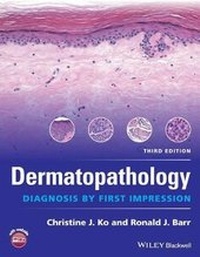
Dermatopathology
Diagnosis by First Impression
3rd Edition
Published on 21. October 2016
Book
Paperback/Softback
344 pages
978-1-119-14945-3 (ISBN)
Description
The atlas that helps you differentiate visually similar diseases
Written with the dermatology trainee in mind, Dermatopathology: Diagnosis by First Impression uses more than 800 high resolution color images to introduce a simple and effective way to defuse the confusion caused by dermatopathology slides. Focused on commonly tested entities, and using low- to high-power views, this atlas emphasizes the key differences between visually similar diseases by using appearance as the starting point for diagnosis.
The Third Edition provides:
800 high resolution and annotated photographs, now all fully downloadable
'Key Differences' to train the eye on distinctive diagnostic features
Disease-based as well as alphabetical indexes
75 new interactive self-assessment questions to perfect your diagnostic skills
Brand new algorithms for pattern analysis
Dermatopathology: Diagnosis by First Impression, Third Edition, once again provides simple and effective guidance to help you approach dermatopathology and accurate diagnosis of skin disease.
Written with the dermatology trainee in mind, Dermatopathology: Diagnosis by First Impression uses more than 800 high resolution color images to introduce a simple and effective way to defuse the confusion caused by dermatopathology slides. Focused on commonly tested entities, and using low- to high-power views, this atlas emphasizes the key differences between visually similar diseases by using appearance as the starting point for diagnosis.
The Third Edition provides:
800 high resolution and annotated photographs, now all fully downloadable
'Key Differences' to train the eye on distinctive diagnostic features
Disease-based as well as alphabetical indexes
75 new interactive self-assessment questions to perfect your diagnostic skills
Brand new algorithms for pattern analysis
Dermatopathology: Diagnosis by First Impression, Third Edition, once again provides simple and effective guidance to help you approach dermatopathology and accurate diagnosis of skin disease.
More details
Edition
3rd edition
Language
English
Place of publication
Hoboken
United Kingdom
Publishing group
John Wiley and Sons Ltd
Target group
Professional and scholarly
Dimensions
Height: 277 mm
Width: 213 mm
Thickness: 20 mm
Weight
975 gr
ISBN-13
978-1-119-14945-3 (9781119149453)
Copyright in bibliographic data and cover images is held by Nielsen Book Services Limited or by the publishers or by their respective licensors: all rights reserved.
Schweitzer Classification
Other editions
New editions
Book
06/2022
Wiley-Blackwell
€128.50
Shipment within 15-20 days
Additional editions
E-Book
09/2016
3rd Edition
Wiley-Blackwell
€99.99
Available for download
E-Book
08/2016
3rd Edition
Wiley-Blackwell
€99.99
Available for download
Previous edition
Book
02/2011
2nd Edition
Wiley-Blackwell
€109.00
Article exhausted; check for reprint
Persons
Christine J. Ko is a Professor of Dermatology and Pathology at Yale University School of Medicine. She trained in dermatology at University of California, Irvine, where she was strongly influenced by Dr. Barr. She subsequently completed a fellowship in dermatopathology under Dr. Scott Binder at University of California, Los Angeles. She lectures nationally and internationally; and has published numerous book chapters, journal articles, and five textbooks/atlases in the fields of dermatology and dermatopathology.
Ronald J. Barr is Professor Emeritus of Dermatology and Pathology at the University of California, Irvine. He is a nationally and internationally recognized dermatopathologist with board certification in dermatology, anatomic pathology, and dermatopathology. He received the Founders' Award from the American Society of Dermatopathology for his myriad contributions to the field of dermatopathology and the Society's Walter Nickel Award for excellence in teaching dermatopathology. He has authored over 150 original articles and book chapters. He is also past president of the American Society of Dermatopathology and past president of the American Board of Dermatology.
Ronald J. Barr is Professor Emeritus of Dermatology and Pathology at the University of California, Irvine. He is a nationally and internationally recognized dermatopathologist with board certification in dermatology, anatomic pathology, and dermatopathology. He received the Founders' Award from the American Society of Dermatopathology for his myriad contributions to the field of dermatopathology and the Society's Walter Nickel Award for excellence in teaching dermatopathology. He has authored over 150 original articles and book chapters. He is also past president of the American Society of Dermatopathology and past president of the American Board of Dermatology.
Content
Preface, vi
Acknowledgments, vii
About the Companion Website, viii
Introduction, 1
Chapter 1 Shape on Low Power, 23
Epidermis
Regular acanthosis, 25
Lobular proliferation, 29
Reticulated proliferation, 35
Central pore, 42
Epidermal perforation, 46
Dermis
Circular islands, 49
Cords/tubules and comma shapes, 53
Space with a lining, 59
Papillations, 70
Polypoid (dome-shaped), 77
Square/rectangular, 82
Palisading reactions, 88
Pseudoepitheliomatous hyperplasia above abscesses, 93
Pink ball, (see Chapter 6)
Chapter 2 Gestalt: Rash/inflammatory, 97
Epidermal changes
Parakeratosis, 99
Spongiosis, 102
Papulosquamous (psoriasiform), 106
Interface (vacuolar), 112
Interface (lichenoid), 117
Inflammation: Specific patterns and Cell Type Epidermal eosinophils, 123
Perivascular, 127
Band-like dermal/papillary dermal infiltrate, 131
Diffuse/nodular, 137
Subcutaneous, 144
Chapter 3 Cell Type, 153
Melanocytic, 155
Spindle cells, 164
Endothelial, 178
Giant, 192
Clear, 202
Chapter 4 "Top-Down", 219
Hyperkeratosis/parakeratosis, 221
Upper epidermal change, 228
Acantholysis, 238
Subepidermal space/cleft, 248
Granular "material" in cells, 255
"Busy" dermis, 260
Dermal material, 263
Fat necrosis, 276
Chapter 5 Color - Blue, 279
Blue tumor, 281
Mucin and glands or ducts, 291
Mucin, 295
Chapter 6 Color - Pink, 303
Pink ball of spindle cells, 305
Pink material, 308
Pink dermis, 315
Epidermal necrosis, 317
Index (Pattern), 323
Index (Histological Category), 329
Index (Alphabetical), 333
Acknowledgments, vii
About the Companion Website, viii
Introduction, 1
Chapter 1 Shape on Low Power, 23
Epidermis
Regular acanthosis, 25
Lobular proliferation, 29
Reticulated proliferation, 35
Central pore, 42
Epidermal perforation, 46
Dermis
Circular islands, 49
Cords/tubules and comma shapes, 53
Space with a lining, 59
Papillations, 70
Polypoid (dome-shaped), 77
Square/rectangular, 82
Palisading reactions, 88
Pseudoepitheliomatous hyperplasia above abscesses, 93
Pink ball, (see Chapter 6)
Chapter 2 Gestalt: Rash/inflammatory, 97
Epidermal changes
Parakeratosis, 99
Spongiosis, 102
Papulosquamous (psoriasiform), 106
Interface (vacuolar), 112
Interface (lichenoid), 117
Inflammation: Specific patterns and Cell Type Epidermal eosinophils, 123
Perivascular, 127
Band-like dermal/papillary dermal infiltrate, 131
Diffuse/nodular, 137
Subcutaneous, 144
Chapter 3 Cell Type, 153
Melanocytic, 155
Spindle cells, 164
Endothelial, 178
Giant, 192
Clear, 202
Chapter 4 "Top-Down", 219
Hyperkeratosis/parakeratosis, 221
Upper epidermal change, 228
Acantholysis, 238
Subepidermal space/cleft, 248
Granular "material" in cells, 255
"Busy" dermis, 260
Dermal material, 263
Fat necrosis, 276
Chapter 5 Color - Blue, 279
Blue tumor, 281
Mucin and glands or ducts, 291
Mucin, 295
Chapter 6 Color - Pink, 303
Pink ball of spindle cells, 305
Pink material, 308
Pink dermis, 315
Epidermal necrosis, 317
Index (Pattern), 323
Index (Histological Category), 329
Index (Alphabetical), 333