

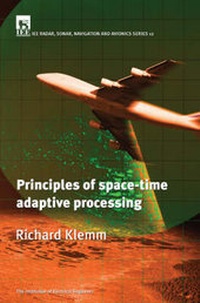
Principles of Space-time Adaptive Processing
Published on 22. April 2002
Book
Hardback
580 pages
978-0-85296-172-8 (ISBN)
Description
This text is part of a two-volume series on space-time adaptive processing (STAP). The second book on "applications of STAP" is to follow. The work is based on the author's primary research; the focus is on giving a systematic introduction to airborne MTI radar design for use in the fields of earth observation, surveillance and reconnaissance, with particular regard to the suppression of clutter returns. Coverage includes signal processing techniques, modelling, adaptive clutter filters, suboptimum techniques, antenna configurations, jamming, channel errors and system applications.
More details
Series
Edition
Revised ed.
Language
English
Place of publication
Stevenage
United Kingdom
Target group
College/higher education
Professional and scholarly
Illustrations
Illustrations
Dimensions
Height: 234 mm
Width: 156 mm
ISBN-13
978-0-85296-172-8 (9780852961728)
Copyright in bibliographic data and cover images is held by Nielsen Book Services Limited or by the publishers or by their respective licensors: all rights reserved.
Schweitzer Classification
Other editions
New editions
Richard Klemm
Principles of Space-Time Adaptive Processing
Book
11/2006
3rd Edition
Institution of Engineering and Technology
€179.50
Shipment within 3-4 weeks
Content
Preface; 1: Introduction; 2: Signal and interference models; 3: Properties of airborne clutter; 4: Fully adaptive space-time processors; 5: Space-time subspace techniques; 6: Spatial transforms for linear arrays; 7: Adaptive space-time digital filters; 8: Antenna related aspects; 9: Space-frequency processing; 10: Radar ambiguities; 11: Clutter rejection under jamming conditions; 12: Space-time processing for bistatic radar; 13: Interrelated problems in SAR and ISAR; 14: Parameter estimation; 15: Special aspects of airborne MTI radar; Appendices, Bibliography, Glossary, Index