

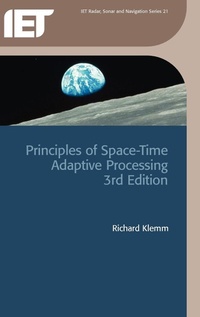
Principles of Space-Time Adaptive Processing
3rd Edition
Published on 28. November 2006
Book
Hardback
672 pages
978-0-86341-566-1 (ISBN)
Description
This third edition of Principles of Space-Time Adaptive Processing provides a detailed introduction to the fundamentals of space-time adaptive processing, with emphasis on clutter suppression in airborne or spacebased phased array radar, covering specifically the principles of airborne or spacebased MTI radar for detection of slow moving targets for use in the fields of earth observation, surveillance and reconnaissance, with special attention paid to clutter rejection techniques.
The book includes topics such as signal processing, clutter models, array processing, bandwidth effects, non-linear antenna arrays, anti-jamming techniques, adaptive monopulse, bistatic radar configurations, SAR and ISAR, and sonar.
After the success of the first and second editions, this third edition has been extensively updated and extended to reflect the numerous advances in the field. A completely new chapter has been added on the impact of the radar range equation, which is of particular importance for radar system designers. This edition concludes with an updated list of more than 750 references on STAP and related topics, representing the worldwide state of-the-art research in space-time adaptive processing.
The book will be of particular interest to electronic and aerospace engineers, university lecturers, postgraduate students, research scientists, radar system engineers and managers working in civilian and military airborne and spacebased radar, as well as potential users of air- and spaceborne radar.
The book includes topics such as signal processing, clutter models, array processing, bandwidth effects, non-linear antenna arrays, anti-jamming techniques, adaptive monopulse, bistatic radar configurations, SAR and ISAR, and sonar.
After the success of the first and second editions, this third edition has been extensively updated and extended to reflect the numerous advances in the field. A completely new chapter has been added on the impact of the radar range equation, which is of particular importance for radar system designers. This edition concludes with an updated list of more than 750 references on STAP and related topics, representing the worldwide state of-the-art research in space-time adaptive processing.
The book will be of particular interest to electronic and aerospace engineers, university lecturers, postgraduate students, research scientists, radar system engineers and managers working in civilian and military airborne and spacebased radar, as well as potential users of air- and spaceborne radar.
Reviews / Votes
'I believe that this comprehensive text book is definitely welcome by the Radar Community.' -- Dr. A. FarinaMore details
Series
Edition
3rd edition
Language
English
Place of publication
Stevenage
United Kingdom
Target group
Professional and scholarly
Dimensions
Height: 240 mm
Width: 161 mm
Thickness: 40 mm
Weight
1164 gr
ISBN-13
978-0-86341-566-1 (9780863415661)
Copyright in bibliographic data and cover images is held by Nielsen Book Services Limited or by the publishers or by their respective licensors: all rights reserved.
Schweitzer Classification
Other editions
Additional editions
Richard Klemm
Principles of Space-Time Adaptive Processing
E-Book
11/2008
3rd Edition
Institution of Engineering and Technology
€184.09
Available for download
Previous edition
Richard A. Klemm
Principles of Space-time Adaptive Processing
Book
04/2002
Institution of Engineering and Technology
€105.42
Article exhausted; check for reprint
Person
Dr Richard Klemm is an active consultant at FGAN (the German Defence Research Establishment). He received his Dipl.-Ing. and Dr.-Ing. degrees from the University of Technology in Berlin, Germany. From 1977-1980 he was with SACLANT ASW Research Centre in La Spezia, Italy, where he conducted research on sonar signal processing, with emphasis on matched field processing. He has been invited to give seminars by many different organisations worldwide. In 1996 he initiated the European Conference on Synthetic Aperture Radar (EUSAR) and has organised and chaired numerous NATO RTO symposia as well as an international IET colloquium on STAP. Richard Klemm has received several awards, such as the Von Karman Medal of NATO. He is an advisor to the IET Radar, Sonar and Navigation professional network.
Content
Chapter 1: Introduction
Chapter 2: Signal and interference models
Chapter 3: Properties of airborne clutter
Chapter 4: Fully adaptive space-time processors
Chapter 5: Space-time subspace techniques
Chapter 6: Spatial transforms for linear arrays
Chapter 7: Adaptive space-time digital filters
Chapter 8: Antenna related aspects
Chapter 9: Space-frequency processing
Chapter 10: Radar ambiguities
Chapter 11: STAP under jamming conditions
Chapter 12: Space-time processing for bistatic radar
Chapter 13: Interrelated problems in SAR and ISAR
Chapter 14: Target parameter estimation
Chapter 15: Influence of the radar equation
Chapter 16: Special aspects of airborne MTI radar
Appendix: Sonar applications
Chapter 2: Signal and interference models
Chapter 3: Properties of airborne clutter
Chapter 4: Fully adaptive space-time processors
Chapter 5: Space-time subspace techniques
Chapter 6: Spatial transforms for linear arrays
Chapter 7: Adaptive space-time digital filters
Chapter 8: Antenna related aspects
Chapter 9: Space-frequency processing
Chapter 10: Radar ambiguities
Chapter 11: STAP under jamming conditions
Chapter 12: Space-time processing for bistatic radar
Chapter 13: Interrelated problems in SAR and ISAR
Chapter 14: Target parameter estimation
Chapter 15: Influence of the radar equation
Chapter 16: Special aspects of airborne MTI radar
Appendix: Sonar applications