

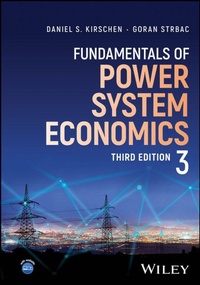
Fundamentals of Power System Economics
3rd Edition
Published on 21. May 2026
Book
Hardback
384 pages
978-1-394-33302-8 (ISBN)
Description
"Where economic theory meets the physics of electricity-everything you need to understand why power markets are unlike any other."
-Jesse Jenkins, Princeton University
"Fundamentals of Power System Economics caters to a wide diversity of students; it can speak to economists and engineers alike."
-Francois Bouffard, McGill University
"Perfectly bridges principles of economics with the power system."
-Chongqing Kang, Tsinghua University
Understand competitive electricity markets in a decarbonizing energy landscape
Designing successful electricity markets requires mastery of both power systems engineering and market economics. Now in its third edition, Fundamentals of Power System Economics explains competitive market principles while contrasting them against the monopoly model as a reference framework. Written by two leading researchers in power system economics, this new edition addresses markets where carbon-free generation predominates.
This edition adds coverage of decarbonization economics, government market interventions, and market clearing with high renewable penetration. New material addresses transmission investment cost allocation, generation investment challenges in energy-only markets, and system operator tools including SCED and SCUC. A new chapter on retail markets covers prosumer interactions, flexible consumers, and energy equity.
The book also includes:
Reorganized structure covering fundamental principles, short-term operational economics, and long-term investment economics across three distinct parts
Detailed analysis of wholesale market structures including demand-side bidding mechanisms and examples showing different renewable generation proportions
Coverage of transmission network integration with system operator responsibilities and optimal power flow methodologies explained in monopoly contexts
Discussion of retail electricity tariffs for residential and commercial consumers alongside emerging prosumer business models and flexibility services
Extensive end-of-chapter exercises and discussion points designed to reinforce concepts and enhance understanding of complex market dynamics
Designed for graduate and undergraduate students in electrical and power engineering, this book serves power system engineers, operators, planners, and policymakers working in deregulated environments. Fundamentals of Power System Economics provides the analytical foundation needed to navigate electricity markets during the transition to low-carbon generation.
-Jesse Jenkins, Princeton University
"Fundamentals of Power System Economics caters to a wide diversity of students; it can speak to economists and engineers alike."
-Francois Bouffard, McGill University
"Perfectly bridges principles of economics with the power system."
-Chongqing Kang, Tsinghua University
Understand competitive electricity markets in a decarbonizing energy landscape
Designing successful electricity markets requires mastery of both power systems engineering and market economics. Now in its third edition, Fundamentals of Power System Economics explains competitive market principles while contrasting them against the monopoly model as a reference framework. Written by two leading researchers in power system economics, this new edition addresses markets where carbon-free generation predominates.
This edition adds coverage of decarbonization economics, government market interventions, and market clearing with high renewable penetration. New material addresses transmission investment cost allocation, generation investment challenges in energy-only markets, and system operator tools including SCED and SCUC. A new chapter on retail markets covers prosumer interactions, flexible consumers, and energy equity.
The book also includes:
Reorganized structure covering fundamental principles, short-term operational economics, and long-term investment economics across three distinct parts
Detailed analysis of wholesale market structures including demand-side bidding mechanisms and examples showing different renewable generation proportions
Coverage of transmission network integration with system operator responsibilities and optimal power flow methodologies explained in monopoly contexts
Discussion of retail electricity tariffs for residential and commercial consumers alongside emerging prosumer business models and flexibility services
Extensive end-of-chapter exercises and discussion points designed to reinforce concepts and enhance understanding of complex market dynamics
Designed for graduate and undergraduate students in electrical and power engineering, this book serves power system engineers, operators, planners, and policymakers working in deregulated environments. Fundamentals of Power System Economics provides the analytical foundation needed to navigate electricity markets during the transition to low-carbon generation.
More details
Edition
3rd edition
Language
English
Place of publication
New York
United States
Target group
Professional and scholarly
Dimensions
Height: 184 mm
Width: 261 mm
Thickness: 25 mm
Weight
942 gr
ISBN-13
978-1-394-33302-8 (9781394333028)
Copyright in bibliographic data and cover images is held by Nielsen Book Services Limited or by the publishers or by their respective licensors: all rights reserved.
Schweitzer Classification
Other editions
Additional editions
Daniel S. Kirschen | Goran Strbac
Fundamentals of Power System Economics
E-Book
04/2026
3rd Edition
Wiley
€114.99
Available for download
Daniel S. Kirschen | Goran Strbac
Fundamentals of Power System Economics
E-Book
04/2026
3rd Edition
Wiley
€114.99
Available for download
Previous edition
Daniel S. Kirschen | Goran Strbac
Fundamentals of Power System Economics
Book
09/2018
2nd Edition
Wiley
€118.90
Article exhausted; check for reprint
Persons
DANIEL S. KIRSCHEN, PHD, is the Donald W. and Ruth Mary Close Professor of Electrical and Computer Engineering at the University of Washington, USA. A Fellow of the IEEE and the Chinese Society for Electrical Engineering, his research focuses on renewable energy integration, power system economics, and grid resilience. He previously taught at The University of Manchester, UK, and developed utility control center software for Control Data and Siemens.
GORAN STRBAC, PHD, is Professor of Energy Systems at Imperial College London, UK, with extensive experience in modelling and analysis of operation, planning, security and economics of energy systems. He led the development of novel analysis methods that have been extensively used to inform industry, governments and regulatory bodies about the role and value of emerging technologies in supporting a cost effective transition to a resilient low carbon energy future.
GORAN STRBAC, PHD, is Professor of Energy Systems at Imperial College London, UK, with extensive experience in modelling and analysis of operation, planning, security and economics of energy systems. He led the development of novel analysis methods that have been extensively used to inform industry, governments and regulatory bodies about the role and value of emerging technologies in supporting a cost effective transition to a resilient low carbon energy future.
Content
Preface to the Third Edition xv
Preface to the Second Edition xvii
Preface to the First Edition xix
Nomenclature xxi
About the Companion Website xxiii
1 Introduction 1
1.1 Why Study Power System Economics? 1
1.2 Industry Structure 1
1.2.1 Vertically Integrated Monopoly Utility 2
1.2.2 The Dawn of Competition 3
1.2.3 Introducing Independent Power Producers 4
1.2.4 Wholesale Competition 4
1.2.5 Retail Competition 5
1.2.6 Incorporating Distributed Energy Resources 6
1.3 Dramatis Personae 6
1.4 Competition and Privatization 8
1.5 Experience and Open Questions 8
1.6 Problems 10
Further Readings 11
2 Concepts from Economics 13
2.1 Introduction 13
2.2 Fundamentals of Markets 13
2.2.1 Modeling the Consumers 13
2.2.1.1 Individual Demand 13
2.2.1.2 Surplus 14
2.2.1.3 Demand and Inverse Demand Functions 15
2.2.1.4 Price Elasticity of Demand 17
2.2.2 Modeling the Producers 18
2.2.2.1 Opportunity Cost 18
2.2.2.2 Supply and Inverse Supply Functions 18
2.2.2.3 Producers' Revenue 20
2.2.2.4 Price Elasticity of Supply 21
2.2.3 Market Equilibrium 21
2.2.4 Pareto Efficiency 23
2.2.5 Global Welfare and Deadweight Loss 24
2.2.6 Time-Varying Prices 25
2.3 Concepts from the Theory of the Firm 25
2.3.1 Inputs and Outputs 25
2.3.2 Long Run and Short Run 26
2.3.3 Costs 28
2.3.3.1 Short-Run Costs 28
2.3.3.2 Long-Run Costs 30
2.3.3.3 Opportunity Costs 32
2.4 Risk 32
2.5 Types of Markets 33
2.5.1 Spot Market 33
2.5.2 Forward Contracts and Forward Markets 34
2.5.3 Future Contracts and Futures Markets 35
2.5.4 Options 36
2.5.5 Contracts for Difference 37
2.5.6 Managing the Price Risks 38
2.5.7 Market Efficiency 38
2.6 Markets with Imperfect Competition 39
2.6.1 Market Power 39
2.6.2 Monopoly 40
2.7 Regulation 40
2.7.1 Goals of Regulation 41
2.7.2 Traditional Regulation 42
2.7.3 Drawbacks of Traditional Regulation 43
2.8 Externalities 43
2.9 Role of Government 44
2.10 Problems 45
Further Readings 51
Reference 51
3 Economic Operation in a Vertically Integrated Environment 53
3.1 Introduction 53
3.2 Short-Run Characteristics of the Demand for Electrical Energy 53
3.3 Short-Run Characteristics of the Generation of Electrical Energy 55
3.3.1 Thermal Generation 55
3.3.2 Wind and Solar Generation 56
3.3.3 Hydro Generation 56
3.4 Short-Run Characteristics of Energy Storage Systems 57
3.5 Economic Dispatch 57
3.5.1 Mathematical Formulation 57
3.5.2 Economic Dispatch Considering Unit Limits 60
3.5.3 Interpretation of the Lagrange Multipliers 63
3.5.4 Economic Dispatch Using Piecewise Linear Cost Curves 64
3.6 Load Flexibility and Storage 67
3.7 Unit Commitment 68
3.7.1 Mathematical Formulation 69
3.7.2 Solving the Unit Commitment Problem 70
3.7.3 Handling Uncertainty 73
3.8 Problems 76
Further Readings 79
4 Structure of Wholesale Markets for Electrical Energy 81
4.1 What Makes an MWh a Unique Commodity? 81
4.2 Trading Periods 82
4.3 Forward Markets 83
4.3.1 Bilateral or Decentralized Trading 83
4.3.2 Centralized Trading 87
4.3.2.1 Principles of Centralized Trading 87
4.3.2.2 Day-ahead Forward Market 92
4.3.2.3 Formulation as an Optimization Problem 92
4.3.2.4 Market-Clearing Price 94
4.3.2.5 Recovering the Fixed Costs 95
4.3.3 Comparison of Centralized and Decentralized Trading 98
4.4 Spot Market 99
4.4.1 Obtaining Balancing Resources 100
4.4.2 Gate Closure 102
4.4.3 Operation of the Spot Market 102
4.4.4 Interactions Between the Spot Market and the Forward Markets 104
4.4.5 Virtual Bidding 104
4.5 The Settlement Process 105
4.6 Problems 107
Further Readings 115
5 Participating in Markets for Electrical Energy 117
5.1 Introduction 117
5.2 The Consumer's Perspective 117
5.3 The Retailer's Perspective 118
5.4 The Producer's Perspective 125
5.4.1 Perfect Competition 125
5.4.1.1 Optimal Dispatch 125
5.4.1.2 Scheduling 128
5.4.1.3 Forecasting Errors 129
5.4.1.4 Cogeneration Plants 129
5.4.1.5 Ancillary Services 129
5.4.2 Imperfect Competition 130
5.4.2.1 Bertrand Model 130
5.4.2.2 Cournot Model 131
5.4.2.3 Factors That Facilitate the Exercise of Market Power 134
5.4.2.4 Supply Functions Equilibria 137
5.4.2.5 Agent-Based Modeling 138
5.4.2.6 Experimental Economics 139
5.4.2.7 Limitations of These Models 139
5.5 Perspective of Plants that Do Not Burn Fossil Fuels 139
5.5.1 Nuclear Power Plants 140
5.5.2 Hydroelectric Power Plants 140
5.5.3 Wind and Solar Generation 141
5.5.3.1 Intermittency and Stochasticity 141
5.5.3.2 Effect on the Markets 141
5.6 The Storage Owner's Perspective 142
5.6.1 Self-Scheduling 142
5.6.2 Centralized Market 143
5.7 The Flexible Consumer's Perspective 146
5.7.1 Flexible Demand vs. Storage 146
5.7.2 Remunerating Flexible Demand 146
5.7.3 Implementation Issues 147
5.8 The Neighbor's Perspective 152
5.9 An Overall Market Perspective 152
5.9.1 Clearing the Market 152
5.9.2 Default Price and Price Cap 156
5.9.3 Exercising Market Power 156
5.9.4 Mitigating Market Power 157
5.10 Problems 158
Further Reading 161
References 161
6 Integrating Wholesale Electricity Markets and Transmission Networks 163
6.1 Introduction 163
6.2 Decentralized Trading over a Transmission Network 163
6.2.1 Physical Transmission Rights 164
6.2.2 Issues with Physical Transmission Rights 165
6.3 Centralized Trading over a Transmission Network 168
6.3.1 Centralized Trading in a Two-Bus System 168
6.3.1.1 Unconstrained Transmission 169
6.3.1.2 Constrained Transmission 171
6.3.1.3 Congestion Surplus 173
6.3.2 Centralized Trading in a Three-Bus System 175
6.3.2.1 Economic Dispatch 176
6.3.2.2 Correcting the Economic Dispatch 178
6.3.2.3 Nodal Prices 181
6.3.2.4 Congestion Surplus 184
6.3.2.5 Economically Counterintuitive Flows 185
6.3.2.6 Economically Counterintuitive Prices 185
6.3.2.7 More Economically Counterintuitive Prices 187
6.3.2.8 Nodal Pricing and Market Power 188
6.3.2.9 A Few Additional Comments on Nodal Marginal Prices 190
6.3.3 Losses in Transmission Networks 190
6.3.3.1 Types of Losses 190
6.3.3.2 Marginal Cost of Losses 191
6.3.3.3 Effect of Losses on Generation Dispatch 192
6.3.3.4 Merchandising Surplus 193
6.3.3.5 Combining Losses and Congestion 194
6.3.3.6 Handling of Losses under Bilateral Trading 195
6.3.4 Mathematical Formulation of Nodal Pricing 195
6.3.4.1 Network with a Single Busbar 196
6.3.4.2 Network of Infinite Capacity with Losses 196
6.3.4.3 Network of Finite Capacity with Losses 198
6.3.4.4 Network of Finite Capacity, DC Power Flow Approximation 199
6.3.4.5 AC Modeling 203
6.3.5 Managing Transmission Risks in a Centralized Trading System 203
6.3.5.1 The Need for Network-Related Contracts 203
6.3.5.2 Financial Transmission Rights 204
6.3.5.3 Point-to-Point Financial Transmission Rights 206
6.3.5.4 Flowgate Rights 209
6.4 Problems 210
Further Reading 216
References 216
7 Power System Operation 217
7.1 Introduction 217
7.2 Operational Reliability 217
7.2.1 The Value of Reliability 218
7.2.2 The Cost of Reliability 218
7.2.3 Procuring Reliability Resources 220
7.3 Operational Issues 221
7.3.1 Balancing Issues 221
7.3.1.1 Load/Generation Balance 221
7.3.1.2 Balancing Resources 223
7.3.2 Network Issues 227
7.3.2.1 Limits on Power Transfers 227
7.3.2.2 Voltage Control and Reactive Support 229
7.3.2.3 Other Stability Resources 233
7.3.3 System Restoration 233
7.3.4 Market Models vs. Operational Models 234
7.4 Obtaining Reliability Resources 234
7.4.1 Compulsory Provision 234
7.4.2 Market for Reliability Resources 235
7.4.3 System Balancing with a Significant Proportion of Variable Renewable Generation 236
7.4.4 Creating a Level-Playing Field 237
7.5 Buying Reliability Resources 238
7.5.1 Quantifying the Needs 238
7.5.2 Remunerating Reliability Resources 239
7.5.2.1 Co-optimization of Energy and Reserve in a Centralized Day-ahead Market 239
7.5.2.2 Operational Reserve Demand Curve (ORDC) 247
7.5.3 Allocation of Transmission Capacity Between Energy and Reserve 248
7.5.4 Allocating the Costs 252
7.5.4.1 Who Should Pay for Reserve? 253
7.5.4.2 Who Should Pay for Regulation and Load Following? 253
7.6 Selling Reliability Resources 254
7.7 Problems 258
Further Reading 261
References 262
8 Investing in Generation and Other Resources 263
8.1 Introduction 263
8.2 Assessing the Profitability of Generating Plants 263
8.2.1 Building New Generation Capacity 263
8.2.2 Retiring Generation Capacity 270
8.2.3 Cyclical Demand and Peak Price Hours 271
8.2.4 Variable Renewable Generation 276
8.2.5 Energy Storage 277
8.2.6 Levelized Cost of Energy 277
8.2.7 Production Costing Models 278
8.2.8 System Integration Cost 279
8.3 Generation Adequacy 279
8.3.1 Assessing Generation Adequacy 280
8.3.2 Generation Adequacy in Energy-only Markets 281
8.3.3 Capacity Payments 282
8.3.4 Capacity Markets 282
8.3.5 Strategic Reserve 283
8.3.6 Operating Reserve Demand Curve (ORDC) 284
8.3.7 Reliability Contracts 284
8.3.8 Long-Term Contracts 285
8.4 Supporting Investments in Renewable Generation 285
8.5 Integrated Resources Planning (IRP) 286
8.6 Problems 287
Further Readings 289
Reference 289
9 Investing in Transmission 291
9.1 Introduction 291
9.2 The Nature of the Transmission Business 292
9.2.1 Rationale for a Transmission Business 292
9.2.2 Transmission Is a Natural Monopoly 292
9.2.3 Ownership Models 292
9.2.4 Transmission Is a Capital-Intensive Business 293
9.2.5 Transmission Assets Have a Long Life 293
9.2.6 Transmission Investments Are Irreversible 293
9.2.7 Transmission Investments Are Lumpy 293
9.2.8 Economies of Scale 294
9.3 Calculating the Optimal Transmission Capacity 294
9.3.1 The Arbitrage Value of Transmission 294
9.3.2 The Transmission Demand Function 296
9.3.3 The Transmission Supply Function 297
9.3.4 Optimal Transmission Capacity 298
9.3.5 Effect of Load Fluctuations 301
9.3.6 Cost Recovery with Optimal Transmission Capacity 304
9.3.7 Cost Recovery with Sub-optimal Transmission Capacity 304
9.3.8 Economies of Scale 307
9.3.9 Optimal Transmission Capacity in a Meshed Network 309
9.4 Non-Wire Transmission Expansion 314
9.5 Allocating the Cost of Transmission Expansion 315
9.6 Other Sources of Value of Transmission 319
9.6.1 Sharing Reserve 319
9.6.2 Sharing Balancing Capacity 322
9.6.3 Sharing Generation Capacity Margin 322
9.7 Problems 325
10 Retail Tariffs 327
10.1 Introduction 327
10.2 Theoretically Optimal Pricing 327
10.2.1 Marginal Cost Pricing 327
10.2.2 Paying for the Fixed Costs 329
10.2.2.1 Equal Share for All Consumers 329
10.2.2.2 Equal Share for All Consumers of the Same Class 329
10.2.2.3 Share the Fixed Cost in Proportion to Each Consumer's Annual Peak Demand 329
10.2.2.4 Share the Fixed Cost in Proportion to Each Consumer's Annual Energy Demand 330
10.2.2.5 Sharing the Fixed Cost Based on Income 330
10.2.2.6 Electricity Supply Infrastructure as a Public Good 330
10.2.3 Incorporating the Externalities 330
10.3 Conventional Pricing 332
10.4 Refinements to Conventional Pricing 332
10.4.1 Customer Classes 333
10.4.2 Time-of-use Tariffs 333
10.4.3 Critical Peak Pricing 333
10.4.4 Social Tariffs 333
10.4.5 Tiered Pricing 333
10.4.6 Minimum Bill 334
10.4.7 Demand Charges 335
10.4.8 Peak Demand Limit 336
10.4.9 Penalty for Low Power Factor 336
10.5 Behind the Meter Generation 336
10.6 Retailers 337
10.7 Problems 338
Further Reading 340
Index 341
Preface to the Second Edition xvii
Preface to the First Edition xix
Nomenclature xxi
About the Companion Website xxiii
1 Introduction 1
1.1 Why Study Power System Economics? 1
1.2 Industry Structure 1
1.2.1 Vertically Integrated Monopoly Utility 2
1.2.2 The Dawn of Competition 3
1.2.3 Introducing Independent Power Producers 4
1.2.4 Wholesale Competition 4
1.2.5 Retail Competition 5
1.2.6 Incorporating Distributed Energy Resources 6
1.3 Dramatis Personae 6
1.4 Competition and Privatization 8
1.5 Experience and Open Questions 8
1.6 Problems 10
Further Readings 11
2 Concepts from Economics 13
2.1 Introduction 13
2.2 Fundamentals of Markets 13
2.2.1 Modeling the Consumers 13
2.2.1.1 Individual Demand 13
2.2.1.2 Surplus 14
2.2.1.3 Demand and Inverse Demand Functions 15
2.2.1.4 Price Elasticity of Demand 17
2.2.2 Modeling the Producers 18
2.2.2.1 Opportunity Cost 18
2.2.2.2 Supply and Inverse Supply Functions 18
2.2.2.3 Producers' Revenue 20
2.2.2.4 Price Elasticity of Supply 21
2.2.3 Market Equilibrium 21
2.2.4 Pareto Efficiency 23
2.2.5 Global Welfare and Deadweight Loss 24
2.2.6 Time-Varying Prices 25
2.3 Concepts from the Theory of the Firm 25
2.3.1 Inputs and Outputs 25
2.3.2 Long Run and Short Run 26
2.3.3 Costs 28
2.3.3.1 Short-Run Costs 28
2.3.3.2 Long-Run Costs 30
2.3.3.3 Opportunity Costs 32
2.4 Risk 32
2.5 Types of Markets 33
2.5.1 Spot Market 33
2.5.2 Forward Contracts and Forward Markets 34
2.5.3 Future Contracts and Futures Markets 35
2.5.4 Options 36
2.5.5 Contracts for Difference 37
2.5.6 Managing the Price Risks 38
2.5.7 Market Efficiency 38
2.6 Markets with Imperfect Competition 39
2.6.1 Market Power 39
2.6.2 Monopoly 40
2.7 Regulation 40
2.7.1 Goals of Regulation 41
2.7.2 Traditional Regulation 42
2.7.3 Drawbacks of Traditional Regulation 43
2.8 Externalities 43
2.9 Role of Government 44
2.10 Problems 45
Further Readings 51
Reference 51
3 Economic Operation in a Vertically Integrated Environment 53
3.1 Introduction 53
3.2 Short-Run Characteristics of the Demand for Electrical Energy 53
3.3 Short-Run Characteristics of the Generation of Electrical Energy 55
3.3.1 Thermal Generation 55
3.3.2 Wind and Solar Generation 56
3.3.3 Hydro Generation 56
3.4 Short-Run Characteristics of Energy Storage Systems 57
3.5 Economic Dispatch 57
3.5.1 Mathematical Formulation 57
3.5.2 Economic Dispatch Considering Unit Limits 60
3.5.3 Interpretation of the Lagrange Multipliers 63
3.5.4 Economic Dispatch Using Piecewise Linear Cost Curves 64
3.6 Load Flexibility and Storage 67
3.7 Unit Commitment 68
3.7.1 Mathematical Formulation 69
3.7.2 Solving the Unit Commitment Problem 70
3.7.3 Handling Uncertainty 73
3.8 Problems 76
Further Readings 79
4 Structure of Wholesale Markets for Electrical Energy 81
4.1 What Makes an MWh a Unique Commodity? 81
4.2 Trading Periods 82
4.3 Forward Markets 83
4.3.1 Bilateral or Decentralized Trading 83
4.3.2 Centralized Trading 87
4.3.2.1 Principles of Centralized Trading 87
4.3.2.2 Day-ahead Forward Market 92
4.3.2.3 Formulation as an Optimization Problem 92
4.3.2.4 Market-Clearing Price 94
4.3.2.5 Recovering the Fixed Costs 95
4.3.3 Comparison of Centralized and Decentralized Trading 98
4.4 Spot Market 99
4.4.1 Obtaining Balancing Resources 100
4.4.2 Gate Closure 102
4.4.3 Operation of the Spot Market 102
4.4.4 Interactions Between the Spot Market and the Forward Markets 104
4.4.5 Virtual Bidding 104
4.5 The Settlement Process 105
4.6 Problems 107
Further Readings 115
5 Participating in Markets for Electrical Energy 117
5.1 Introduction 117
5.2 The Consumer's Perspective 117
5.3 The Retailer's Perspective 118
5.4 The Producer's Perspective 125
5.4.1 Perfect Competition 125
5.4.1.1 Optimal Dispatch 125
5.4.1.2 Scheduling 128
5.4.1.3 Forecasting Errors 129
5.4.1.4 Cogeneration Plants 129
5.4.1.5 Ancillary Services 129
5.4.2 Imperfect Competition 130
5.4.2.1 Bertrand Model 130
5.4.2.2 Cournot Model 131
5.4.2.3 Factors That Facilitate the Exercise of Market Power 134
5.4.2.4 Supply Functions Equilibria 137
5.4.2.5 Agent-Based Modeling 138
5.4.2.6 Experimental Economics 139
5.4.2.7 Limitations of These Models 139
5.5 Perspective of Plants that Do Not Burn Fossil Fuels 139
5.5.1 Nuclear Power Plants 140
5.5.2 Hydroelectric Power Plants 140
5.5.3 Wind and Solar Generation 141
5.5.3.1 Intermittency and Stochasticity 141
5.5.3.2 Effect on the Markets 141
5.6 The Storage Owner's Perspective 142
5.6.1 Self-Scheduling 142
5.6.2 Centralized Market 143
5.7 The Flexible Consumer's Perspective 146
5.7.1 Flexible Demand vs. Storage 146
5.7.2 Remunerating Flexible Demand 146
5.7.3 Implementation Issues 147
5.8 The Neighbor's Perspective 152
5.9 An Overall Market Perspective 152
5.9.1 Clearing the Market 152
5.9.2 Default Price and Price Cap 156
5.9.3 Exercising Market Power 156
5.9.4 Mitigating Market Power 157
5.10 Problems 158
Further Reading 161
References 161
6 Integrating Wholesale Electricity Markets and Transmission Networks 163
6.1 Introduction 163
6.2 Decentralized Trading over a Transmission Network 163
6.2.1 Physical Transmission Rights 164
6.2.2 Issues with Physical Transmission Rights 165
6.3 Centralized Trading over a Transmission Network 168
6.3.1 Centralized Trading in a Two-Bus System 168
6.3.1.1 Unconstrained Transmission 169
6.3.1.2 Constrained Transmission 171
6.3.1.3 Congestion Surplus 173
6.3.2 Centralized Trading in a Three-Bus System 175
6.3.2.1 Economic Dispatch 176
6.3.2.2 Correcting the Economic Dispatch 178
6.3.2.3 Nodal Prices 181
6.3.2.4 Congestion Surplus 184
6.3.2.5 Economically Counterintuitive Flows 185
6.3.2.6 Economically Counterintuitive Prices 185
6.3.2.7 More Economically Counterintuitive Prices 187
6.3.2.8 Nodal Pricing and Market Power 188
6.3.2.9 A Few Additional Comments on Nodal Marginal Prices 190
6.3.3 Losses in Transmission Networks 190
6.3.3.1 Types of Losses 190
6.3.3.2 Marginal Cost of Losses 191
6.3.3.3 Effect of Losses on Generation Dispatch 192
6.3.3.4 Merchandising Surplus 193
6.3.3.5 Combining Losses and Congestion 194
6.3.3.6 Handling of Losses under Bilateral Trading 195
6.3.4 Mathematical Formulation of Nodal Pricing 195
6.3.4.1 Network with a Single Busbar 196
6.3.4.2 Network of Infinite Capacity with Losses 196
6.3.4.3 Network of Finite Capacity with Losses 198
6.3.4.4 Network of Finite Capacity, DC Power Flow Approximation 199
6.3.4.5 AC Modeling 203
6.3.5 Managing Transmission Risks in a Centralized Trading System 203
6.3.5.1 The Need for Network-Related Contracts 203
6.3.5.2 Financial Transmission Rights 204
6.3.5.3 Point-to-Point Financial Transmission Rights 206
6.3.5.4 Flowgate Rights 209
6.4 Problems 210
Further Reading 216
References 216
7 Power System Operation 217
7.1 Introduction 217
7.2 Operational Reliability 217
7.2.1 The Value of Reliability 218
7.2.2 The Cost of Reliability 218
7.2.3 Procuring Reliability Resources 220
7.3 Operational Issues 221
7.3.1 Balancing Issues 221
7.3.1.1 Load/Generation Balance 221
7.3.1.2 Balancing Resources 223
7.3.2 Network Issues 227
7.3.2.1 Limits on Power Transfers 227
7.3.2.2 Voltage Control and Reactive Support 229
7.3.2.3 Other Stability Resources 233
7.3.3 System Restoration 233
7.3.4 Market Models vs. Operational Models 234
7.4 Obtaining Reliability Resources 234
7.4.1 Compulsory Provision 234
7.4.2 Market for Reliability Resources 235
7.4.3 System Balancing with a Significant Proportion of Variable Renewable Generation 236
7.4.4 Creating a Level-Playing Field 237
7.5 Buying Reliability Resources 238
7.5.1 Quantifying the Needs 238
7.5.2 Remunerating Reliability Resources 239
7.5.2.1 Co-optimization of Energy and Reserve in a Centralized Day-ahead Market 239
7.5.2.2 Operational Reserve Demand Curve (ORDC) 247
7.5.3 Allocation of Transmission Capacity Between Energy and Reserve 248
7.5.4 Allocating the Costs 252
7.5.4.1 Who Should Pay for Reserve? 253
7.5.4.2 Who Should Pay for Regulation and Load Following? 253
7.6 Selling Reliability Resources 254
7.7 Problems 258
Further Reading 261
References 262
8 Investing in Generation and Other Resources 263
8.1 Introduction 263
8.2 Assessing the Profitability of Generating Plants 263
8.2.1 Building New Generation Capacity 263
8.2.2 Retiring Generation Capacity 270
8.2.3 Cyclical Demand and Peak Price Hours 271
8.2.4 Variable Renewable Generation 276
8.2.5 Energy Storage 277
8.2.6 Levelized Cost of Energy 277
8.2.7 Production Costing Models 278
8.2.8 System Integration Cost 279
8.3 Generation Adequacy 279
8.3.1 Assessing Generation Adequacy 280
8.3.2 Generation Adequacy in Energy-only Markets 281
8.3.3 Capacity Payments 282
8.3.4 Capacity Markets 282
8.3.5 Strategic Reserve 283
8.3.6 Operating Reserve Demand Curve (ORDC) 284
8.3.7 Reliability Contracts 284
8.3.8 Long-Term Contracts 285
8.4 Supporting Investments in Renewable Generation 285
8.5 Integrated Resources Planning (IRP) 286
8.6 Problems 287
Further Readings 289
Reference 289
9 Investing in Transmission 291
9.1 Introduction 291
9.2 The Nature of the Transmission Business 292
9.2.1 Rationale for a Transmission Business 292
9.2.2 Transmission Is a Natural Monopoly 292
9.2.3 Ownership Models 292
9.2.4 Transmission Is a Capital-Intensive Business 293
9.2.5 Transmission Assets Have a Long Life 293
9.2.6 Transmission Investments Are Irreversible 293
9.2.7 Transmission Investments Are Lumpy 293
9.2.8 Economies of Scale 294
9.3 Calculating the Optimal Transmission Capacity 294
9.3.1 The Arbitrage Value of Transmission 294
9.3.2 The Transmission Demand Function 296
9.3.3 The Transmission Supply Function 297
9.3.4 Optimal Transmission Capacity 298
9.3.5 Effect of Load Fluctuations 301
9.3.6 Cost Recovery with Optimal Transmission Capacity 304
9.3.7 Cost Recovery with Sub-optimal Transmission Capacity 304
9.3.8 Economies of Scale 307
9.3.9 Optimal Transmission Capacity in a Meshed Network 309
9.4 Non-Wire Transmission Expansion 314
9.5 Allocating the Cost of Transmission Expansion 315
9.6 Other Sources of Value of Transmission 319
9.6.1 Sharing Reserve 319
9.6.2 Sharing Balancing Capacity 322
9.6.3 Sharing Generation Capacity Margin 322
9.7 Problems 325
10 Retail Tariffs 327
10.1 Introduction 327
10.2 Theoretically Optimal Pricing 327
10.2.1 Marginal Cost Pricing 327
10.2.2 Paying for the Fixed Costs 329
10.2.2.1 Equal Share for All Consumers 329
10.2.2.2 Equal Share for All Consumers of the Same Class 329
10.2.2.3 Share the Fixed Cost in Proportion to Each Consumer's Annual Peak Demand 329
10.2.2.4 Share the Fixed Cost in Proportion to Each Consumer's Annual Energy Demand 330
10.2.2.5 Sharing the Fixed Cost Based on Income 330
10.2.2.6 Electricity Supply Infrastructure as a Public Good 330
10.2.3 Incorporating the Externalities 330
10.3 Conventional Pricing 332
10.4 Refinements to Conventional Pricing 332
10.4.1 Customer Classes 333
10.4.2 Time-of-use Tariffs 333
10.4.3 Critical Peak Pricing 333
10.4.4 Social Tariffs 333
10.4.5 Tiered Pricing 333
10.4.6 Minimum Bill 334
10.4.7 Demand Charges 335
10.4.8 Peak Demand Limit 336
10.4.9 Penalty for Low Power Factor 336
10.5 Behind the Meter Generation 336
10.6 Retailers 337
10.7 Problems 338
Further Reading 340
Index 341