

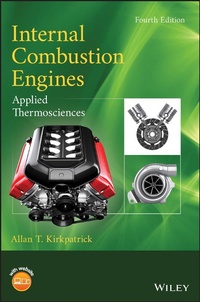
Internal Combustion Engines
Applied Thermosciences
Published on 25. September 2020
Book
Hardback
656 pages
978-1-119-45450-2 (ISBN)
Description
A comprehensive resource covering the foundational thermal-fluid sciences and engineering analysis techniques used to design and develop internal combustion engines
Internal Combustion Engines: Applied Thermosciences, Fourth Edition combines foundational thermal-fluid sciences with engineering analysis techniques for modeling and predicting the performance of internal combustion engines.
This new 4th edition includes brand new material on:
* New engine technologies and concepts
* Effects of engine speed on performance and emissions
* Fluid mechanics of intake and exhaust flow in engines
* Turbocharger and supercharger performance analysis
* Chemical kinetic modeling, reaction mechanisms, and emissions
* Advanced combustion processes including low temperature combustion
* Piston, ring and journal bearing friction analysis
The 4th Edition expands on the combined analytical and numerical approaches used successfully in previous editions. Students and engineers are provided with several new tools for applying the fundamental principles of thermodynamics, fluid mechanics, and heat transfer to internal combustion engines.
Each chapter includes MATLAB programs and examples showing how to perform detailed engineering computations. The chapters also have an increased number of homework problems with which the reader can gauge their progress and retention. All the software is 'open source' so that readers can see in detail how computational analysis and the design of engines is performed. A companion website is also provided, offering access to the MATLAB computer programs.
More details
Other editions
New editions

Book
approx. 12/2026
5th Edition
Wiley
€172.32
Not yet published
Additional editions
E-Book
09/2020
4th Edition
Wiley-ISTE
€99.99
Available for download
E-Book
08/2020
4th Edition
Wiley-ISTE
€99.99
Available for download
Previous edition
Book
07/2015
Wiley
€116.56
Article exhausted; check for reprint
Person
Dr. Kirkpatrick is a Professor in the Mechanical Engineering Department at Colorado State University. He has BS and PhD degrees in Mechanical Engineering from the Massachusetts Institute of Technology. As an internationally recognized authority in the applied thermal-fluid sciences, he has published four books and over 100 publications in the internal combustion engine, combustion instability, fluid jets, and engineering education areas. He is a Fellow of the American Society of Mechanical Engineers and is the recipient of numerous awards, including the Ben Sparks Medal by ASME.
Content
Preface ix
Acknowledgements xi
1 Introduction to Internal Combustion Engines 1
1.1 INTRODUCTION 1
1.2 HISTORICAL BACKGROUND 5
1.3 ENGINE CYCLES 7
1.4 ENGINE PERFORMANCE PARAMETERS 11
1.5 ENGINE CONFIGURATIONS 25
1.6 EXAMPLES OF INTERNAL COMBUSTION ENGINES 31
1.7 ALTERNATIVE POWERTRAIN TECHNOLOGY 35
1.8 FURTHER READING 41
1.9 REFERENCES 41
References 41
1.10 HOMEWORK 41
2 Ideal Gas Engine Cycles 43
2.1 INTRODUCTION 43
2.2 GAS CYCLE ENERGY ADDITION 44
2.3 CONSTANT VOLUME ENERGY ADDITION 45
2.4 CONSTANT PRESSURE ENERGY ADDITION 50
2.5 LIMITED PRESSURE CYCLE 54
2.6 MILLER CYCLE 54
2.7 IDEAL FOUR-STROKE PROCESS AND RESIDUAL FRACTION 60
2.8 FINITE ENERGY RELEASE 69
2.9 REFERENCES 89
References 89
2.10 HOMEWORK 90
3 Thermodynamic Properties of Fuel-Air Mixtures 93
3.1 INTRODUCTION 93
3.2 PROPERTIES OF IDEAL GAS MIXTURES 93
3.3 LIQUID-VAPOR-GAS MIXTURES 101
3.4 STOICHIOMETRY 106
3.5 CHEMICAL EQUILIBRIUM 108
3.6 LOW TEMPERATURE COMBUSTION MODELING 112
3.7 CHEMICAL EQUILIBRIUM USING LAGRANGE MULTIPLIERS 118
3.8 CHEMICAL EQUILIBRIUM USING EQUILIBRIUM CONSTANTS 123
3.9 ISENTROPIC COMPRESSION AND EXPANSION 130
3.10 CHEMICAL KINETICS 134
3.11 REFERENCES 141
References 141
3.12 HOMEWORK 141
4 Thermodynamics of Combustion 145
4.1 INTRODUCTION 145
4.2 FIRST LAW ANALYSIS OF COMBUSTION 145
4.3 SECOND LAW ANALYSIS OF COMBUSTION 151
4.4 FUEL-AIR OTTO CYCLE 156
4.5 FOUR-STROKE FUEL-AIR OTTO CYCLE 161
4.6 LIMITED-PRESSURE FUEL AIR CYCLE 166
4.7 TWO ZONE FINITE ENERGY RELEASE MODEL 173
4.8 COMPRESSION IGNITION ENGINE FUEL-AIR MODEL 181
4.9 COMPARISON OF FUEL-AIR CYCLES WITH ACTUAL SPARK AND
COMPRESSION IGNITION CYCLES 185
4.10 FURTHER READING 188
4.11 REFERENCES 188
References 188
4.12 HOMEWORK 188
5 Intake and Exhaust Flow 191
5.1 INTRODUCTION 191
5.2 FLOW THROUGH INTAKE AND EXHAUST VALVES 191
5.3 INTAKE AND EXHAUST MANIFOLD FLOW 217
5.4 AIRFLOW IN TWO-STROKE ENGINES 221
5.5 SUPERCHARGERS AND TURBOCHARGERS 234
5.6 FURTHER READING 259
5.7 REFERENCES 259
References 259
5.8 HOMEWORK 260
6 Fuel and Air Flow in the Cylinder 263
6.1 INTRODUCTION 263
6.2 FUEL INJECTION - SPARK IGNITION 264
6.3 FUEL INJECTION - COMPRESSION IGNITION 267
6.4 FUEL SPRAYS 273
6.5 GASEOUS FUEL INJECTION 282
6.6 PRECHAMBERS 288
6.7 CARBURETION 291
6.8 LARGE SCALE IN-CYLINDER FLOW 294
6.9 IN-CYLINDER TURBULENCE 301
6.10 FURTHER READING 312
6.11 REFERENCES 312
References 312
6.12 HOMEWORK 315
7 Combustion Processes in Engines 317
7.1 INTRODUCTION 317
7.2 COMBUSTION IN SPARK IGNITION ENGINES 318
7.3 ABNORMAL COMBUSTION (KNOCK) IN SPARK IGNITION ENGINES 333
7.4 COMBUSTION IN COMPRESSION IGNITION ENGINES 338
7.5 LOW TEMPERATURE COMBUSTION 352
7.6 FURTHER READING 363
7.7 REFERENCES 363
References 363
7.8 HOMEWORK 365
8 Emissions 369
8.1 INTRODUCTION 369
8.2 NITROGEN OXIDES 370
8.3 CARBON MONOXIDE 384
8.4 HYDROCARBONS 386
8.5 PARTICULATES 392
8.6 EMISSIONS REGULATION AND CONTROL 400
8.7 FURTHER READING 409
References 409
8.8 HOMEWORK 410
9 Fuels 413
9.1 INTRODUCTION 413
9.2 REFINING 414
9.3 HYDROCARBON CHEMISTRY 416
9.4 THERMODYNAMIC PROPERTIES OF FUEL MIXTURES 420
9.5 GASOLINE FUELS 431
9.6 ALTERNATIVE FUELS FOR SPARK IGNITION ENGINES 435
9.7 DIESEL FUELS 446
9.8 FURTHER READING 453
References 453
9.9 HOMEWORK 454
10 Friction and Lubrication 455
10.1 INTRODUCTION 455
10.2 FRICTION COEFFICIENT 455
10.3 ENGINE OILS 458
10.4 FRICTION POWER AND MEAN EFFECTIVE PRESSURE 462
10.5 FRICTION MEASUREMENTS 463
10.6 FRICTION SCALING PARAMETERS 466
10.7 PISTON AND RING FRICTION 468
10.8 JOURNAL BEARINGS 484
10.9 VALVE TRAIN FRICTION 490
10.10ACCESSORY FRICTION 494
10.11PUMPING MEAN EFFECTIVE PRESSURE 496
10.12OVERALL ENGINE FRICTION MEAN EFFECTIVE PRESSURE 497
10.13FURTHER READING 501
10.14REFERENCES 501
References 501
10.15HOMEWORK 502
11 Heat and Mass Transfer 505
11.1 INTRODUCTION 505
11.2 ENGINE COOLING SYSTEMS 506
11.3 ENGINE ENERGY BALANCE 507
11.4 HEAT TRANSFER MEASUREMENTS 512
11.5 HEAT TRANSFER MODELING 515
11.6 HEAT TRANSFER CORRELATIONS 521
11.7 RADIATION HEAT TRANSFER 529
11.8 HEAT TRANSFER IN THE EXHAUST SYSTEM 533
11.9 MASS LOSS OR BLOWBY 534
11.10FURTHER READING 537
11.11REFERENCES 537
References 537
11.12HOMEWORK 538
12 Engine Instrumentation and Testing 541
12.1 INTRODUCTION 541
12.2 INSTRUMENTATION 542
12.3 COMBUSTION ANALYSIS 550
12.4 EXHAUST GAS ANALYSIS 555
12.5 CONTROL SYSTEMS IN ENGINES 568
12.6 VEHICLE EMISSIONS TESTING 571
12.7 FURTHER READING 572
References 572
12.8 HOMEWORK 573
13 Overall Engine Performance 575
13.1 INTRODUCTION 575
13.2 EFFECT OF ENGINE SIZE, BORE, AND STROKE 575
13.3 EFFECT OF ENGINE SPEED 578
13.4 EFFECT OF AIR-FUEL RATIO AND LOAD 580
13.5 ENGINE PERFORMANCE MAPS 584
13.6 EFFECT OF IGNITION AND INJECTION TIMING 588
13.7 EFFECT OF COMPRESSION RATIO 591
13.8 VEHICLE PERFORMANCE SIMULATION 591
13.9 FURTHER READING 593
References 593
13.10HOMEWORK 593
A Appendix
Conversion Factors and Physical Constants 597
B Appendix
Physical Properties of Air 601
C Appendix
Thermodynamic Property Tables for Various Ideal Gases 605
D Appendix
Curve Fit Coefficients for Thermodynamic Properties of Various Fuels and Ideal
Gases 613
E Appendix
Detailed Thermodynamic and Fluid Flow Analyses 617
E.1 Thermodynamic Derivatives 617
E.2 Numerical Solution of Equilibrium Combustion Equations 619
E.3 Isentropic Compression/Expansion with known _P 623
E.4 Isentropic Compression/Expansion with known _v 623
E.5 Constant Volume Combustion 624
E.6 Quality of Exhaust Products 626
E.7 Finite Difference Form of the Reynolds Slider Equation 627
References 627
F Appendix
Computer Programs 629
F.1 Volume.m 630
F.2 Velocity.m 631
F.3 BurnFraction.m 631
F.4 FiniteHeatRelease.m 631
F.5 FiniteHeatMassLoss.m 633
F.6 CIHeatRelease.m 635
F.7 FourStrokeOtto.m 637
F.8 RunFarg.m 638
F.9 farg.m 638
F.10 fuel.m 641
F.11 RunEcp.m 642
F.12 ecp.m 643
F.13 AdiabaticFlameTemp.m 651
F.14 OttoFuelAir.m 651
F.15 FourStrokeFuelAir.m 653
F.16 TwoZoneFuelAir.m 656
F.17 Fuel Injected.m 661
F.18 LimitPressFuelAir.m 665
F.19 ValveFlow.m 668
F.20 Droplet.m 676
F.21 Kinetic.m 681
F.22 Soot.m 683
F.23 TwoZoneNO.m 684
F.24 RingPressure.m 689
F.25 Friction.m 691
F.26 HeatTransfer.m 693