

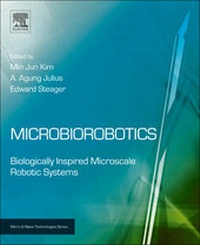
Microbiorobotics
Biologically Inspired Microscale Robotic Systems
Published on 4. April 2012
Book
Hardback
328 pages
978-1-4557-7891-1 (ISBN)
Description
Microbiorobotics is a new engineering discipline that inherently involves a multidisciplinary approach (mechanical engineering, cellular biology, mathematical modeling, control systems, synthetic biology, etc). Building robotics system in the micro scale is an engineering task that has resulted in many important applications, ranging from micromanufacturing techniques to cellular manipulation. However, it is also a very challenging engineering task. One of the reasons is because many engineering ideas and principles that are used in larger scales do not scale well to the micro-scale. For example, locomotion principles in a fluid do not function in the same way, and the use of rotational motors is impractical because of the difficulty of building of the required components.
More details
Series
Language
English
Place of publication
Norwich
United States
Target group
Professional and scholarly
MEMS (Micro Electro-Mechanical Systems) engineers, Mechanical, biomedical and electrical engineers in corporate R&D groups and academia; robotics professionals; graduate students in disciplines listed.
Dimensions
Height: 235 mm
Width: 191 mm
Weight
750 gr
ISBN-13
978-1-4557-7891-1 (9781455778911)
Copyright in bibliographic data and cover images is held by Nielsen Book Services Limited or by the publishers or by their respective licensors: all rights reserved.
Schweitzer Classification
Other editions
New editions
Minjun Kim | Anak Agung Julius | U. Kei Cheang
Microbiorobotics
Biologically Inspired Microscale Robotic Systems
Book
02/2017
2nd Edition
Elsevier
€154.75
Shipment within 15-20 days
Additional editions
Book
08/2016
William Andrew Publishing
€136.50
Shipment within 15-20 days
E-Book
03/2012
William Andrew
€131.00
Available for download
Persons
Dr MinJun Kim is presently an associate professor at Drexel University with a joint appointment in both the Department of Mechanical Engineering & Mechanics and the School of Biomedical Engineering, Science & Health System.. For the past several years, Dr. Kim has been exploring biological transport phenomena including cellular/molecular mechanics and engineering in novel nano/microscale architectures to produce new types of nanobiotechology, such as nanopore technology and nano/micro robotics. His notable awards include the National Science Foundation CAREER Award (2008), Drexel Career Development Award (2008), Human Frontier Science Program Young Investigator Award (2009), Army Research Office Young Investigator Award (2010), Alexander von Humboldt Fellowship (2011), KOFST Brain Pool Fellowship (2013), Bionic Engineering Outstanding Contribution Award (2013), Louis & Bessie Stein Fellowship (2014), ISBE Fellow (2014), and ASME Fellow (2014). Dr. Anak Agung Julius is an Assistant Professor at the Department of Electrical, Computer, and Systems Engineering at the Rensselaer Polytechnic Institute. He is also a faculty member of the Rensselaer Center for Automation Technologies and Systems. His research interests lie in the intersection of systems and control theory, systems biology, and theoretical computer science
Content
Introduction
B: Fundamentals of Cellular Mechanics
B.1: Fluid-structure Interactions and Flagellar Actuation
B.2: Mathematical Models for Swimming Bacteria
B.3: Tetrahymena pyriformis in Motion
C: Theoretical Microbiorobotics
C.1: Piezoelectric Cellular Actuators with Nested Rhombus Strain Amplification
C.2: Stochastic Models and Control of Bacterial Bioactuators and Biomicrorobots
C.3: Stochastic Model and Control in Microbiorobotics
D: Experimental Microbiorobotics
D.1: Bacteria-Inspired Microrobots
D.2: Magnetotactic Bacteria for Microrobotics
D.3: Flexible magnetic microswimmers
D.4: Bacteria-Powered Microrobots
D.5: Control of Tetrahymena pyriformis as a Microrobot
E: Perspectives and Outlook
B: Fundamentals of Cellular Mechanics
B.1: Fluid-structure Interactions and Flagellar Actuation
B.2: Mathematical Models for Swimming Bacteria
B.3: Tetrahymena pyriformis in Motion
C: Theoretical Microbiorobotics
C.1: Piezoelectric Cellular Actuators with Nested Rhombus Strain Amplification
C.2: Stochastic Models and Control of Bacterial Bioactuators and Biomicrorobots
C.3: Stochastic Model and Control in Microbiorobotics
D: Experimental Microbiorobotics
D.1: Bacteria-Inspired Microrobots
D.2: Magnetotactic Bacteria for Microrobotics
D.3: Flexible magnetic microswimmers
D.4: Bacteria-Powered Microrobots
D.5: Control of Tetrahymena pyriformis as a Microrobot
E: Perspectives and Outlook