

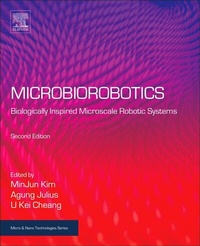
Microbiorobotics
Biologically Inspired Microscale Robotic Systems
2nd Edition
Published on 20. February 2017
Book
Hardback
290 pages
978-0-323-42993-1 (ISBN)
Description
Microbiorobotics: Biologically Inspired Microscale Robotic Systems, Second Edition presents information on a new engineering discipline that takes a multidisciplinary approach to accomplish precise manipulation of microscale spaces.
Microorganisms have evolved various mechanisms to thrive in microscale environments and are therefore a useful tool for use in many applications, ranging from micromanufacturing techniques, to cellular manipulation. In the context of microrobotics, biological microrobots can directly harness the microorganisms for propulsive and sensing power and synthetic microrobots can mimic the microorganisms' motions for effective locomotion.
This second edition covers new advances and insights that have emerged in recent years. Several new chapters have been added on important new research areas, with existing chapters thoroughly revised. In particular, increased coverage is given to fluid dynamics of microswimmers in nature.
Microorganisms have evolved various mechanisms to thrive in microscale environments and are therefore a useful tool for use in many applications, ranging from micromanufacturing techniques, to cellular manipulation. In the context of microrobotics, biological microrobots can directly harness the microorganisms for propulsive and sensing power and synthetic microrobots can mimic the microorganisms' motions for effective locomotion.
This second edition covers new advances and insights that have emerged in recent years. Several new chapters have been added on important new research areas, with existing chapters thoroughly revised. In particular, increased coverage is given to fluid dynamics of microswimmers in nature.
More details
Series
Edition
2nd edition
Language
English
Place of publication
Philadelphia
United States
Target group
Professional and scholarly
MEMS (Micro Electro-Mechanical Systems) engineers, Mechanical, biomedical and electrical engineers in corporate R&D groups and academia; robotics professionals; graduate students in disciplines listed.
Dimensions
Height: 235 mm
Width: 191 mm
Weight
810 gr
ISBN-13
978-0-323-42993-1 (9780323429931)
Copyright in bibliographic data and cover images is held by Nielsen Book Services Limited or by the publishers or by their respective licensors: all rights reserved.
Schweitzer Classification
Other editions
Additional editions
Minjun Kim | Anak Agung Julius | U. Kei Cheang
Microbiorobotics
Biologically Inspired Microscale Robotic Systems
E-Book
03/2017
2nd Edition
Elsevier
€129.00
Available for download
Previous edition
Book
08/2016
William Andrew Publishing
€136.50
Shipment within 15-20 days
Persons
Dr MinJun Kim is presently an associate professor at Drexel University with a joint appointment in both the Department of Mechanical Engineering & Mechanics and the School of Biomedical Engineering, Science & Health System.. For the past several years, Dr. Kim has been exploring biological transport phenomena including cellular/molecular mechanics and engineering in novel nano/microscale architectures to produce new types of nanobiotechology, such as nanopore technology and nano/micro robotics. His notable awards include the National Science Foundation CAREER Award (2008), Drexel Career Development Award (2008), Human Frontier Science Program Young Investigator Award (2009), Army Research Office Young Investigator Award (2010), Alexander von Humboldt Fellowship (2011), KOFST Brain Pool Fellowship (2013), Bionic Engineering Outstanding Contribution Award (2013), Louis & Bessie Stein Fellowship (2014), ISBE Fellow (2014), and ASME Fellow (2014). Dr. Anak Agung Julius is an Assistant Professor at the Department of Electrical, Computer, and Systems Engineering at the Rensselaer Polytechnic Institute. He is also a faculty member of the Rensselaer Center for Automation Technologies and Systems. His research interests lie in the intersection of systems and control theory, systems biology, and theoretical computer science U Kei Cheang works with under Min Jun Kim researching flagella integrated microbiorobots
Content
Part 1: Introduction
Part 2: Theoretical Microbiorobotics
1. Controlling swarms of robots with global inputs: Breaking symmetry
2. Optimization of magnetic forces for drug delivery in the inner ear
Part 3: Biological Microrobots
3. Development of active controllable tumor targeting bacteriobot
4. Control of magnetotactic bacteria
5. Obstacle avoidance for bacteria-powered microrobots
6. Interacting with boundaries
Part 4: Synthetic Microrobots
7. Control of three bead achiral robotic microswimmers
8. Micro- and nanorobots in Newtonian and biological viscoelastic fluids
9. Magnetic microrobots for microbiology
10. Magnetic mobile microrobots for mechanobiology and automated biomanipulation
11. Magnetic swarm control of microorganisms
Part 2: Theoretical Microbiorobotics
1. Controlling swarms of robots with global inputs: Breaking symmetry
2. Optimization of magnetic forces for drug delivery in the inner ear
Part 3: Biological Microrobots
3. Development of active controllable tumor targeting bacteriobot
4. Control of magnetotactic bacteria
5. Obstacle avoidance for bacteria-powered microrobots
6. Interacting with boundaries
Part 4: Synthetic Microrobots
7. Control of three bead achiral robotic microswimmers
8. Micro- and nanorobots in Newtonian and biological viscoelastic fluids
9. Magnetic microrobots for microbiology
10. Magnetic mobile microrobots for mechanobiology and automated biomanipulation
11. Magnetic swarm control of microorganisms