

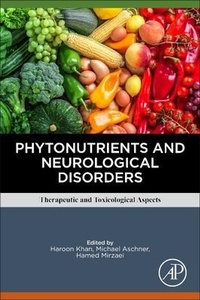
Phytonutrients and Neurological Disorders
Therapeutic and Toxicological Aspects
Published on 12. July 2023
Book
Paperback/Softback
416 pages
978-0-12-824467-8 (ISBN)
Description
Phytonutrients and Neurological Disorders: Therapeutic and Toxicological Aspects provides and assesses the latest research and developments surrounding the use of phytonutrients for the treatment of neurological disorders. The volume analyzes advances in phytonutrient isolation, characterization and therapeutic applications, giving particular emphasis to mechanisms and safety profiles. The book takes toxicological considerations into account, including adverse drug reactions, toxicokinetics and toxicodynamics. Sections cover bioactive compound classes and biosynthesis pathways, general considerations, including quality control, standardization, and technology, and toxicology. This title is a comprehensive work on the latest research in phytonutrients and neurological disorders that will be useful to researchers and medical practitioners.
Reviews / Votes
"...provides a good introduction to plant-based nutraceuticals in neurological disorders [and] helps the reader understand the many different plant derivatives, including polyphenols, flavones, flavanols, cathechins, and anthrocyanins. [A]ims to discuss the latest research into the role of phytonutraceuticals in neurological illnesses. [A] helpful resource for neurologists as often patients are interested in incorporating nutraceuticals in their treatment plans... [A] decent reference for phytonutraceuticals in neurological disorders. It can be a helpful resource for neurologists who are interested in advising patients about non-pharmacological plant-derived supplements." -- (c)Doody's Review Service, 2024, Shin Beh, MD, FAAN, FAHS (University of Texas Southwestern Medical Center at Dallas)More details
Language
English
Place of publication
San Diego
United States
Publishing group
Elsevier Science Publishing Co Inc
Target group
Professional and scholarly
College/higher education
Primary: Natural product researchers; nutritionists; medical practitioners; pharmacologists and pharmacognosists; food chemists; food scientists; phytochemists; medical chemistry researchers.
Secondary: Medical students and graduate students in pharmacology, pharmaceutical science, and related fields.
Product notice
Paperback (trade)
Unsewn / adhesive bound
Illustrations
40 illustrations (20 in full color); Illustrations
Dimensions
Height: 192 mm
Width: 234 mm
Thickness: 25 mm
Weight
870 gr
ISBN-13
978-0-12-824467-8 (9780128244678)
Copyright in bibliographic data and cover images is held by Nielsen Book Services Limited or by the publishers or by their respective licensors: all rights reserved.
Schweitzer Classification
Other editions
Additional editions
Haroon Khan | Michael Aschner | Hamed Mirzaei
Phytonutrients and Neurological Disorders
Therapeutic and Toxicological Aspects
E-Book
07/2023
Academic Press
€132.00
Available for download
Persons
Prof. Dr. Haroon Khan has obtained the degree of B. Pharm (1999), M. Phil (2005), and PhD (2011) from the Department of Pharmacy, University of Peshawar. He started his career as a lecturer from the Gandhara College of Pharmacy, Gandhara University, Peshawar and currently, Professor of Pharmacy at the Department of Pharmacy, Abdul Wali Khan University Mardan, Pakistan. He has more than seventeen years of experience in pharmacy teaching, research and professional expertise in various fields of pharmaceutical sciences. Dr. Khan has 162 publications, including research, review, and editorial in various national and international reputable journals with considerable impact factor while several others are submitted or in the process of submission. His research focus is phytomedicines including phytopharmacological and phytochemical investigations of extracts/isolated compounds in collaboration with numerous national and international research groups.
The scientific contribution of Dr. Khan has been acknowledged by the Pakistan Council for Science and Pakistan Council for Science and Technology (PCST) and awarded Research Productivity four times 2011-2014. He has also published three books with LAMBERT Academic publishers, Germany and four chapters. He is also the editorial board member of various international journals. Additionally, he is supervising many post-graduate scholars in various research projects. Dr. Aschner serves as the Harold and Muriel Block Chair in Molecular Pharmacology at Albert Einstein College of Medicine. He served on numerous toxicology panels (Institute of Medicine, US Environmental Protection Agency, Center for Disease Control), and is a member of the Neurotoxicology and Alcohol study section (NIH). Research in our lab focuses on the following topics: (1) Modulation of C. elegans genes (aat, skn-1, daf-16) that are homologous to mammalian regulators of MeHg uptake and cellular resistance will modify dopaminergic neurodegeneration in response to MeHg exposure. (2) Under conditions of MeHg-induced oxidative stress, Nrf2 (a master regulator of antioxidant responses) coordinates the upregulation of cytoprotective genes that combat MeHg-induced oxidative injury, and that genetic and biochemical changes that negatively impact upon Nrf2 function increase MeHg's neurotoxicity. (3) PARK2, a strong PD genetic risk factor, alters neuronal vulnerability to modifiers of cellular Mn status, particularly at the level of mitochondrial dysfunction and oxidative stress. Our studies are designed to (1) shed novel mechanistic insight into metal-induced neurodegeneration; (2) identify targets for genetic or pharmacologic modulation of neurodegenerative disorders; (3) increase knowledge of the pathway involved in oxidative stress; (4) develop improved research models for human disease using knowledge of environmental sciences. Hamed Mirzaei is a Professor at the Research Center for Biochemistry and Nutrition in Metabolic Diseases, Kashan University of Medical Sciences, Iran.
The scientific contribution of Dr. Khan has been acknowledged by the Pakistan Council for Science and Pakistan Council for Science and Technology (PCST) and awarded Research Productivity four times 2011-2014. He has also published three books with LAMBERT Academic publishers, Germany and four chapters. He is also the editorial board member of various international journals. Additionally, he is supervising many post-graduate scholars in various research projects. Dr. Aschner serves as the Harold and Muriel Block Chair in Molecular Pharmacology at Albert Einstein College of Medicine. He served on numerous toxicology panels (Institute of Medicine, US Environmental Protection Agency, Center for Disease Control), and is a member of the Neurotoxicology and Alcohol study section (NIH). Research in our lab focuses on the following topics: (1) Modulation of C. elegans genes (aat, skn-1, daf-16) that are homologous to mammalian regulators of MeHg uptake and cellular resistance will modify dopaminergic neurodegeneration in response to MeHg exposure. (2) Under conditions of MeHg-induced oxidative stress, Nrf2 (a master regulator of antioxidant responses) coordinates the upregulation of cytoprotective genes that combat MeHg-induced oxidative injury, and that genetic and biochemical changes that negatively impact upon Nrf2 function increase MeHg's neurotoxicity. (3) PARK2, a strong PD genetic risk factor, alters neuronal vulnerability to modifiers of cellular Mn status, particularly at the level of mitochondrial dysfunction and oxidative stress. Our studies are designed to (1) shed novel mechanistic insight into metal-induced neurodegeneration; (2) identify targets for genetic or pharmacologic modulation of neurodegenerative disorders; (3) increase knowledge of the pathway involved in oxidative stress; (4) develop improved research models for human disease using knowledge of environmental sciences. Hamed Mirzaei is a Professor at the Research Center for Biochemistry and Nutrition in Metabolic Diseases, Kashan University of Medical Sciences, Iran.
Content
Part A, Section 1: Bioactive compound classes and biosynthesis pathway
1. Current therapies for neurological disorders and their limitations
2. Biosynthesis of phytonutrients
3. Neuroprotective effects of flavonoids
4. Neuroprotective effects of glycosides
5. Neuroprotective effects of terpenoids
6. Neuroprotective effects of alkaloids
7. Neuroprotective effects of saponins
8. Neuroprotective effects of steroids
9. Neuroprotective effects of essential oils
10. Neuroprotective effects of phytonutrients at gene levels
Part A Section 2: General considerations
11. Latest development in quality control parameters/specification in phytonutrients studies
12. Phytonutrients standardization for effective therapeutic outcomes
13. Phytonutrients and technological development in formulations
Part B Sections: Toxicological considerations in phytonutrients
a. Adverse drug reactions
b. Toxicokinetics
c. Toxicodynamics
1. Current therapies for neurological disorders and their limitations
2. Biosynthesis of phytonutrients
3. Neuroprotective effects of flavonoids
4. Neuroprotective effects of glycosides
5. Neuroprotective effects of terpenoids
6. Neuroprotective effects of alkaloids
7. Neuroprotective effects of saponins
8. Neuroprotective effects of steroids
9. Neuroprotective effects of essential oils
10. Neuroprotective effects of phytonutrients at gene levels
Part A Section 2: General considerations
11. Latest development in quality control parameters/specification in phytonutrients studies
12. Phytonutrients standardization for effective therapeutic outcomes
13. Phytonutrients and technological development in formulations
Part B Sections: Toxicological considerations in phytonutrients
a. Adverse drug reactions
b. Toxicokinetics
c. Toxicodynamics