

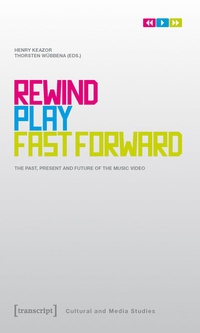
Rewind, Play, Fast Forward
The Past, Present and Future of the Music Video
1st Edition
Published on 4. November 2010
Book
Paperback/Softback
280 pages
978-3-8376-1185-4 (ISBN)
Description
Due to shifts in the contexts of the production and presentation of the music video, more and more people start to talk about a possible end of this genre. At the same time disciplines such as visual-, film- and media-studies, art- and music-history begin to realize that despite the fact that the music video obviously has come of age, they still lack a well defined and matching methodical approach for analyzing and discussing videoclips.For the first time this volume brings together different disciplines as well as journalists, museum curators and gallery owners in order to take a discussion of the past and present of the music video as an opportunity to reflect upon suited methodological approaches to this genre and to allow a glimpse into its future.
Reviews / Votes
Reviewed in: Cineblog, 15.12.2010UniReport, 1 (2011)GMK-Newsletter, 5 (2011)More details
Series
Language
English
Place of publication
Bielefeld
Germany
Target group
Professional and scholarly
Product notice
Klappenbroschur
Illustrations
74
44 s/w Abbildungen, 30 farbige Abbildungen
zahlreiche Abbildungen
Dimensions
Height: 225 mm
Width: 135 mm
Thickness: 20 mm
Weight
401 gr
ISBN-13
978-3-8376-1185-4 (9783837611854)
Schweitzer Classification
Other editions
Additional editions
Henry Keazor | Thorsten Wübbena
Rewind, Play, Fast Forward
The Past, Present and Future of the Music Video
E-Book
07/2015
1st Edition
transcript
€26.99
Available for download
Persons
Editor
Henry Keazor, Universität Heidelberg, Deutschland
Henry Keazor lehrt Neuere und Neueste Kunstgeschichte am Institut für Europäische Kunstgeschichte der Universität Heidelberg.
Thorsten Wübbena, Leibniz-Institut für Europäische Geschichte, Deutschland
Thorsten Wübbena leitet den Bereich »Digitale Historische Forschung | DH Lab« am Leibniz-Institut für Europäische Geschichte (IEG), Mainz. Seine Forschungsinteressen umfassen die Digitale Methodik in den Geistes- und Kulturwissenschaften, Forschungsinfrastrukturen im Bereich des kulturellen Erbes sowie Prozess- und Projektmanagement in den Digital Humanities.