

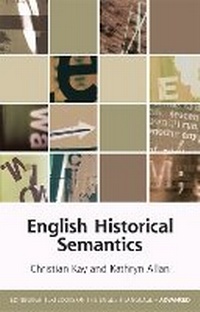
English Historical Semantics
Published on 8. October 2015
Book
Hardback
224 pages
978-0-7486-4478-0 (ISBN)
Description
This guide gives students a solid grounding in the basic methodology of how to analyse corpus data to study new words entering the language or language change. It uses a number of case studies to provide insights into collocations, phraseology, metaphor and metonymy, syntactic structures, male and female language, and language change. Students will become proficient in the key concepts in semantic change by applying ideas from theoretical semantics to historical data. They will also cover recent work at the intersections between historical semantics and other disciplines.
More details
Series
Language
English
Place of publication
Edinburgh
United Kingdom
Target group
College/higher education
Professional and scholarly
Illustrations
8 black and white illustrations
Dimensions
Height: 216 mm
Width: 138 mm
Weight
386 gr
ISBN-13
978-0-7486-4478-0 (9780748644780)
Copyright in bibliographic data and cover images is held by Nielsen Book Services Limited or by the publishers or by their respective licensors: all rights reserved.
Schweitzer Classification
Other editions
Additional editions
Christian Kay | Kathryn L. Allan
English Historical Semantics
E-Book
10/2015
1st Edition
Edinburgh University Press
€25.49
Available for download
Christian Kay | Kathryn L. Allan
English Historical Semantics
E-Book
10/2015
1st Edition
Edinburgh University Press
€0.00
Available for download
Persons
Christian Kay is Professor Emeritus and Honorary Professorial Research Fellow in English Language at the University of Glasgow. She was an editor of the Historical Thesaurus of the Oxford English Dictionary, and A Thesaurus of Old English, and founded the Scottish Corpus of Texts and Speech. She has written on historical semantics and lexicography and contributed to projects on metaphor and semantic annotation based on the Historical Thesaurus of English dataset. Kathryn Allan is Senior Lecturer in the History of English at University College London. Her research interests are in historical semantics and lexicology, and she is the co-editor of Historical Cognitive Linguistics and Current Methods in Historical Semantics. Her monograph Metaphor and Metonymy: A Diachronic Approach was published in the Philological Society series, and she is a collaborator on the Keywords Project
Content
Chapter 1: Introduction; Chapter 2: A brief history of the English lexicon; 2.1 Introduction; 2.2 Old English (OE: 700-1150); 2.3 Middle English (ME: 1150-1500); 2.4 Early Modern English (EModE: 1500-1750); 2.5 Late Modern English (LModE: 1750 to present day); 2.6 Conclusion: The Present Day; Chapter 3: Categories of meaning; 3.1. Introduction; 3.2 Traditional approaches to Semantics; 3.2.1 Reference; 3.2.2 Sense; 3.2.2.1 Sense relationships; 3.2.3 Components, sets and fields; 3.2.4 A note on homonymy; 3.2.5 A memory aid; 3.3 Categories and prototypes; 3.3.1 Prototypes in action; 3.3.2 Lexical prototypes; 3.3.3 Homonymy revisited; 3.4 Domains and frames; 3.5. Conclusion; Chapter 4: Tracing the development of individual words; 4.1 Introduction; 4.2 Introducing the OED; 4.2.1 OED1; 4.2.2 OED2; 4.2.3 OED3; 4.3 What the OED tells us; 4.3.1 manga2; 4.3.2 monster; 4.3.2.1 Formal history and etymology of monster; 4.3.2.2 Semantic history; 4.3.3 Overview; 4.4 Some other historical dictionaries; 4.4.1 Middle English Dictionary (MED); 4.4.2 Anglo-Norman Dictionary (AND); 4.4.3 Dictionary of the Scots Language (DSL); 4.4.4 Dictionary of Old English (DOE); 4.4.5 Other dictionaries; 4.5 Historical corpora; Chapter 5: How and why words change meaning; 5.1 Introduction; 5.2 The significance of meaning change; 5.3 Studying semantic change; 5.4 The process of semantic change; 5.5 Categories of meaning change; 5.5.1 Widening (or broadening or generalisation) and narrowing (or specialisation); 5.5.2 Amelioration (or elevation) and pejoration (or deterioration or degeneration); 5.5.3 Metaphor and metonymy; 5.6 Grammaticalisation; 5.7 Why do words change meaning?; 5.7.1 External factors; 5.7.2 Internal factors: polysemy, homonymy, synonymy; 5.7.3 Stylistic factors; 5.8 Conclusion; Chapter 6: Larger categories; 6.1 Introduction; 6.2 A brief history of thesauruses; 6.3 The structure of thesauruses; 6.3.1 Basic level and other categories; 6.3.2 Folk and expert categories; 6.4 Using HTOED; 6.4.1 The structure of HTOED; 6.4.2 Inside HTOED categories; 6.5 Conclusion; Chapter 7: English Colour Terms: A case study, C. P. Biggam; 7.1 Introduction; 7.2 How to describe colour; 7.3 What are Basic Colour Terms?; 7.4 The evolution of basic colour categories; 7.5 The development of colour terms in English; 7.5.1 Old English (OE: 700-1150); 7.5.2 Middle English (ME: 1150-1500); 7.5.3 Modern English (ModE 1500-); 7.6 The changing nature of a basic category: BLUE; 7.7 Summary; 7.8 Conclusion; Chapter 8: Language and culture; 8.1 Introduction; 8.2 Linguistics and anthropology; 8.3 Pronouns of address; 8.4 Kinship; 8.4.1 Recent changes; 8.5 Time; 8.6 Conclusion; Chapter 9: Metaphor and metonymy; 9.1 Introduction; 9.2 Metaphor in language and thought; 9.3 Another kind of mapping: metonymy; 9.4 Metaphor and motivation; 9.5 Metonymy and motivation; 9.6 Conclusion; Chapter 10: The big picture and a look ahead; 10.1 Introduction; 10.2 The big picture; 10.3 Green as an example; 10. 4 Looking ahead; References; Glossary of key terms; Index