

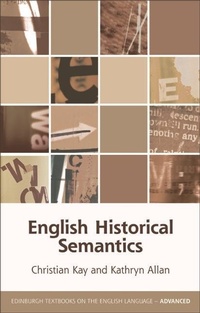
English Historical Semantics
1st Edition
Published on 8. October 2015
189 pages
978-0-7486-4479-7 (ISBN)
Description

This guide gives students a solid grounding in the basic methodology of how to analyse corpus data to study new words entering the language or language change. It uses a number of case studies to provide insights into collocations, phraseology, metaphor and metonymy, syntactic structures, male and female language, and language change. Students will become proficient in the key concepts in semantic change by applying ideas from theoretical semantics to historical data. They will also cover recent work at the intersections between historical semantics and other disciplines.
More details
Other editions
Additional editions
Christian Kay | Kathryn L. Allan
English Historical Semantics
Book
10/2015
Edinburgh University Press
€163.42
Shipment within 15-20 days
Content
- Cover
- Half Title
- Title Page
- Copyright
- Contents
- List of figures
- Acknowledgements
- Abbreviations and conventions
- 1 Introduction
- 2 A brief history of the English lexicon
- 2.1 Introduction
- 2.2 Old English (OE: 700-1150)
- 2.3 Middle English (ME: 1150-1500)
- 2.4 Early Modern English (EModE: 1500-1750)
- 2.5 Late Modern English (LModE: 1750 to present day)
- 2.6 Conclusion: The present day
- Exercises
- Further reading
- 3 Categories of meaning
- 3.1 Introduction
- 3.2 Traditional approaches to Semantics
- 3.3 Categories and prototypes
- 3.4 Domains and frames
- 3.5 Conclusion
- Exercises
- Further reading
- 4 Tracing the development of individual words
- 4.1 Introduction
- 4.2 Introducing the OED
- 4.3 What the OED tells us
- 4.4 Some other historical dictionaries
- 4.5 Historical corpora
- Exercises
- Further reading
- 5 How and why words change meaning
- 5.1 Introduction
- 5.2 The significance of meaning change
- 5.3 Studying semantic change
- 5.4 The process of semantic change
- 5.5 Categories of meaning change
- 5.6 Grammaticalisation
- 5.7 Why do words change meaning?
- 5.8 Conclusion
- Exercises
- Further reading
- 6 Larger categories
- 6.1 Introduction
- 6.2 A brief history of thesauruses
- 6.3 The structure of thesauruses
- 6.4 Using HTOED
- 6.5 Conclusion
- Exercises
- Further reading
- 7 English colour terms: A case study C. P. Biggam
- 7.1 Introduction
- 7.2 How to describe colour
- 7.3 What are basic colour terms?
- 7.4 The evolution of basic colour categories
- 7.5 The development of colour terms in English
- 7.6 The changing nature of a basic category: BLUE
- 7.7 Summary
- 7.8 Conclusion
- Exercises
- Further reading
- 8 Language and culture
- 8.1 Introduction
- 8.2 Linguistics and anthropology
- 8.3 Pronouns of address
- 8.4 Kinship
- 8.5 Time
- 8.6 Conclusion
- Exercises
- Further reading
- 9 Metaphor and metonymy
- 9.1 Introduction
- 9.2 Metaphor in language and thought
- 9.3 Another kind of mapping: Metonymy
- 9.4 Metaphor and motivation
- 9.5 Metonymy and motivation
- 9.6 Conclusion
- Exercises
- Further reading
- 10 The big picture and a look ahead
- 10.1 Introduction
- 10.2 The big picture
- 10.3 Green as an example
- 10.4 Looking ahead
- Glossary of key terms
- References
- Index
