

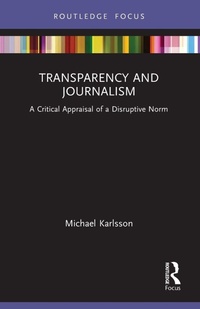
Transparency and Journalism
A Critical Appraisal of a Disruptive Norm
1st Edition
Published on 27. May 2024
Book
Paperback/Softback
128 pages
978-1-032-10105-7 (ISBN)
Description
This book offers a comprehensive, authoritative, and accessible introduction to journalistic transparency.
Pulling from historical and theoretical perspectives, Transparency and Journalism explains the concept of transparency and its place in journalistic practice, offering a critical assessment of what transparency can and cannot offer to journalism. The author also reviews the key theoretical claims underlying transparency and how they have been researched in different parts of the world, ultimately proposing a communication model that can be used to study the concept of transparency across journalism research. Other topics discussed include the use of algorithmic forms of transparency, the limitations of the transparency myth, and suggestions for future avenues for research.
Transparency and Journalism is an important resource for students and scholars in the field of journalism and media studies, as well as for journalists and researchers interested in delving into an ever-relevant topic for the field.
Pulling from historical and theoretical perspectives, Transparency and Journalism explains the concept of transparency and its place in journalistic practice, offering a critical assessment of what transparency can and cannot offer to journalism. The author also reviews the key theoretical claims underlying transparency and how they have been researched in different parts of the world, ultimately proposing a communication model that can be used to study the concept of transparency across journalism research. Other topics discussed include the use of algorithmic forms of transparency, the limitations of the transparency myth, and suggestions for future avenues for research.
Transparency and Journalism is an important resource for students and scholars in the field of journalism and media studies, as well as for journalists and researchers interested in delving into an ever-relevant topic for the field.
Reviews / Votes
"Michael Karlsson is one of the preemi-nent scholars on transparency in journalism... [his] book, written in a re-freshing, self-reflective tone, offers vital insights for both researchers and journal-ism practitioners" - Michael Koliska Assistant Professor Communication, Culture and Technology Georgetown University Washington, DC, USAMore details
Series
Language
English
Place of publication
London
United Kingdom
Publishing group
Taylor & Francis Ltd
Target group
College/higher education
Postgraduate and Undergraduate
Illustrations
1 s/w Tabelle
1 Tables, black and white
Dimensions
Height: 216 mm
Width: 140 mm
Thickness: 7 mm
Weight
174 gr
ISBN-13
978-1-032-10105-7 (9781032101057)
Copyright in bibliographic data and cover images is held by Nielsen Book Services Limited or by the publishers or by their respective licensors: all rights reserved.
Schweitzer Classification
Other editions
Additional editions
Book
08/2021
1st Edition
Routledge
€76.80
Shipment within 15-20 days
E-Book
08/2021
1st Edition
Routledge
€27.49
Available for download
E-Book
08/2021
1st Edition
Routledge
€27.49
Available for download
Person
Michael Karlsson is professor in media and communication at Karlstad University, Sweden. His research interest lies primarily within digital journalism and his work has been widely published in journals such as Digital Journalism, Journalism Studies, Journalism, Journalism and Mass Communication Quarterly, Journal of Computer-Mediated Communication, and Communication Theory.
Content
Preface and Acknowledgements
1 Transparency and its Connection to Journalism
1.1 Transparency: Essence, Purpose, and How it Made its Way into Journalism
1.2 The Fragile Theoretical and Empirical Foundation of Transparency in Journalism
1.3 Transparency as Ritual in Journalistic Practice
1.4 Theoretical Points of Departure Influencing the Book
1.5 The Imagined Audience, Structure, and Content of the Book
2 Journalistic Transparency in History and Context
2.1 The Emergence and Solidification of Transparency
2.2 The Philosophical Roots of Transparency in Liberal Democratic Theory
2.3 Comparing the Transparency Dimension in Governmental and Journalistic Institutions
2.4 The Implicit Theory of Transparency
2.5 The Performative Transparency Model
2.6 Black Box and Glass Box
2.7 Summary
3 Can You See the Sunlight? Transparency at Work
3.1 Can You See the Sunlight?
3.2 Journalistic Actors
3.3 Content: Stage, Aesthetics, and Delivery
3.4 The Public
3.5 ... And transparency for all?
3.6 Transparency in Practice: Not Much Sunlight Thus Far
4 Algorithmic Forms of Transparency and Opacity
4.1 The Increasing Role of Algorithms in Journalism
4.2 Russian Dolls: Black Boxes Inside Other Black Boxes, Inside...
4.3 Unpacking the Role of Algorithms in Transparent Journalistic Performance
4.4 Computer Says No
5 The Limits of the Transparency Myth
5.1 Inevitable Cost/Benefit Trade-Offs
5.2 The Need for Professional Discretion and the Ever-Present Curtain and Backstage
5.3 Transparency as the Opposite of Trust
5.4 Transparency is not Openness
5.5 A Successful Flop: How Transparency was Adopted Despite a Lack of Evidence
5.6 What is Left of Transparency?
6 Transparency After All?
6.1 Three Waves of Transparency in Journalism
6.2 Transparency Pathways
6.3 Targeted Transparency
6.4 Suggestions for a Future Research Agenda
6.5 Not so Disruptive After All
1 Transparency and its Connection to Journalism
1.1 Transparency: Essence, Purpose, and How it Made its Way into Journalism
1.2 The Fragile Theoretical and Empirical Foundation of Transparency in Journalism
1.3 Transparency as Ritual in Journalistic Practice
1.4 Theoretical Points of Departure Influencing the Book
1.5 The Imagined Audience, Structure, and Content of the Book
2 Journalistic Transparency in History and Context
2.1 The Emergence and Solidification of Transparency
2.2 The Philosophical Roots of Transparency in Liberal Democratic Theory
2.3 Comparing the Transparency Dimension in Governmental and Journalistic Institutions
2.4 The Implicit Theory of Transparency
2.5 The Performative Transparency Model
2.6 Black Box and Glass Box
2.7 Summary
3 Can You See the Sunlight? Transparency at Work
3.1 Can You See the Sunlight?
3.2 Journalistic Actors
3.3 Content: Stage, Aesthetics, and Delivery
3.4 The Public
3.5 ... And transparency for all?
3.6 Transparency in Practice: Not Much Sunlight Thus Far
4 Algorithmic Forms of Transparency and Opacity
4.1 The Increasing Role of Algorithms in Journalism
4.2 Russian Dolls: Black Boxes Inside Other Black Boxes, Inside...
4.3 Unpacking the Role of Algorithms in Transparent Journalistic Performance
4.4 Computer Says No
5 The Limits of the Transparency Myth
5.1 Inevitable Cost/Benefit Trade-Offs
5.2 The Need for Professional Discretion and the Ever-Present Curtain and Backstage
5.3 Transparency as the Opposite of Trust
5.4 Transparency is not Openness
5.5 A Successful Flop: How Transparency was Adopted Despite a Lack of Evidence
5.6 What is Left of Transparency?
6 Transparency After All?
6.1 Three Waves of Transparency in Journalism
6.2 Transparency Pathways
6.3 Targeted Transparency
6.4 Suggestions for a Future Research Agenda
6.5 Not so Disruptive After All